Most of us carry a few moles we no longer notice. They’ve been there for years, as familiar as the lines on a palm. Then one morning, a finger passing over one of them finds it sitting a little higher than you remember.
Or perhaps you’ve noticed a new, fleshy growth near your collar that looks nothing like the dark, flat spots you’ve always known.
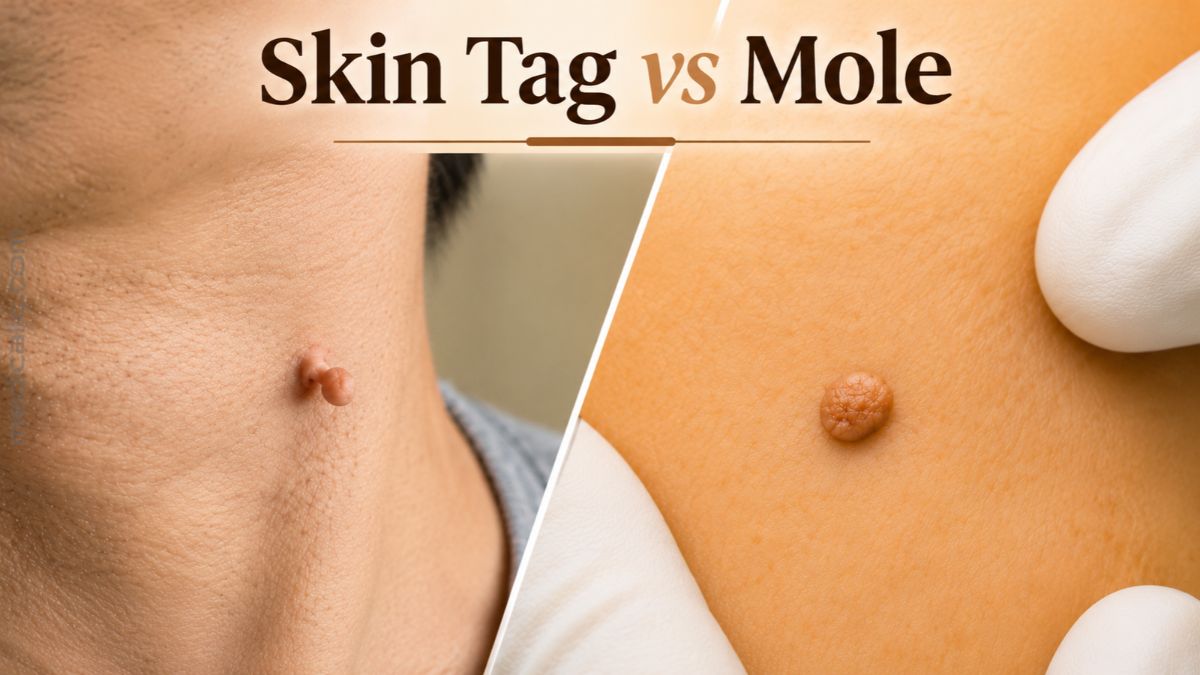
Is it a skin tag or a mole? The difference isn’t always obvious. Both are usually harmless, but they differ in how they develop, what they look like, and when they need medical attention.
Skin Tag vs Mole: Key Differences at a Glance
The core difference is the tissue each one grows from. A skin tag is made mainly of connective tissue wrapped in skin, while a mole forms when pigment-producing cells grow together in a cluster. Here’s how they usually compare:
| Feature | Skin Tag | Mole |
|---|---|---|
| Medical name | Acrochordon | Melanocytic nevus |
| Appearance | Small, fleshy projection | Flat, rounded, or raised growth |
| Texture | Usually soft and flexible | Varies from soft to firm |
| Attachment | Frequently has a narrow stalk | Often has a broader base |
| Color | Flesh-colored or darker | Flesh-colored, pink, tan, brown, or black |
| Common locations | Neck, eyelids, armpits, and other skin folds | Almost anywhere on the body |
| Onset | More common in adulthood | Often appears during childhood or early adulthood |
| Cancer potential | Noncancerous | Most are harmless; rarely, a mole may develop into melanoma |
These are typical traits, not fixed rules, and the gap narrows when a mole grows outward instead of staying flat.

Why Skin Tags and Moles Are Different
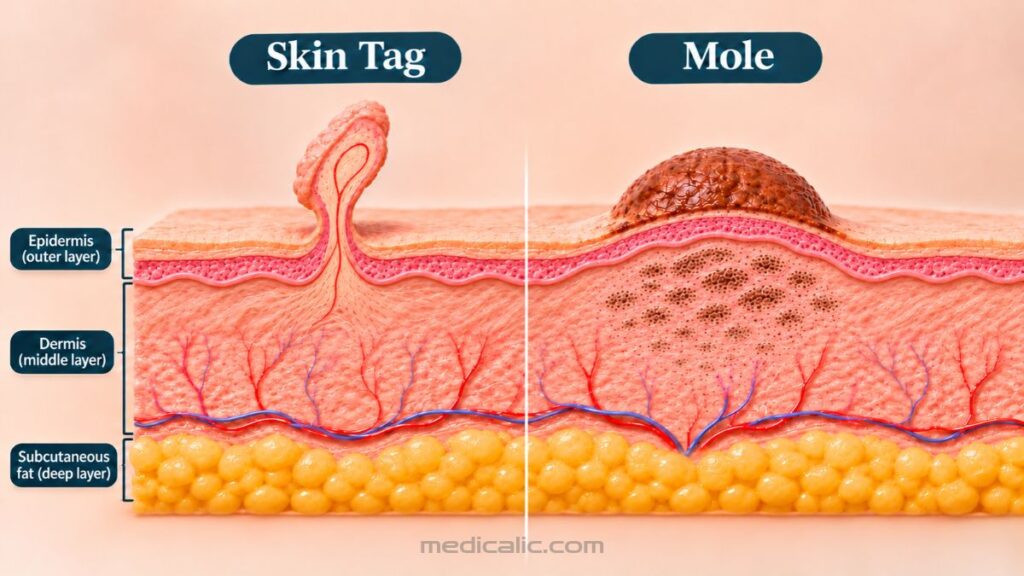
Most of what separates these two is hidden beneath the surface of your skin.
What Skin Tags Are Made Of
A skin tag is built from loosely arranged collagen fibers and tiny blood vessels, all wrapped in the epidermis, the outermost layer of your skin. That soft, collagen-rich core is why many tags feel pliable. Picture a small extension of skin with a core of connective tissue.[1]
How Moles Develop
Moles start with melanocytes, the cells that make melanin, the pigment that contributes to skin color. Normally these cells are scattered individually through the skin. In a mole, they gather into a localized cluster.
Some moles are present at birth, while others appear as you grow older, and genetics and sun exposure both influence how many you end up with. Where the cluster sits within the skin also helps determine whether the mole looks flat or raised.[2]
When a Mole Looks Like a Skin Tag
If you’ve always pictured a mole as a flat brown spot, its range may surprise you. Some types share several features with skin tags.
Raised and Flesh-Colored Moles
An intradermal nevus is a mole whose cells sit in the dermis, the layer beneath the skin’s surface. These often show up as rounded, dome-shaped bumps, and some contain so little visible pigment that they blend almost perfectly into the surrounding skin. They can also feel soft and fleshy.
What usually sets them apart from a typical dangling skin tag is the base. A raised intradermal mole tends to sit more evenly against the skin, with a broader, rounded base.
You might also notice a hair growing from a mole. A hair doesn’t prove that a growth is harmless, though.[3]
Moles That Hang From the Skin
Some intradermal moles develop a stalk-like attachment. Dermatologists call these pedunculated nevi. A pedunculated mole can mimic a skin tag so closely that telling them apart from a photograph becomes difficult, so even a soft, hanging growth isn’t automatically a skin tag.
Warts can cause similar confusion, although what’s going on beneath them is quite different. Our guide to skin tags vs warts walks through those differences.
Can Color Help You Tell Them Apart?
A uniformly brown spot may point toward a mole, but color works best as one clue among several.
Skin tags can look noticeably darker than the skin around them. Occasionally, a skin tag may turn dark purple or black if twisting disrupts its blood supply. But sudden darkening shouldn’t automatically be attributed to a twisted skin tag, particularly if you’re unsure what the growth is.[4] Moles, meanwhile, can have very little visible pigment, and their shade varies with natural skin tone: common moles often look darker in people with darker skin.[5]
So instead of asking whether a growth is too dark to be a skin tag, ask whether its color has changed or turned uneven. That’s often more medically significant than the original shade.
Can a Mole Turn Into a Skin Tag?
Not in the usual sense. The two grow from fundamentally different tissue, so one doesn’t transform into the other. What can change is how a mole looks. Benign moles may slowly become more prominent or fade in color, which can make them resemble a skin tag.
But if a mole you’ve had for years has recently started projecting outward, don’t assume it’s becoming a skin tag. A noticeable change in height deserves a professional look, especially when it comes with other changes.
Which Changes Should You Pay Attention To?
A growth that looks unusual isn’t necessarily dangerous. What matters most is how it changes over time.
True skin tags are benign, and common moles are noncancerous too. Only rarely does a mole develop into melanoma. Melanoma can also appear as an entirely new growth rather than from an existing mole.
When you’re checking a mole, the ABCDE rule helps you spot potential warning signs:
- Asymmetry (A): The two halves have noticeably different shapes.
- Border (B): The edges appear irregular, blurred, or uneven.
- Color (C): Several colors or uneven patches develop within the same growth.
- Diameter (D): The growth measures more than 6 mm, although melanoma can be smaller.
- Evolving (E): Its size, shape, color, or overall appearance changes.
Persistent itching, unexplained bleeding, or a sore that doesn’t heal also deserves attention. Another useful clue is the ugly duckling sign: a mole that looks distinctly different from the other moles on your body.
None of these findings automatically means cancer, but each is a good reason to arrange a skin examination.
How Dermatologists Tell Skin Tags and Moles Apart
When two growths look nearly identical, a dermatologist can examine what a bathroom mirror can’t show. The usual tool is a dermatoscope, a handheld device that pairs magnification with specialized lighting to reveal how pigment is distributed, what the blood vessel patterns look like, and other structures within the growth. This examination, called dermoscopy, is noninvasive and painless.
If the diagnosis remains uncertain, or the growth looks suspicious, the dermatologist may perform a biopsy. The collected tissue is examined under a microscope to establish what kind of growth it really is.
Are Skin Tags and Moles Removed Differently?
Neither a confirmed skin tag nor a typical benign mole necessarily needs treatment. Unless a growth causes discomfort or raises medical concerns, removal is largely a personal choice.
A dermatologist can remove a skin tag with a minor procedure such as surgical snipping or freezing. Moles call for a somewhat different approach. Depending on the diagnosis, a dermatologist may perform a surgical shave or excision, allowing the removed tissue to be examined for abnormal cells. If you’re considering mole removal, it’s worth understanding how to get rid of moles safely and what the procedure involves.
That’s why techniques meant for removing skin tags at home should never be used on a suspected mole or an unidentified growth. Besides causing bleeding, infection, and scarring, trying to destroy a mole at home could delay the diagnosis of skin cancer.[6]
When to Get a Skin Growth Checked
If you can’t tell whether a growth is a skin tag or a mole, see a dermatologist, especially if it’s new or changing. If you have older photographs showing the growth, bring them along. Knowing when it appeared and how it has changed gives the examination useful context.
Most bumps on your skin will never need more than a glance. The ones worth a professional’s time are the ones that change, and a short skin exam is usually enough to settle whether yours is one of them.
Most skin growths turn out to be harmless, but you don’t have to wait for one to change before getting it checked. Sometimes, knowing exactly what’s on your skin is all you need to stop wondering about it.
Medical References
Update History
Originally written by Dr. Jubair Islam.
Your answer helps us improve the clarity and usefulness of our health content.