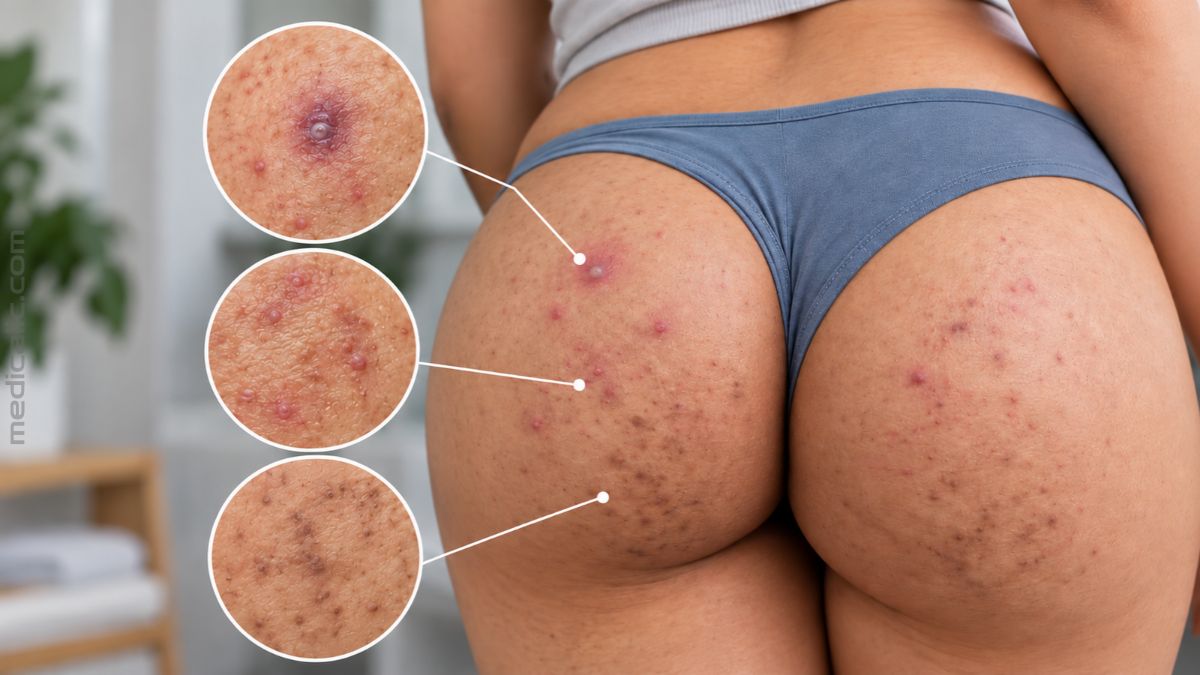
You’re getting close to your partner, but instead of feeling fully at ease, your attention drifts to those red, rough, or pimple-like bumps on your buttocks.
It’s easy to call them acne, but that label can be misleading. If you’re trying to figure out how to get rid of butt acne, the first step isn’t buying another spot treatment—it’s knowing what the bumps actually are.
Folliculitis, keratosis pilaris, ingrown hairs, and true acne can look similar at first, but they don’t all respond to the same treatment. Once you have a better idea of what’s causing them, choosing the right approach becomes much easier—and you’re less likely to irritate your skin with products that don’t fit the problem.
For mild cases, a few targeted changes are often enough to make a noticeable difference.
Is It Really Butt Acne?
“Butt acne” is a convenient label, not a precise diagnosis. True acne can occur on the buttocks, but many bumps that look like acne are actually folliculitis, keratosis pilaris, ingrown hairs, or other skin conditions.[1]
Folliculitis develops when a hair follicle becomes inflamed. It can cause small red or pus-filled bumps that may itch, burn, or feel tender. This inflammation often follows irritation or damage to the follicle, although infection can also play a role. Friction, shaving, tight clothing, heat, and moisture can all increase the likelihood of folliculitis.[2]
Keratosis pilaris (KP) looks and feels different from typical acne. It develops when keratin—a natural protein in the skin—builds up and plugs hair follicles. Instead of inflamed pimples, this buildup causes tiny, rough bumps with a goosebump-like or sandpaper texture, often described as “chicken skin.”[3]
Ingrown hairs can cause small, inflamed, pimple-like bumps after shaving, waxing, or plucking. They develop when a hair curls back or grows into the skin instead of rising normally from the follicle. Ingrown hairs can occur on the buttocks, but they’re more common in areas such as the pubic or bikini region, where the hair is often coarser or curlier.
True acne on the buttocks looks and behaves much like facial acne. It becomes more likely when blackheads or whiteheads appear along with inflammatory bumps such as papules and pustules in the same area.
Repeated painful lumps, fluid drainage, scarring, or tunnel-like tracts beneath the skin shouldn’t be brushed off as ordinary acne. These are important clues of hidradenitis suppurativa (HS), a chronic inflammatory condition that commonly affects areas where skin rubs together, including the buttocks.[4]
n fact, true acne rarely shows up as a single type of bump; it’s common to see blackheads, whiteheads, papules, and pustules all coexisting at the exact same time.
How to Get Rid of Butt Acne
Once you have a better idea of what the bumps might be, treatment becomes much more straightforward. For mild cases, start with gentle skin care, reduce common triggers like friction and sweat, and use products that match the type of bumps you’re trying to treat.
1. Cleanse Gently
Wash the area regularly, especially after exercise or heavy sweating. A mild cleanser is usually enough.
Avoid trying to scrub the bumps away. Clean is good—scrubbed raw is not. Rough washcloths, harsh body scrubs, and aggressive exfoliation can irritate the skin barrier and worsen inflammation.
2. Consider Benzoyl Peroxide for Inflamed Acne Bumps
Benzoyl peroxide is a well-established acne treatment that helps reduce acne-causing bacteria.[5] It comes in several forms, including washes or cleansers, gels, creams, and lotions.
For the buttocks, a benzoyl peroxide wash can be more practical than a leave-on treatment because it covers a larger area and can be rinsed off easily.
Start with conservative use and follow the product directions carefully. If your skin becomes very dry, irritated, or starts to sting, use it less often or switch to a lower-strength product.
One practical warning: benzoyl peroxide can bleach towels, underwear, and bedding. Rinse it off thoroughly and consider using white towels while you’re using it.
3. Try Salicylic Acid for Rough or Clogged Skin
If the skin feels uneven, grainy, or covered with tiny bumps that seem to sit around the hair follicles, salicylic acid may be a good option. It helps loosen dead skin cells and clear buildup around the follicles, which can gradually smooth the texture.
Salicylic acid is also a keratolytic ingredient commonly used for keratosis pilaris, where excess keratin can plug the hair follicles and create rough, persistent bumps.
4. Don’t Skip Moisturizer
A good moisturizer helps keep the skin barrier healthy, especially when you’re using ingredients like benzoyl peroxide or salicylic acid that can leave the skin dry or irritated.
For smoother, softer skin on the buttocks, choose a gentle moisturizer and use it consistently. Keeping the skin well hydrated can reduce dryness and irritation, making the area less prone to the kind of friction and barrier disruption that can aggravate acne-like bumps.
If the bumps resemble keratosis pilaris, products containing urea or lactic acid can be especially helpful because they moisturize while also softening rough, keratin-filled bumps.
5. Reduce Sweat and Friction
Sweat trapped under tight clothing can keep the skin warm and damp while increasing friction around hair follicles.
After a workout, shower when you can and change out of sweaty leggings, shorts, or underwear. Avoid staying in damp clothes for hours, and wash workout clothes between uses.
Choose breathable, well-fitting underwear that doesn’t trap moisture or rub against your skin. If you sweat heavily, change into a clean, dry pair.
After using the bathroom, gently pat the washed area dry before pulling up your underwear. Avoid leaving moisture trapped against your skin.
Activities like cycling or running can also cause repeated friction. If the same area keeps rubbing, looser clothing or a better fit may help.
6. Give Shaving and Waxing a Break
Notice bumps appearing after shaving or waxing? Your hair removal routine might be irritating your skin rather than leaving it smooth.
Give the area a break until the bumps settle. When you shave again, use a clean, sharp razor and shave in the direction of hair growth. Avoid going over the same spot repeatedly.
If the bumps keep returning, consider trimming instead of shaving too close to the skin.
7. Stop Picking and Popping
Picking at bumps out of habit can backfire, turning small spots into sores and leaving darker marks or scars behind. Instead of focusing too much on the bumps, stick with your skincare routine and give your skin time to heal.
What About Butt Acne Dark Spots?
After the bumps heal, they can leave flat brown, gray, or dark marks on the skin. This is called post-inflammatory hyperpigmentation (PIH), and the marks can be especially noticeable and slow to fade in darker skin tones.[6]
Before trying to fade these spots, focus on controlling new bumps. Otherwise, fresh inflammation can keep leaving new marks behind.
Once the bumps have settled, ingredients like azelaic acid, glycolic acid, or retinoids may help fade the discoloration. However, topical retinoids should be avoided during pregnancy or when trying to conceive.[7]
Keep in mind that raised or indented scars are different from dark spots and may need professional treatment.
How Long Does It Take to Clear?
How quickly the bumps clear depends on what’s causing them.
Folliculitis triggered by friction may improve once that friction is reduced. True acne often needs around six to eight weeks of consistent treatment before you can judge the results.[8] Keratosis pilaris tends to improve more gradually and may require ongoing care.
Give your skincare routine enough time to work, but avoid switching to stronger products for months if nothing improves.
Don’t reach for steroid creams hoping to fade dark spots faster. Using them without medical guidance can cause skin problems, worsen an underlying infection, or lead to further discoloration.[9]
When to Consult a Dermatologist
A treatment that isn’t working may be a clue that you’re treating the wrong condition.
If the bumps persist despite consistent care, keep returning, spread, or become unusually painful, it’s time to see a dermatologist. Deep boils, drainage, or scarring also deserve attention, as they may signal conditions such as hidradenitis suppurativa (HS).
Seek prompt medical care if redness, warmth, swelling, or pain spreads quickly, especially if you develop fever, chills, or feel generally unwell.[10]
Most mild cases can improve with simple, consistent care. But when home treatment isn’t helping, getting a proper diagnosis is better than continuing to experiment with products.
Medical References
Update History
Reference accuracy and source links verified.
New medical references added.
Originally written by Dr. Rahul Kushwaha.
Your answer helps us improve the clarity and usefulness of our health content.