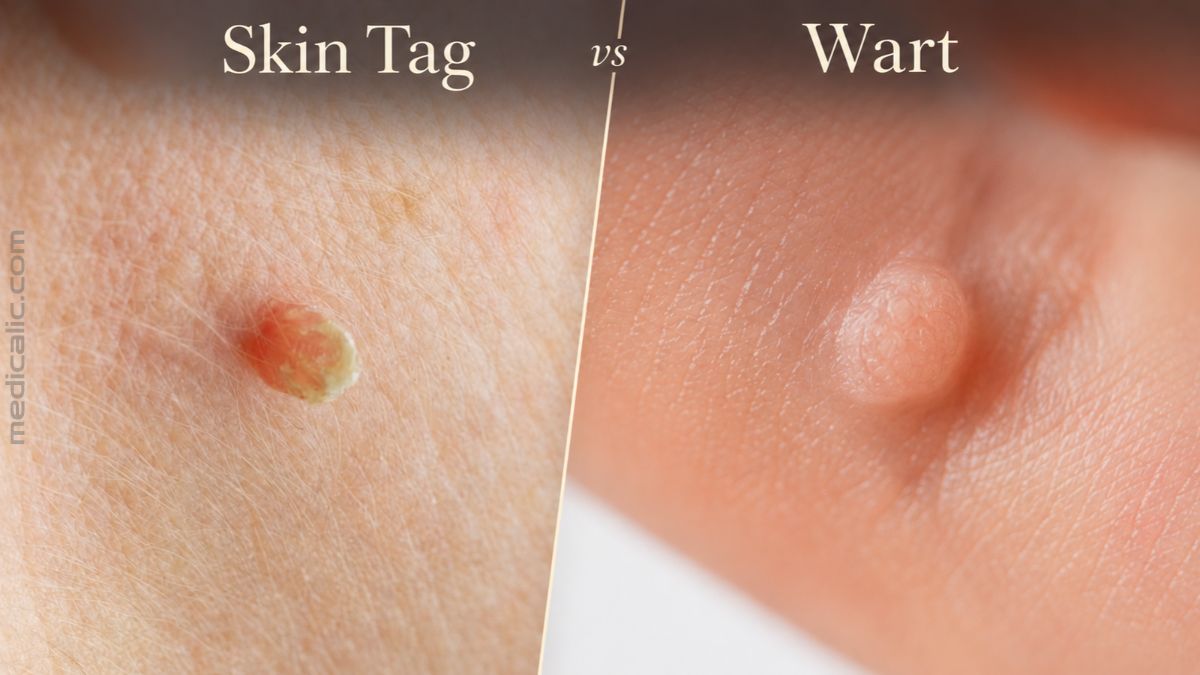
You’re running your hand along the back of your neck, or drying your fingers with a towel, when your skin catches on something. A small, uneven bump where things used to feel smooth. You check the mirror. It doesn’t hurt, it doesn’t itch. It just sits there.
And strangely, it doesn’t feel entirely new. You’ve seen something like this before, on a relative’s neck, a friend’s hand, a coworker’s eyelid. Back then, you may have heard someone brush it off as “just a skin tag,” while somebody else, looking at a similar bump, called it a wart. Two names for what looked like the same thing, and nobody stopped to explain the difference.
Now the bump is on your skin, and the question stops being casual: what exactly is it? The answer decides what you should do next, and the bump itself offers a few quiet hints if you know how to read them.
Skin Tag vs Wart: Key Differences at a Glance
A skin tag (acrochordon) is a harmless growth made mainly of connective tissue, blood vessels, and an outer layer of skin.[1] A wart is a noncancerous growth that appears when the human papillomavirus (HPV) infects skin cells. Both can show up as small, raised bumps, yet they differ in structure, behavior, and how they’re treated.
| Feature | Skin Tag | Wart |
|---|---|---|
| Appearance | Often hangs from the skin | Usually appears as a raised bump |
| Texture | Soft and smooth | Typically firm and rough |
| Attachment | Often has a narrow stalk | Usually has a broader base |
| Color | Skin-colored or darker | Skin-colored, pink, brown, or grayish |
| Common locations | Neck, eyelids, armpits, and groin | Hands, fingers, knees, and feet |
| Cause | Exact cause unknown; several contributing factors | HPV infection |
| Contagiousness | Not contagious | Contagious |
| Natural course | Usually remains unless removed | May disappear on its own |
Think of this table as a starting point rather than a verdict. Skin growths don’t always follow textbook descriptions, so a closer look at their features often tells you more.
How to Tell a Skin Tag From a Wart
No single feature settles it. What helps is seeing how several of them fit together. You don’t need to squeeze, scratch, pull, scrape, or cut a growth to study it. Even a closer look can reveal some useful clues.
Shape and Attachment
The way a growth connects to your skin is one of the most telling clues. Many skin tags hang from a thin stem, medically called a peduncle, which holds up a small, rounded or elongated piece of tissue. That stem lets the growth move slightly when touched. A common wart sits more firmly against the skin, with its base blending into the surrounding surface.
There are exceptions, though. Not every skin tag has a noticeable stalk, and some types of warts grow narrow, projecting shapes.
Texture and Firmness
A skin tag usually feels like a tiny fold of loose skin: flexible and compressible. A common wart feels different. Its outer layer is thickened and rich in keratin, the protective protein your skin naturally makes. This gives it a harder, sometimes grainy surface that can resemble a miniature cauliflower.
Color
Color is one of the least reliable clues. Both can blend almost perfectly with your natural skin tone or look noticeably darker. A wart may also appear pink, brown, or grayish, but there’s enough overlap in color that it’s difficult to tell the two apart on that basis alone.
Tiny Black Dots
Look closely at a common or plantar wart and you may spot tiny red or black specks scattered across its surface. They’re sometimes called wart seeds, but they’re neither seeds nor roots. They’re small blood vessels, and some of them contain clotted blood.[2]
These dots can be a helpful clue, but not every wart has visible ones, so don’t rule out a wart just because you can’t see any.
Common Body Locations
Where a growth appears adds useful context. A small growth tucked into a neck crease or beneath a breast fits the usual pattern of skin tags. A rough bump beside a fingernail or on a weight-bearing part of the foot points more toward a wart.
Plantar warts are especially sneaky. Pressure from walking pushes them inward, so they often look like thickened skin or a callus instead of a growth sticking out. Either way, location is a clue, not a diagnosis.

Can a Wart Look Like a Skin Tag?
Yes. If you’ve been comparing photos online and nothing quite matches, you may be dealing with one of the less typical forms of wart.
Filiform Warts
Filiform warts are probably the easiest warts to mistake for a skin tag. Instead of forming a rounded, rough bump, they develop thin, finger-like projections that extend outward from a narrow base. They’re especially common on the face, around the eyelids, nose, and mouth.
Their elongated shape can be misleading, but several fine projections on one growth may help set it apart from a skin tag.
Flat Warts
Not every wart is thick and crusty. Flat warts, also called verruca plana, are small, slightly raised growths with smooth, flat tops. They often appear in groups on the face, hands, or legs. Their smooth surface can be misleading, but unlike typical skin tags, they tend to sit close to the skin rather than hang from it.
Genital Warts
The line between a skin tag and a wart can get particularly blurry in the genital area. Genital warts can appear as single growths, clusters, or small, fleshy projections.
Finding an unfamiliar bump there doesn’t automatically mean you have a sexually transmitted infection (STI). Skin tags aren’t sexually transmitted, but genital warts are caused by HPV. Because these and several other genital growths can look alike, this is one place where a professional examination is especially worthwhile.[3]
What Causes Skin Tags and Warts?
The reason these two growths behave so differently over time lies in something you can’t see on the surface: where they come from.
Why Skin Tags Develop
The exact reason skin tags form isn’t fully understood. Friction may play a part, but it doesn’t explain every case. Several factors are linked to a greater likelihood of developing them:
- Increasing age
- Family history
- Obesity
- Pregnancy-related hormonal changes
- Insulin resistance and type 2 diabetes
Having skin tags doesn’t necessarily mean there’s an underlying health condition. Plenty of otherwise healthy people get them. And if new ones keep appearing, the original isn’t spreading. New tags can develop independently, often in people who are already prone to them.
Why Warts Develop and Spread
Warts begin when HPV slips into the skin, often through tiny breaks too small to notice. The infection stimulates skin cells to multiply, and a visible growth gradually forms.
Unlike skin tags, common skin warts can spread through direct contact or through contaminated objects and surfaces. Scratching, picking, or shaving over a wart can also carry the virus to nearby skin. Still, not everyone who encounters HPV develops a wart. The condition of your skin barrier and how your immune system responds to the virus can both influence whether a wart develops.
Do Skin Tags and Warts Go Away on Their Own?
If a confirmed skin tag isn’t bothering you, leaving it alone is perfectly reasonable. Most stay in place indefinitely, although some occasionally fall off naturally.
Warts follow a different life cycle. Your immune system may eventually recognize and control the HPV infection, allowing the growth to disappear, but this can take several months or even years. For people with weakened immune systems, warts can be more persistent.
Whether waiting makes sense depends on how much the growth interferes with your daily life, whether it’s changing, and how certain you are about what it is.
Skin Tag vs Wart: Treatment and Removal
When a small growth becomes uncomfortable or dents your confidence, removing it feels like the obvious next step. But the right treatment depends on what you’re actually removing.
How Skin Tags Are Removed
A dermatologist can usually remove a skin tag during a routine office visit using snip excision, cryotherapy (freezing), or electrodesiccation (using an electrical current). The choice depends on the growth’s size, location, and your individual skin characteristics.[4]
Trying to remove a skin tag yourself can lead to bleeding, infection, scarring, or changes in skin pigmentation.
How Warts Are Treated
Unlike skin tags, warts may respond to over-the-counter treatments such as salicylic acid. Dermatologists also use cryotherapy and other treatments for persistent warts. Treatment can take several weeks or longer, and even after successful removal, warts can sometimes return.
Standard over-the-counter wart removers should not be used on the face or genitals. If you have diabetes, poor circulation, or a weakened immune system, seek medical advice before attempting home treatment.[5]
If you’re wondering how to remove a skin tag at home, it’s important to understand which methods may cause more harm than good.
What If It’s Neither a Skin Tag Nor a Wart?
Skin tags and warts are only two of many possible explanations for a small skin growth. Other conditions that may resemble them include:
- Raised moles: Benign growths that can be flesh-colored and dome-shaped.
- Seborrheic keratoses: Often waxy or rough growths that appear stuck onto the skin.
- Molluscum contagiosum: Small, rounded bumps that frequently have a central indentation.
Occasionally, certain skin cancers can also pass for an ordinary, harmless bump. An unusual-looking growth isn’t necessarily dangerous, but even a familiar-looking one deserves attention once it starts behaving differently.[6]
When to See a Dermatologist
Most skin tags and warts are harmless, but not every small skin growth is what it seems. Have a growth examined if it:
- Grows rapidly or changes in shape or color.
- Bleeds without an obvious injury.
- Becomes persistently painful or develops an open sore.
- Appears in the genital area or interferes with vision.
If you’re unsure what the growth is, a dermatologist can examine it using a dermatoscope or, when necessary, perform a biopsy. Getting the right diagnosis can spare you unnecessary worry, ineffective treatments, and avoidable damage to your skin.
Medical References
Update History
Originally written by Dr. Rahul Kushwaha.
Your answer helps us improve the clarity and usefulness of our health content.