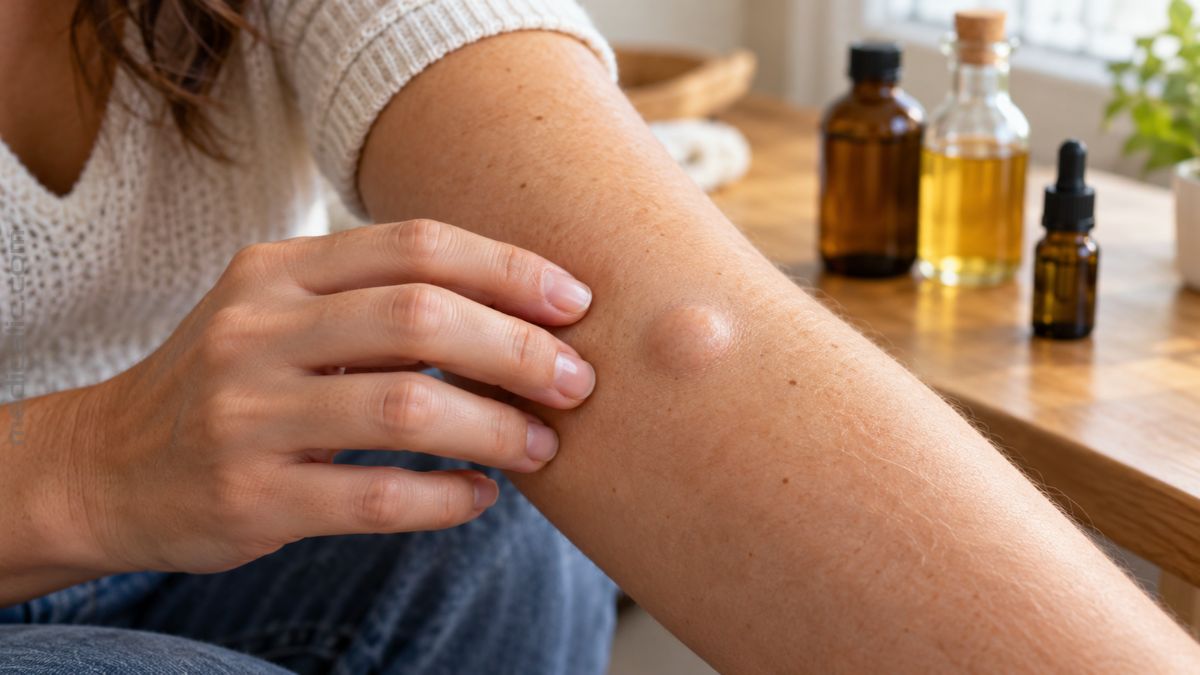
A cyst usually starts small. A bump you notice while washing your face. A firm spot behind your knee when you stand up. A tender little knot that wasn’t there last week. You press it once, then again, then far more often than you’d like to admit.
Then the worrying begins. Is it serious? Will it ever go away? Is there something you can do about it tonight?
So you type how to dissolve a cyst naturally into a search bar, and the rabbit hole opens. Castor oil packs. Apple cider vinegar. A tea tree oil trick a stranger swears shrank theirs in three days. Every page sounds certain, and half of them quietly contradict each other.
Here’s what those pages rarely stop to ask: what kind of cyst is this? Your lump doesn’t read the internet. It will do what its own kind does, no matter what a remedy promises.
So before you raid the kitchen cabinet, let’s start there.
What Is a Cyst, and Why Does the Type Matter?
A cyst is a closed pocket of tissue holding fluid, keratin, or something thicker. That’s all the word promises. Everything else, including how it behaves, depends on how it was built.
Some cysts are temporary guests. They fill up, linger for a while, and quietly go away. Others are long-term residents, built in a way that makes them far more likely to stick around.
That difference changes what “gone” really means. A temporary guest leaves on its own. A long-term resident can shrink, drain, or seem to dissolve, then settle right back in. Smaller isn’t the same as gone.
So the question that matters isn’t “which remedy?” It’s “which cyst?” Let’s start with the ones that need no remedy at all.
Which Types of Cysts Can Go Away Naturally?
Functional ovarian cysts are the most reassuring of the bunch. They’re a side effect of ovulation: either a follicle that never releases its egg and keeps growing, or the sac left behind after the egg is released filling with fluid. Most fade within six to eight weeks without treatment.[1]
Not every ovarian cyst is this harmless, though. Endometriomas and dermoid cysts play by different rules, and a cyst that looks complex on ultrasound needs a closer look. Telling which is which usually starts with the scan, sometimes backed by other tests.
Ganglion cysts are jelly-filled bumps that show up near the wrist or hand joints. Many simply fade, but this one demands patience. Think months, sometimes up to a year.[2]
Bartholin’s cysts form near the vaginal opening when a gland duct gets blocked. Some drain by themselves. Others turn painful or infected.
Baker’s cysts sit behind the knee and usually travel with another joint problem, such as arthritis. Calm the knee, and the cyst often calms with it.
They don’t all move at the same pace, and not every one will settle, but all four can resolve without anyone cutting them out.
Why Epidermoid (Sebaceous) Cysts Rarely Go Away on Their Own
Epidermoid cysts often show up as round, slow-growing lumps on the face, neck, back, or chest. You’ll hear them called sebaceous cysts, but that nickname is misleading, since true sebaceous cysts are much rarer. These are filled with keratin, the same protein that makes up your skin, hair, and nails. Appearance alone can’t confirm what a lump is, though.
What makes them stubborn is the wall. It’s a living lining that keeps producing keratin, so even when the contents drain, the lining usually stays behind.[3] That’s why a lump you shrank last month can be back this month.
Left alone, an epidermoid cyst can stay put for years. Once confirmed, it’s usually harmless, and a small, painless one that isn’t bothering you often needs no treatment.
Still, a harmless lump can be tender, unsightly, or simply impossible to ignore.
How to Care for a Cyst at Home Safely
Home care won’t reliably get rid of a cyst. What it can do is take the edge off while you wait, as long as you know what the lump is.
Warm compress for a skin cyst. Soak a clean washcloth in comfortably warm water, wring it out, and hold it against the area for 10 to 15 minutes, a few times a day. It should feel soothing, never hot enough to sting. Warmth can ease soreness and sometimes nudge a cyst to drain, but it won’t touch the wall underneath.
Warm sitz bath for a diagnosed Bartholin’s cyst. Sit in a shallow bath of warm water a few times a day for three to four days.[4] The soak eases discomfort and can help the cyst drain.
Rest and support for joint cysts. For a Baker’s cyst, rest the knee and hold a cold pack wrapped in a cloth against it for short stretches to ease swelling. For a ganglion cyst, a wrist support can take some pressure off a sore joint.
Hands off. Wash gently with mild soap and water, and resist the urge to rub, poke, or press. Never cut, puncture, or pop a cyst yourself. That can leave you with more inflammation, an infection, or even a scar. If a skin cyst opens on its own, keep it clean, cover it with a nonstick dressing, and watch for worsening redness, pain, or discharge.
It isn’t glamorous, and that’s exactly why the pantry cures sound so tempting.
Do Home Remedies for Cysts Actually Work?
Here’s the logic trap behind most online cyst advice: a substance that fights bacteria or calms inflammation sounds like it should dissolve a cyst. It doesn’t follow. Soothing the surface is a different job from changing the structure beneath it.
There’s a second trap, too. Many cysts fade on their own, so it’s easy to credit whichever remedy happened to be in use at the time.
Castor oil. Castor oil packs are everywhere, with promises that the oil soaks into tissue and breaks the cyst down. Reliable human studies haven’t shown that. A warm pack feels soothing, but the oil isn’t known to add anything beyond that warmth, and it can irritate sensitive skin.
Apple cider vinegar. Its acidity is exactly what earns it a reputation as a cure-all, and exactly what makes it risky. There’s no proof it dissolves a cyst, and there are documented cases of chemical burns from putting it on the skin.[5] Keep it off a cyst, and especially off irritated or broken skin.
Tea tree oil, turmeric, ginger, aloe, and honey. Tea tree oil fights microbes in the lab, turmeric and ginger have a reputation for calming inflammation, and aloe and honey have a long history of use on skin. None has been shown to shrink or remove a cyst in real people, and essential oils in particular can trigger allergic reactions or contact dermatitis.
Diet and supplements. Eating well supports your body in general, but no food, detox drink, or supplement has been shown to dissolve a cyst that already exists. Be wary of anything sold as a “cyst cleanser” or “natural dissolver,” especially if it promises results overnight.
When to See a Doctor for a Cyst
A lump that looks like a cyst isn’t always one. It could be an abscess, a swollen lymph node, or something else that needs different care. A cyst that refuses to shrink isn’t automatically a bad sign, but a lump that is new, unexplained, or keeps coming back deserves a proper look instead of more experiments.
Get it checked promptly if you notice:
- Spreading redness, warmth, swelling, or tenderness
- Pus, fever, or a general sense of being unwell
- Fast growth or worsening pain
- A lump that feels hard, fixed in place, or changes unexpectedly
Seek emergency care for sudden, severe pelvic pain, especially with vomiting, fainting, dizziness, or heavy bleeding. These can point to ovarian torsion, a ruptured cyst, or, if pregnancy is possible, an ectopic pregnancy. Sudden calf pain or swelling also needs urgent assessment, particularly if you know you have a Baker’s cyst, since a ruptured one can look a lot like a blood clot. If it comes with sudden breathlessness or chest pain, treat it as an emergency.[6]
And if you’re pregnant, have a weakened immune system, or have an undiagnosed lump in your breast, neck, or genital area, skip the home remedies altogether and go straight to a professional. A new lump near the vaginal opening after age 40 or after menopause should always be examined.
Medical Treatment for Cysts: What Doctors Actually Do
When a cyst turns painful, gets infected, or starts getting in the way of daily life, home remedies have done all they can. Medical care is the more reliable route, and the options are broader than most people expect.
For an epidermoid cyst, a clinician can calm inflammation with a steroid injection when there’s no infection, drain it for relief, or remove the entire sac, which is the option least likely to let it return.
Ganglion cysts can be monitored, drained with a needle, or removed surgically if they cause trouble.
Ovarian cysts are managed according to what the ultrasound shows, your symptoms, your age, and other risk factors. Many need nothing more than monitoring. Some call for surgery.
Bartholin’s cysts that stay painful, get infected, or keep coming back call for a small drainage procedure, sometimes with a tiny tube left in place for a few weeks so the opening doesn’t close too soon.
Baker’s cysts that stay swollen and sore can call for physiotherapy or a steroid injection in the knee.
The best treatment isn’t the most aggressive one. It’s the one that fits the diagnosis.
What to Do Next If You Think You Have a Cyst
If you’ve found a visible lump and there are no urgent warning signs, take a clear photo and jot down when you first noticed it, whether it’s changing, and whether it hurts. For an internal cyst, keep track of your symptoms and any scan results instead. Those notes make an appointment far more useful.
And if you’ve been checking the same spot in the mirror all evening, step away for tonight. Pressing it again won’t bring you any closer to an answer.
Medical References
Update History
Originally written by Dr. Rahul Kushwaha.
Your answer helps us improve the clarity and usefulness of our health content.