A good meal should leave you satisfied, warm, maybe a little sleepy, and definitely not wondering what’s going on inside your body.
Sometimes, though, you do. An ache settles in under your ribs after something rich, and suddenly your dinner has your full attention. Then a doctor, a friend, or a late-night search throws out a word, “gallbladder,” and you realize you have no idea what that organ does.
Don’t feel bad. Most of us have never given it a single thought, and honestly, it seems to prefer it that way. It doesn’t thump like the heart or swell like the lungs. It simply gets on with its job, meal after meal, for decades.
So let’s give it the attention it never asks for, starting with the basics: where it actually lives.
Where Is the Gallbladder Located?
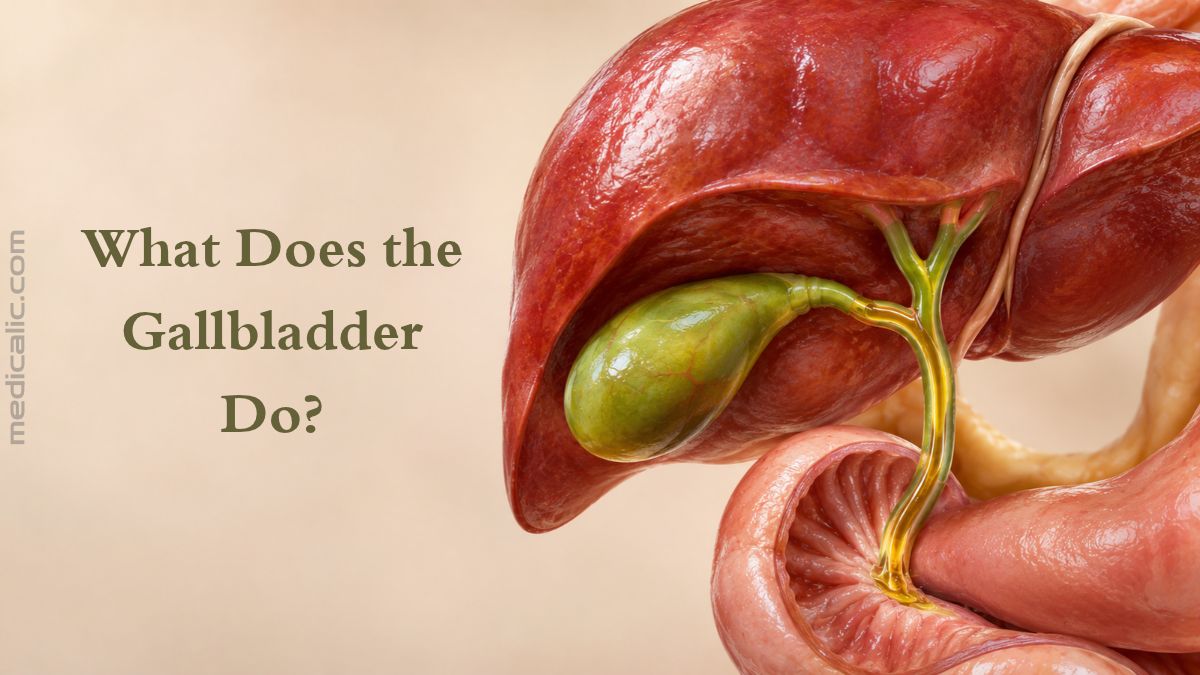
Rest your hand just under your right ribs. Somewhere beneath it, tucked against the underside of your liver, sits a pear-shaped pouch about 3 to 4 inches long.
Don’t expect much room inside. When full, it holds only 30 to 50 milliliters, which is two or three tablespoons.[1] A network of narrow tubes called bile ducts links it to your liver and small intestine, and together they make up your biliary system.
Two or three tablespoons of what, you might ask. Of something your liver makes and your lunch depends on.
What Does the Gallbladder Do? Its Three Main Jobs
In a sentence: the gallbladder is a storage tank for bile that doubles as a delivery service. It holds the bile, concentrates it, and sends it out when you eat. What it doesn’t do is make the stuff. That’s the liver’s job.
Bile is a yellowish-green fluid, mostly water, carrying bile salts, cholesterol, and a pigment called bilirubin. Your liver turns out somewhere between half a liter and a full liter of it every day. The gallbladder’s role in that supply chain comes down to three moves.
It Stores Bile
Your liver doesn’t take breaks, so bile keeps trickling out even when your plate is empty. Between meals, your intestine needs less bile, so a good share of it is directed into the gallbladder to wait for the next meal, although some still flows directly into the intestine.
It Concentrates Bile
Here’s the clever part: with only those few tablespoons of room, the gallbladder makes every drop count. Like a cook reducing broth to a rich stock, it concentrates the bile inside, only without the heat.
The cells lining the gallbladder absorb water and certain electrolytes from the bile, while the bile salts and other key ingredients stay put. The result is bile that’s several times more concentrated than when it left the liver. A little goes a long way.
It Delivers Bile When You Eat
When a meal reaches your intestine, especially one with some fat in it, the gallbladder squeezes and sends its concentrated bile on its way.
The way it knows exactly when to squeeze is the best part of the story.
How Does the Gallbladder Work? Step by Step
Say you’ve just finished eggs and avocado with a generous glug of olive oil. You feel perfectly fine. Your gut, meanwhile, is busy.
As the meal leaves your stomach and slides into the first stretch of the small intestine, called the duodenum, cells in its lining notice the fat and protein. They respond by releasing a hormone called cholecystokinin, or CCK, a name that roughly translates to “gallbladder mover.”[2] Medical names can be refreshingly literal.
CCK travels through your bloodstream with a simple message: food’s here. The gallbladder’s muscular wall contracts. At the same moment, a ring of muscle called the sphincter of Oddi, a valve guarding the spot where the bile duct opens into the duodenum, relaxes, and nerve signals help keep the timing neat. Bile flows out through the cystic duct, into the common bile duct, and then into the duodenum, right where your olive oil is waiting.
And once bile has done its work, your body doesn’t throw it away. Most bile salts are reabsorbed farther down the small intestine and returned to the liver, where they can be used again. It’s one of the most efficient recycling programs in your body.
Getting bile to the intestine is one thing. What it does once it meets the fat is where it really earns its keep.
Why Does Your Body Need Bile to Digest Fat?
Shake oil and vinegar into a salad dressing and watch it separate again within minutes. Fat and water simply refuse to mix, and your intestine is a very watery place. Left alone, the fat from your meal would clump into big greasy blobs that are hard to digest.
Bile salts fix that. Like dish soap on a greasy pan, they disperse the big blobs into much smaller droplets, a process called emulsification. Emulsification doesn’t chemically digest the fat. It simply creates more surface area for pancreatic lipase, the enzyme that does the actual chemistry. (Bile isn’t an enzyme itself. It’s the assistant that makes the enzyme’s job possible.)
The story doesn’t stop at digestion. Bile salts also gather into microscopic carriers called micelles, which ferry digested fat to the intestinal wall for absorption, along with the fat-soluble vitamins A, D, E, and K. Without enough bile, those vitamins struggle to get in.[3]
Bile even has a side career. Its bile acids also act as chemical messengers to your gut and liver, and they influence which bacteria thrive in your intestine.
All of this works beautifully, until something gets in the way.
What Happens When the Gallbladder Doesn’t Work Properly?
Most of the time, you’d never know your gallbladder was there. But when bile can’t flow freely, trouble can follow.
The classic culprit is gallstones, hardened deposits that form inside the gallbladder. If one lodges at the exit, the gallbladder keeps squeezing against the blockage. The result is pain in the upper right or upper middle of your abdomen, sometimes spreading to your back or right shoulder, sometimes with nausea. Plenty of people have gallstones and never feel a thing. And occasionally the gallbladder doesn’t empty properly even when no stones are found, causing similar symptoms.
Since other digestive problems can feel very similar, pain after eating doesn’t automatically mean your gallbladder is to blame. Still, know the warning signs: seek urgent medical care for sudden, severe abdominal pain or pain that lasts several hours, especially if it comes with fever or chills, jaundice (yellowing of the skin or eyes), repeated vomiting, dark urine, or pale stools.[4]
Sometimes, recurring gallbladder problems lead doctors to recommend surgery, which leaves most people wondering about one thing.
Can You Live Without a Gallbladder?
You can, and a great many people do. After the gallbladder is removed, in an operation called a cholecystectomy, your liver keeps making bile. What changes is the delivery. Instead of a pitcher poured at mealtime, bile now drips down more or less continuously, like a tap that never quite shuts off.
Your body can still digest fat, and most people go back to eating normally. Some notice looser stools or discomfort after fatty meals. There are treatment options, so if that lingers, it’s worth raising with your doctor.[5]
A Quiet Organ Worth Knowing
So the next time you push back from the table, pleasantly full, spare a thought for the pouch under your right ribs. It did its job, as it has for decades, and asked for nothing.
And if an ache is what sent you searching, you now know a little more about what’s normal, which makes it easier to notice what isn’t. If something feels off and keeps feeling off, a doctor can help work out what’s causing it.
This article is for general educational purposes and is not a substitute for professional medical advice, diagnosis, or treatment.
Medical References
Update History
Originally written by Dr. Jubair Islam.
Your answer helps us improve the clarity and usefulness of our health content.