This medical case study is based on publicly available news reports, official statements, and neurosurgical literature. It does not include private clinical records, the full operative note, complete CT findings, ventilator charts, sedation records, serial neurological examinations, or the death certificate.
For that reason, the article distinguishes between reported facts and medical interpretation. It should be read as an educational case study of a fatal cranial gunshot injury, not as an official forensic report.
Case Summary
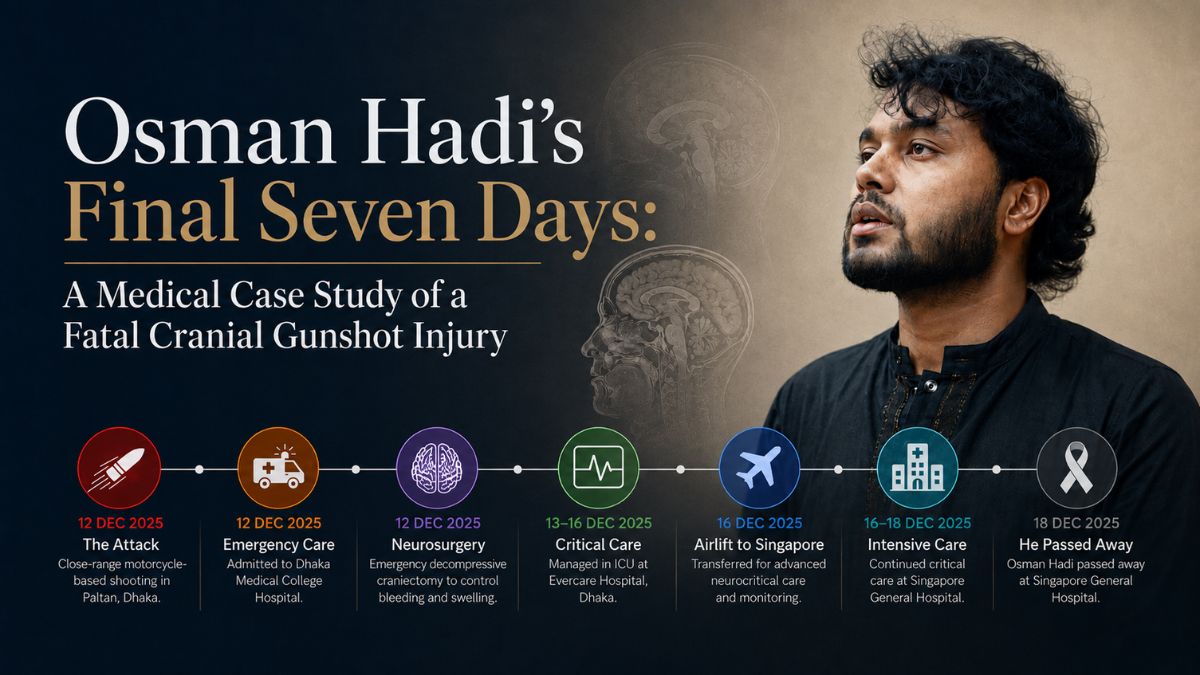
Sharif Osman Bin Hadi, a 32-year-old Bangladeshi political and youth movement figure, sustained a reported through-and-through cranial gunshot wound on 12 December 2025 while travelling in a battery-powered rickshaw in Dhaka’s Paltan/Bijoynagar area. Public reports described the incident as a close-range motorcycle-based attack. He was taken to Dhaka Medical College Hospital, underwent emergency neurosurgery, was transferred to Evercare Hospital for critical-care support, and was later airlifted to Singapore for advanced neurocritical care. He died at Singapore General Hospital on 18 December 2025. [1, 4, 5]
Published reports differ on the exact entry and exit side of the bullet. The most careful medical description is that the projectile passed through the skull and brain, with an entry wound near one ear and an exit wound on the opposite side. Reported findings included massive brain injury, a very low Glasgow Coma Scale score, artificial ventilation, brainstem involvement, heavy bleeding, decompressive skull surgery, blood pressure and heart-rate instability, and lung injury. [1, 2, 3]
This timeline focuses on the reported medical sequence: injury, emergency response, neurosurgery,
critical-care support, air ambulance transfer, and neurocritical care in Singapore.
Hadi was shot in Dhaka’s Paltan/Bijoynagar area while travelling in a rickshaw.
Media and police accounts described assailants on a motorcycle approaching the rickshaw
and firing at close range. [1, 2]
He was taken to Dhaka Medical College Hospital for emergency care. Public reporting described
a profoundly low Glasgow Coma Scale score, indicating deep unresponsiveness at presentation.
The Business Standard reported that he was taken to the operating theatre at around 3:50 pm. [1]
Emergency neurosurgery was performed to manage the catastrophic cranial injury. Reports described
decompressive skull surgery, drainage of blood and fluid, and efforts to reduce pressure inside
the skull. This type of intervention is used when swelling and bleeding threaten further brain damage. [1, 2]
After surgery, he was transferred to Evercare Hospital for advanced critical-care support.
Public reports described artificial ventilation and continued management of bleeding, pressure,
oxygenation, and unstable physiology. [1]
A 12-member medical board reportedly described his condition as very critical. New Age reported
severe brain damage, brainstem injury, blood pressure and heart-rate fluctuations, and lung injury.
These findings suggested a grave neurological and systemic condition. [3]
He was transported from Evercare Hospital to the airport by ICU ambulance and airlifted to Singapore
for advanced neurocritical care. Prothom Alo reported that the aircraft departed at around 1:55 pm.
The transfer indicated that he was considered transportable with critical-care support, not necessarily
that his neurological condition had improved. [4]
Singapore’s Ministry of Foreign Affairs stated that Hadi was evacuated to Singapore General Hospital’s
Neurosurgical Intensive Care Unit on 15 December and died on 18 December despite treatment by SGH and
the National Neuroscience Institute. International outlets including Reuters, Al Jazeera, and
Channel NewsAsia also reported that he was shot in Dhaka, flown to Singapore, and died there after
several days of life support. [5, 6, 7, 8]Timeline of Reported Events
Mechanism of Injury
A bullet that enters and exits the skull causes a perforating cranial gunshot injury. In this type of trauma, the projectile does more than create a narrow wound track. As it passes through the skull and brain, it transfers kinetic energy into surrounding tissues, directly destroys brain tissue, fractures bone, may scatter bone and bullet fragments, tears blood vessels, and can trigger rapid swelling. [9, 10]
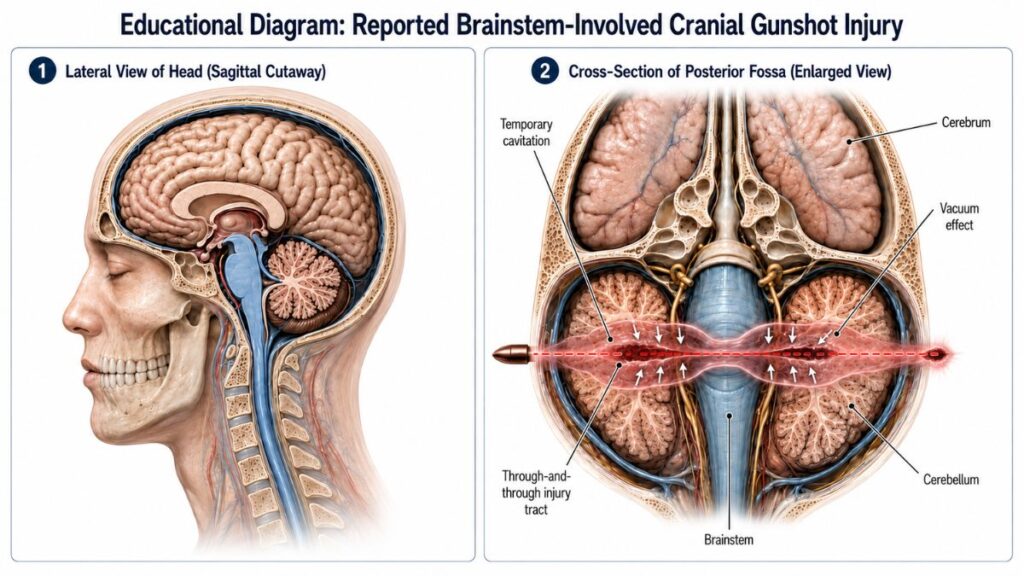
This injury pattern is especially dangerous because the brain is soft, highly vascular, and enclosed within the rigid skull. When bleeding and swelling develop inside this closed space, there is very little room for expansion. As intracranial pressure rises, blood flow to the brain may fall, injured tissue may shift, and vital structures can become compressed. In selected severe cases, doctors perform a decompressive craniectomy, removing part of the skull to give the swollen brain more room and reduce pressure-related secondary injury. [2, 9, 10]
In Hadi’s case, reported brainstem involvement was one of the gravest findings. The brainstem helps regulate breathing, heart rate, blood pressure, arousal, and basic consciousness pathways. Damage in this region can destabilize the entire body within minutes or hours. ICU treatment can temporarily support breathing, circulation, and oxygen delivery, but it cannot restore brainstem tissue that has been structurally destroyed. [3, 10, 11]
Temporary Cavitation and the “Vacuum Effect”
Doctors reportedly referred to a “vacuum effect” after the bullet passed through the brain. In medical ballistics, the more precise explanation is temporary cavitation with a brief suction effect along the wound path.
When a bullet travels through brain tissue, it creates a permanent wound track where tissue is directly crushed and destroyed. At the same time, kinetic energy from the projectile forces nearby tissue outward, creating a short-lived temporary cavity. As that cavity rapidly expands and collapses, surrounding brain tissue may be stretched, sheared, compressed, or torn beyond the bullet’s actual diameter. [9]
This explains why a cranial gunshot wound can cause damage far wider than the visible bullet path. The “vacuum effect” is a simplified way to describe part of this process, but the full mechanism includes kinetic-energy transfer, pressure-wave transmission, temporary cavity formation, cavity collapse, vascular injury, and possible suction of air, skin, hair, bone fragments, bullet fragments, or debris into brain tissue. [9]
Thermal injury from bullet heat may contribute locally, but it should not be overstated. In a fatal cranial gunshot wound, the dominant mechanisms are direct brain destruction, fragmentation, temporary cavitation, bleeding, swelling, raised intracranial pressure, and injury to vital structures such as the brainstem. [9, 12]
Pain, Awareness, and Coma
Based on published reports and accounts from people who were with Hadi, he appeared to have no normal response or clear conscious awareness immediately after the injury. In a severe cranial gunshot wound, rapid loss of consciousness is medically expected because the injury can disrupt the brain systems that maintain awareness, breathing, blood pressure, and circulation. [1, 2]
Hadi’s reported GCS 3, artificial ventilation, severe brain injury, and brainstem involvement point toward profound neurological collapse rather than organized awareness. A GCS score of 3 is the lowest possible score and indicates deep unresponsiveness. This does not prove exactly what he felt at the moment of impact, but it strongly suggests that he was unlikely to consciously experience the crowd, hospital care, ICU treatment, or later transfer like an awake patient.
If consciousness persisted for a few seconds after the shot, he may have felt sudden impact, shock, pressure, or very brief pain. However, with catastrophic brain injury and rapid unconsciousness, the window for conscious pain is usually very short, and memory formation is often lost.
This was not a simple fainting episode caused by fear, pain, or emotional shock. His unconsciousness was more likely caused by structural brain injury, bleeding, swelling, raised intracranial pressure, impaired oxygen delivery, and brainstem dysfunction.
The most responsible medical interpretation is that he may have experienced a brief moment of shock or pain at the time of injury, but the available evidence does not support seven days of conscious pain or meaningful awareness. During ICU care, sedation and analgesia may have been used as clinically needed, but his exact medication record is not public.
Emergency Treatment Priorities
In a severe cranial gunshot injury, the first priority is not simply to remove the bullet. Emergency care begins with stabilizing the patient’s airway, breathing, and circulation; controlling bleeding; maintaining oxygenation and blood pressure; and preventing secondary brain injury. Rapid neurological assessment, urgent CT imaging when possible, and early neurosurgical evaluation are also central to management. [10, 11]
AANS and UCLA Health both describe aggressive resuscitation as a key part of early care. Once oxygenation and blood pressure are supported, CT imaging can help identify the bullet path, bleeding, swelling, fragments, and possible surgical targets. Surgery is considered based on the patient’s level of consciousness, brainstem function, imaging findings, and whether there is a surgically reversible problem, such as a blood clot or pressure effect. [10, 11]
Hadi’s reported treatment appears to have followed this emergency framework. Public reports describe emergency neurosurgery, pressure-relieving skull surgery, drainage of blood and fluid, ENT management for heavy bleeding, artificial ventilation, ICU transfer, and later air ambulance evacuation for advanced neurocritical care. [1, 2, 4]
Air Ambulance Transfer and Critical-Care Stability
A common question in a case like this is why the patient was not airlifted earlier for advanced treatment abroad. The medical answer is that air ambulance transfer depends not only on how serious the injury is, but also on whether the patient can survive the journey with ICU-level support.
For air ambulance transfer, “stable” does not mean the patient is safe, improving, or close to normal. In critical care, it means the patient is stable enough to tolerate transport while receiving intensive support. A patient may still be ventilated, deeply unconscious, bleeding-prone, or at high risk of deterioration, yet be considered transportable if the airway, oxygenation, circulation, and emergency support needs can be managed during the transfer.
In Hadi’s case, earlier airlifting may not have been medically possible or safe immediately after the injury. He first needed emergency resuscitation, neurosurgical intervention, pressure-relieving skull surgery, drainage of blood and fluid, airway and ventilator support, and stabilization for transport. Prothom Alo reported that he left Evercare Hospital in an ICU ambulance and was flown to Singapore by air ambulance. [4]
The transfer should not be interpreted as proof of recovery. It means the treating team considered him transportable enough to attempt advanced neurocritical care abroad. In a catastrophic cranial gunshot injury, air ambulance transfer can expand access to specialized care, but it cannot reverse brain tissue that has already been destroyed.
Prognosis and Survival Possibility
Cranial gunshot wounds have a very high fatality rate. AANS states that gunshot wounds to the head are fatal about 90% of the time, while UCLA Health states that cranial gunshot wounds carry a fatality rate greater than 90%. Prognosis depends on several factors, including the initial Glasgow Coma Scale score, brainstem function, blood pressure, oxygenation, swelling, vascular injury, and the bullet’s path through the brain. [10, 11]
Reported Poor Prognostic Factors
These factors are based on publicly reported details and are presented for educational interpretation only.
These reported factors collectively suggest an extremely low chance of meaningful neurological recovery. Some people do survive gunshot wounds to the head, but those cases are usually medically different. Survival is more likely when the bullet path is limited, avoids the brainstem and major blood vessels, does not cross multiple critical brain regions, and the patient arrives with better neurological function. Hadi’s reported injury pattern was far more severe than the rare survival scenarios often discussed publicly. [9, 10, 11]
This does not mean doctors could ethically declare the outcome hopeless without full imaging, serial neurological examinations, pupil and brainstem reflex assessment, oxygenation records, and operative findings. However, based on the public reports and neurosurgical guidance, his prognosis appeared extremely poor from the beginning.
Was Death Inevitable?
No responsible medical interpretation should describe death as “inevitable” without access to the full CT report, operative findings, pupil responses, brainstem reflexes, blood pressure records, oxygenation records, medication chart, ventilator data, and serial neurological examinations.
However, the publicly available reports and neurosurgical guidance indicate a near-fatal prognosis. If the brainstem damage was severe and irreversible, ICU treatment could temporarily support breathing, circulation, oxygen delivery, and blood pressure, but it could not restore brainstem tissue that had been structurally destroyed. [10, 11]
The doctors were not simply waiting for death. They were treating the secondary cascade that follows catastrophic brain injury: bleeding, swelling, raised intracranial pressure, reduced oxygen delivery, cardiovascular instability, and systemic complications. Based on public reports, the primary injury appears to have been too deep, too extensive, and too vital to reverse.
Why He Survived for Several Days
Hadi survived for several days because intensive care can temporarily support essential body functions after catastrophic brain injury. Mechanical ventilation can move oxygen into the lungs when the brain can no longer regulate breathing reliably. ICU treatment can also support blood pressure, manage bleeding, reduce swelling, drain blood or fluid, treat complications, and monitor neurological deterioration.
Survival for several days does not necessarily mean the brain was recovering. In severe brain injury, the body may remain biologically alive with ventilator and ICU support even while hemorrhage, swelling, raised intracranial pressure, reduced brain perfusion, and brainstem dysfunction continue to progress.
In Hadi’s case, the reported brainstem involvement, severe swelling, artificial ventilation, and unstable physiology suggest that life support was maintaining essential body functions while the underlying neurological injury remained extremely severe.
Final Medical Interpretation
Sharif Osman Hadi’s case appears, based on public reports, to have been a fatal perforating traumatic brain injury caused by a cranial gunshot wound with reported brainstem involvement. The likely medical sequence included direct brain destruction, skull fracture and bone-fragment injury, vascular injury, temporary cavitation, pressure-wave damage, hemorrhage, severe swelling, raised intracranial pressure, brainstem dysfunction, cardiorespiratory instability, and eventual death despite neurosurgical and ICU support.
The public evidence does not support the idea of a prolonged, conscious seven-day experience. It points to something medically more tragic: he remained biologically alive for several days, but he was very likely beyond meaningful awareness for most of that period.
Closing Reflection
He did not get the chance to describe his pain, fear, or final thoughts. What remains is the silence of a patient who could no longer speak, and the grief of people trying to understand how one bullet could end so much hope.
Medical References
Update History
Originally written by Medicalic.
Your answer helps us improve the clarity and usefulness of our health content.