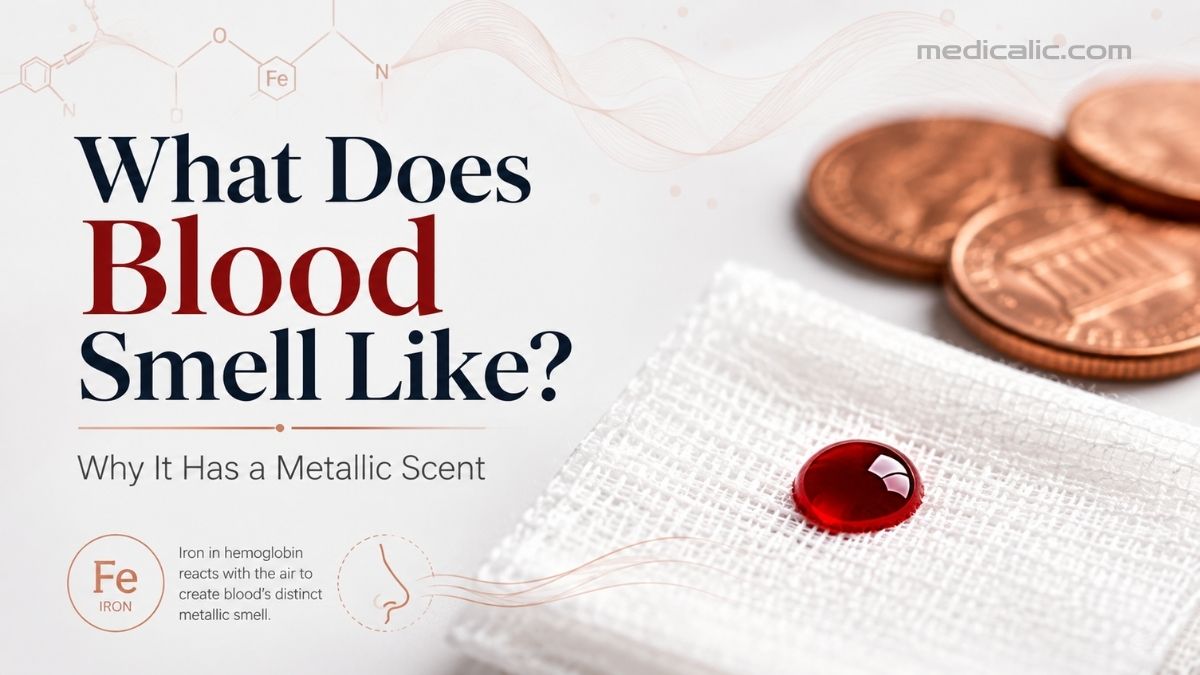
That sharp metallic smell is easy to recognize. Whether it comes from a paper cut, a nosebleed, or menstrual bleeding, fresh blood is often described as coppery, iron-like, or similar to the scent left on your hands after handling coins.
If you have ever noticed that smell and wondered what you are actually detecting, the answer is more complex than simply “blood contains iron.”
The familiar metallic odor comes from a mixture of volatile compounds. Some form through iron-related reactions involving fats, especially when blood contacts the skin, while others are part of blood’s own odor profile—including trans-4,5-epoxy-(E)-2-decenal, or E2D.
So what is considered a normal blood smell, why does it change, and when can an unusual odor point to something else?
Key Takeaways
- Fresh blood commonly smells metallic, coppery, or coin-like.
- The scent comes from volatile compounds and iron-related chemical reactions—not simply from smelling iron itself.
- Menstrual blood can normally smell mildly metallic, while a persistent fishy odor may point to a vaginal condition such as BV.
- A foul-smelling wound with redness, pain, swelling, drainage, or fever needs medical attention.
- Repeatedly smelling blood or metal when no source is present may reflect a smell disorder such as phantosmia.
What Does Blood Smell Like?
The smell is usually described as metallic or coin-like, although the exact impression varies from person to person.
Some people notice the metallic note immediately; others pick up a slightly earthy or musty quality.
That variation is not surprising. Smell depends partly on individual sensitivity, and blood does not release just one odor molecule. Its overall scent comes from a mixture of volatile organic compounds, or VOCs—small molecules that can enter the air and reach odor receptors in the nose.
That metallic impression has a chemical explanation.
Why Does Blood Smell Metallic?
Red blood cells contain hemoglobin, the protein that carries oxygen throughout the body. Hemoglobin contains iron, which is one reason blood and iron have long been associated with the same metallic smell.
But iron itself does not simply evaporate from blood and travel into your nose as an odor.
Research into the familiar smell produced when skin contacts iron has found that iron can react with substances in skin oils, particularly lipid peroxides. These reactions create volatile aldehydes and ketones that our noses can detect. One important odorant identified in this process is 1-octen-3-one, which has a mushroom-like, metallic smell.[1]
The same basic chemistry helps explain the metallic smell left on your fingers after handling coins or iron objects, and it can also occur when blood contacts skin. But it is only part of blood’s odor.
What Makes Blood’s Odor So Distinctive?
Blood’s odor is not limited to what happens on the skin. One compound researchers have studied closely is trans-4,5-epoxy-(E)-2-decenal (E2D), which forms through lipid peroxidation.
E2D has been described as producing a strongly metallic, blood-like odor. Humans can detect it at extremely low concentrations, which helps explain why even a relatively small amount of blood may sometimes have a recognizable scent.
Researchers studying blood odor in animals have also found that E2D can produce behavioral responses similar to those triggered by whole mammalian blood.[2] This does not mean that E2D alone accounts for everything humans recognize as blood odor. Blood contains many volatile compounds, and the final smell reflects their combined effects.
Does Fresh Blood Smell Different From Dried Blood?
It can. As blood ages and dries, its volatile odor profile changes. Fresh blood may smell distinctly metallic, while dried blood can seem weaker, stale, or less recognizable. The surface matters too: blood on skin mixes with sweat and natural oils, while blood on clothing can interact with fabric, moisture, detergent, and microorganisms.
A change in smell matters more when it appears alongside other symptoms. The sections below explain what to watch for in menstrual bleeding, wounds, and gastrointestinal bleeding.
What Does Period Blood Smell Like?
A mild metallic or blood-like odor during menstruation is common. Menstrual fluid contains blood along with endometrial tissue, cervical mucus, and vaginal secretions, so its scent may also seem slightly musky or different from blood from a small cut.
A strong fish-like odor, however, deserves more attention—especially when it is persistent or accompanied by unusual discharge, itching, irritation, or burning.
One possible cause is bacterial vaginosis (BV), a common condition caused by an imbalance in vaginal bacteria. The U.S. Centers for Disease Control and Prevention lists a strong fish-like vaginal odor, particularly after sex, among possible symptoms of BV.[3]
A fishy smell does not automatically mean BV, but if it is new, persistent, or comes with discharge, itching, or irritation, it is worth getting checked.
What Should Blood From a Wound Smell Like?
A fresh cut may have the familiar mild metallic smell of blood.
A new foul smell from the wound itself is different, especially when the wound is becoming more painful, red, swollen, or draining.
Possible signs of wound infection include:[4]
- pus or increasing drainage
- bad or foul odor
- increasing redness
- warmth or swelling
- worsening tenderness or pain
- fever or chills
If the wound is worsening instead of gradually healing, it should be evaluated. Rapidly spreading redness, severe pain, high fever, confusion, or uncontrolled bleeding warrants urgent care.
Can You Smell Blood in Stool?
You cannot reliably identify blood in stool by smell. Bleeding higher in the digestive tract can cause melena—typically black, tarry stool that may also have an unusually strong odor.[5]
Not every dark stool means internal bleeding. Iron supplements, bismuth-containing medicines, and some foods can also make stool look black.
Black tarry stool can signal gastrointestinal bleeding, particularly when it occurs with dizziness, fainting, shortness of breath, red blood in the stool, or vomiting blood or coffee-ground-like material. These symptoms warrant prompt medical attention.
Why Do I Smell Blood When There Is No Blood?
If a metallic or blood-like smell appears when there is no obvious source, one possibility is phantosmia—perceiving an odor that is not actually present.[6]
Phantom odors vary widely. People may describe smoke, burning, chemicals, metal, or other unusual smells.
Phantosmia can occur after an upper respiratory infection or head injury and may also be associated with sinus inflammation, certain medications, seizures, Parkinson’s disease, and other conditions. Mayo Clinic recommends discussing persistent phantosmia with a healthcare professional so that potentially important causes can be assessed.
There is also a related condition called parosmia. With parosmia, a real odor is present, but your brain perceives it differently from the way it smelled before.
An occasional unexplained smell may be harmless. If it keeps returning, lasts, affects eating or daily life, or started after a head injury, mention it to a healthcare professional.
Does Blood Smell Reveal Your Iron Level?
No. Although iron-related chemistry contributes to the metallic scent, the smell of blood tells you nothing reliable about whether your iron stores are low, normal, or high.
Doctors evaluate iron status using symptoms, medical history, and appropriate blood tests, which may include hemoglobin, ferritin, serum iron, total iron-binding capacity, and transferrin saturation.[7]
A stronger metallic smell does not mean you have excess iron, just as barely noticing an odor does not suggest iron deficiency.
When Should an Unusual Blood-Related Smell Be Checked?
A metallic smell by itself is rarely the important part. Get medical advice when an unusual odor comes with signs of infection, abnormal vaginal discharge, or a wound that is getting worse.
Seek urgent care for uncontrolled bleeding, vomiting blood, black tarry stool with significant symptoms, fainting, severe dizziness, shortness of breath, confusion, or other signs of major blood loss.
Blood in urine does not have a specific, reliable smell. Urine odor can change for many reasons, so visible pink, red, or brown urine should be evaluated rather than judged by smell alone.
Miscarriage blood usually does not have a unique smell and may smell mildly metallic like other blood. A foul odor, especially with fever, severe pain, or heavy bleeding, needs medical attention.
The Bottom Line
Blood usually has a metallic, coin-like smell, but the odor comes from volatile chemicals and iron-related reactions rather than from simply “smelling iron.” A mild metallic scent is usually expected; a new foul or fishy odor matters more when it appears with infection symptoms, unusual bleeding, or other changes.
Medical References
Update History
New medical references added.
Originally written by Dr. Jubair Islam.
Your answer helps us improve the clarity and usefulness of our health content.