When you have celiac disease or gluten sensitivity, even a simple trip to the grocery store can leave you second-guessing your food choices. And cornstarch? It’s hiding in more everyday foods than you might realize, from creamy soups and sauces to your favorite desserts.
So, is cornstarch gluten free? In the next five minutes, we’ll show you what to look for on food labels, so you can avoid unnecessary risks without giving up the foods you love.
Is Cornstarch Naturally Gluten-Free?
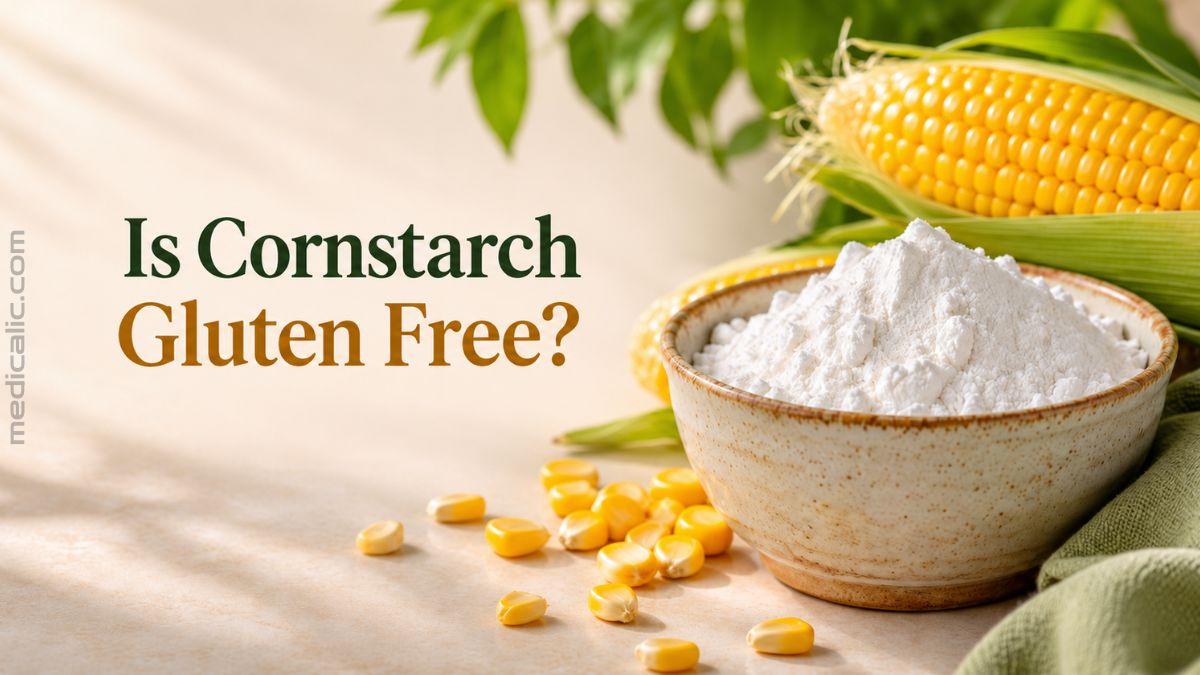
Yes, pure cornstarch is naturally gluten-free. It comes from corn, which doesn’t contain the gluten proteins found in wheat, barley, or rye.
Cornstarch is made from the endosperm, the starch-rich center of a corn kernel. During processing, most of the protein and fiber are removed, leaving behind the fine white powder commonly used in cooking.
So, cornstarch itself isn’t the concern. What matters is what happens during processing and packaging, when gluten cross-contact can sometimes occur.
Is It Safe If You Have Celiac Disease?
For most people with celiac disease, yes. Cornstarch is so highly refined that the risk of gluten cross-contact during production is considered low, which is why plain cornstarch doesn’t need a gluten-free label to be suitable for a gluten-free diet.
Still, cross-contact can happen when gluten-free food touches gluten through shared equipment, utensils, or surfaces. At home, clean spoons, bowls, and countertops go a long way. If you’re unsure about a particular product, check with the manufacturer.
But cornstarch is rarely the ingredient you need to worry about. Other ingredients in the same packaged food may contain gluten, which is why reading the full label matters.
How to Read Cornstarch Labels
Reading food labels doesn’t have to be complicated. Here are three things to check.
Check the ingredients. Plain cornstarch usually contains just one ingredient: corn starch. But in packaged foods like soups, sauces, and gravy mixes, it may appear alongside wheat flour or other gluten-containing ingredients. Always check the full list.
Look for a gluten-free claim. In the U.S., foods labeled “gluten-free” must meet FDA requirements, including containing less than 20 parts per million (ppm) of gluten. Third-party certification offers extra reassurance, but it isn’t required. And remember, plain cornstarch can be suitable for a gluten-free diet even without the label.
Don’t rely on wheat warnings alone. U.S. food labeling rules require wheat to be declared when used as an ingredient, but barley and rye aren’t covered by the same allergen-labeling requirement. So, the absence of a “Contains Wheat” statement doesn’t guarantee a product is gluten-free.
It’s also worth checking labels each time you shop, since ingredients can change.
But here’s an important distinction: cornstarch, corn flour, and cornmeal don’t all carry the same risk of gluten cross-contact.
Cornstarch, Corn Flour, and Cornmeal Are Not Twins
All three start as corn, yet they’re processed differently, and that changes the risk.
| Ingredient | What it is | Gluten-free note |
|---|---|---|
| Cornstarch | Refined starch from the corn kernel | Naturally gluten-free; low cross-contact risk |
| Corn flour (U.S.) | Finely ground whole corn | Naturally gluten-free; cross-contact during processing is a bigger concern |
| Cornmeal | Coarsely ground corn | Naturally gluten-free; choose a gluten-free label if you have celiac disease |
| Cornflour (U.K.) | What Americans call cornstarch | Naturally gluten-free when made from corn |
The numbers explain the caution. In testing, roughly one in six corn flour samples came in above the 20 ppm gluten limit. That finding is about corn flour, not cornstarch, so it says nothing about how often cornstarch is contaminated. It does explain why people with celiac disease are encouraged to pick corn flour and cornmeal that carry a gluten-free label.
One tip for recipe hunters: if a British recipe calls for “cornflour,” it almost always means what you’d call cornstarch.
Then there’s a word that makes many shoppers flinch: modified.
What About “Modified” Cornstarch?
Usually, it’s fine. Modified cornstarch is simply starch that has been treated physically, chemically, or with enzymes so it behaves better in food, for instance by holding its texture through heating or freezing. “Modified” doesn’t mean gluten has been added.
The wording is what matters. “Modified corn starch” names corn as the source. “Modified food starch” is broader and can come from other plants, including wheat. In the U.S., a wheat-based starch generally has to say so on the label.
Here’s a subtle point worth knowing. Specially processed wheat starch can meet gluten-free standards, but that doesn’t make it automatically suitable for someone with a wheat allergy, because celiac disease and wheat allergy involve different immune responses. If wheat allergy is part of your story, let your allergist, not a gluten-free label, guide you.
Once you know what’s safe, the fun part begins.
Putting Cornstarch to Work in a Gluten-Free Kitchen
This is where cornstarch earns its place. Gravy, stir-fry sauces, fruit fillings, and puddings all love it.
The one rule worth memorizing is to dissolve it in cold water before it meets anything hot. That mixture, called a slurry, keeps cornstarch from clumping into stubborn little lumps. Stir it in, heat until the liquid bubbles gently, and watch it thicken.
Cornstarch is also a stronger thickener than wheat flour, so start with about half the amount a flour-based recipe calls for and adjust from there.
Baking is a different story. Cornstarch softens the crumb and adds tenderness, but it can’t build the structure that gluten gives bread. Think of it as a supporting player in a gluten-free flour blend rather than a one-to-one swap for wheat flour. And always glance at the rest of the recipe, because gluten-free cornstarch can’t rescue a cake that still contains regular flour.
Gluten-free is one question. Whether cornstarch suits your everyday diet is another, and we cover that in Is Cornstarch Bad for You?
Back to the Stove
Gluten-free living isn’t about fearing every ingredient. It’s about knowing which questions are worth asking and which ones you can let go of. Cornstarch happens to be one of the easy ones. So take that white box out from behind the spices, whisk up your slurry, and make the sauce you’ve been quietly wanting.
Update History
Originally written by Arooj Ahsan, RDN.
Your answer helps us improve the clarity and usefulness of our health content.