Shaky hands, sweating, sudden hunger or confusion can make you wonder whether your blood sugar has dropped. Anxiety, dehydration and medication effects can feel similar. Confusion can also result from an infection, a neurological condition or severe fatigue.
Doctors use Whipple’s triad to determine whether these symptoms are caused by low blood sugar, also called hypoglycemia.
What Is Whipple’s Triad?
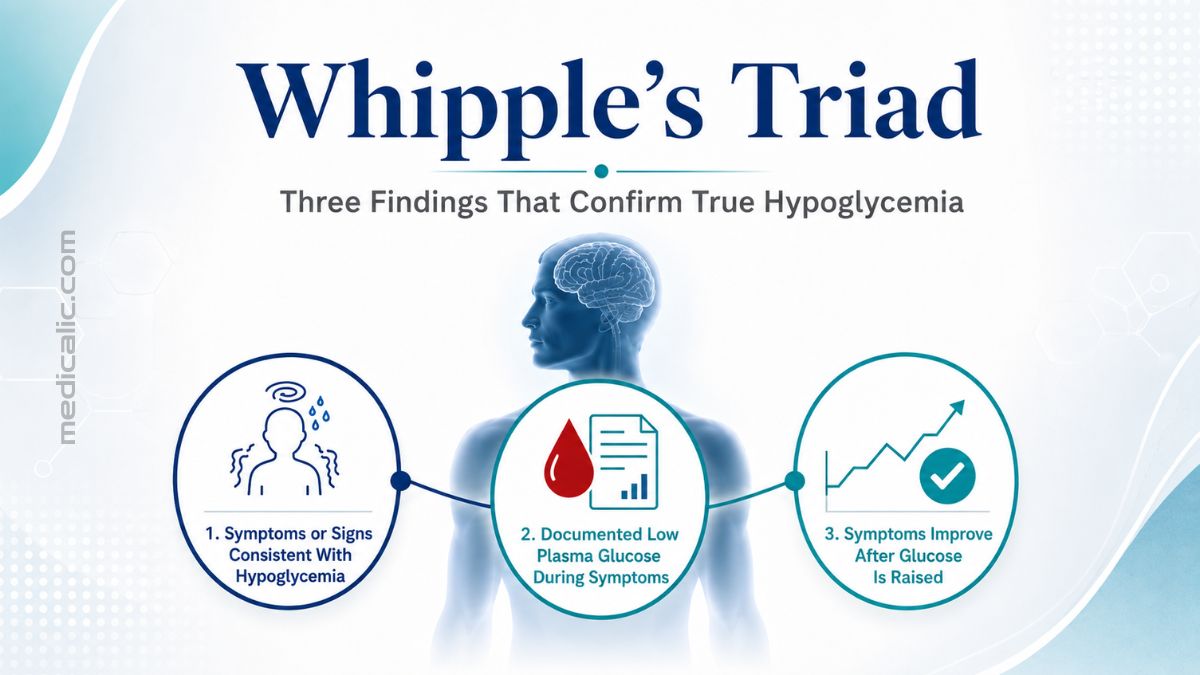
Whipple’s triad connects an episode of symptoms to a confirmed low glucose level. It has three parts:[1]
- Symptoms or signs that fit hypoglycemia.
- Low plasma glucose measured while those symptoms are happening.
- Symptoms improve after glucose is raised.
Together, these findings help doctors establish that low glucose caused the episode. They do not explain why it happened. That comes from further evaluation.
This distinction helps avoid unnecessary fasting studies, scans or invasive tests for symptoms that may have another explanation. An incomplete triad means the cause remains uncertain; it does not mean the symptoms should be dismissed.
Whipple’s triad was historically linked to insulinoma, a rare insulin-releasing pancreatic tumour, and is now used more broadly to evaluate suspected hypoglycemia.
Note: Whipple’s triad concerns low blood glucose. Whipple disease is a separate bacterial infection caused by Tropheryma whipplei.
The Three Parts, Explained
1. Symptoms That Fit Low Blood Sugar
Hypoglycemia can produce two broad groups of symptoms. Autonomic or neurogenic symptoms are the body’s warning response to falling glucose. Neuroglycopenic symptoms occur when the brain does not have enough glucose to function normally.
| Body’s warning symptoms | Symptoms affecting brain function |
|---|---|
| Shaking or tremor | Confusion or unusual behaviour |
| Sweating | Blurred vision |
| Hunger | Difficulty speaking |
| Palpitations, or a racing heartbeat | Weakness or poor coordination |
| Tingling | Seizure |
| Anxiety or a sense of unease | Loss of consciousness |
Severe episodes can cause injury and need urgent treatment. Some people stop noticing their usual warning signs after repeated lows, particularly during insulin treatment. This is called impaired hypoglycemia awareness, and it increases the risk of severe hypoglycemia.[2]
2. Low Glucose Measured During the Episode
The timing of the measurement matters: glucose needs to be low while the symptoms are present. Plasma glucose refers to glucose measured in the liquid part of the blood.
In adults without diabetes, symptoms often appear around 55 mg/dL (3.0 mmol/L). This is a useful reference point, but there is no single number that defines hypoglycemia in every person and situation. Doctors also consider medicines, illness, symptom timing and how reliably glucose was measured. An unexpected low result may need confirmation.
If laboratory plasma glucose is clearly normal during the symptoms, another explanation is more likely.
For people with diabetes, hypoglycemia is classified differently:[3]
| Level | Glucose level or clinical description |
|---|---|
| Level 1 | Below 70 mg/dL (3.9 mmol/L), but at least 54 mg/dL (3.0 mmol/L) |
| Level 2 | Below 54 mg/dL (3.0 mmol/L) |
| Level 3 | Severe changes in mental or physical functioning that require another person’s help, regardless of the measured glucose level |
A reading below 70 mg/dL is an important treatment alert for someone taking insulin or certain diabetes medicines. It is not a universal diagnostic cutoff for Whipple’s triad in someone without diabetes.
3. Symptoms Improve After Glucose Is Raised
Imagine someone becomes shaky and confused. A blood sample taken during the episode confirms low glucose. After glucose is given, the symptoms resolve. All three parts of the triad are present.
Feeling better after a snack, on its own, is not enough to establish this connection. The low glucose level also needs to be documented during the symptoms.
Treatment must not wait for formal documentation if someone is severely confused, having a seizure, losing consciousness or unable to swallow safely.
Can a Home Glucose Meter or CGM Confirm It?
Home glucose meters and continuous glucose monitors (CGMs) help identify patterns and guide treatment for people with diabetes. But they cannot replace reliable laboratory plasma glucose testing when diagnosing a hypoglycemic disorder in someone without diabetes.[4]
Meters are less accurate at very low glucose levels. CGMs measure glucose in the fluid between cells rather than directly in blood, so readings may differ when glucose is changing quickly. Pressure on a sensor during sleep can also create a falsely low reading, often called a compression low.[5]
Keep a brief record to help your doctor identify a pattern:
- When symptoms started.
- What you last ate and when.
- Recent exercise or alcohol use.
- Medicines and supplements.
- The glucose reading and device used.
- Any treatment you took and how quickly you improved.
What to Do During a Suspected Low
If you have diabetes, are awake and can swallow safely, follow your personal hypoglycemia plan. This often involves 15–20 grams of fast-acting carbohydrate, followed by another glucose check after 15 minutes. Repeat treatment if glucose remains below the target in your plan, and seek care if the low persists.[6]
Options include glucose tablets or gel, juice, regular sugar-containing soda or sugar. Chocolate and other high-fat foods act more slowly and are not ideal for the first treatment.
If someone is unconscious, having a seizure or unable to swallow safely, call emergency services—911 in the United States or the local emergency number elsewhere. Do not give food or drink. Give glucagon if it is available and you know how to administer it.
Also seek emergency help for:
- Severe confusion or unusual behaviour.
- Glucose that stays low despite treatment.
- Suspected insulin or diabetes-medication overdose.
- Hypoglycemia during a serious illness.
If symptoms start while driving, pull over safely and stop driving. Get help rather than continuing to drive while unwell.
Recurring episodes need medical assessment, especially if you do not have diabetes, are not taking glucose-lowering medicines or have been repeatedly treating unexplained symptoms with sugar.
What Can Cause Confirmed Hypoglycemia?
Once low glucose has been linked to the symptoms, doctors look for the cause. They consider diabetes treatment, other medicines, nutrition, alcohol use, illness and whether episodes occur during fasting or after meals.[7]
In insulin-mediated hypoglycemia, insulin keeps lowering glucose even though glucose is already low. Other causes involve problems with glucose supply or the body’s ability to maintain it.
| Insulin-mediated causes | Other causes |
|---|---|
| Insulin or insulin-releasing medicines, such as sulfonylureas or meglitinides, including accidental, unrecognised or intentional exposure | Liver or kidney disease, or critical illness |
| Excess insulin made within the body, including insulinoma | Alcohol without adequate food; prolonged fasting or undernutrition, especially when stored glucose or glucose production is impaired |
| Hypoglycemia after bariatric surgery | Hormone deficiencies, including adrenal insufficiency |
| Insulin autoimmune syndrome and other rare disorders involving excess insulin activity | Rare non-islet-cell tumours or other metabolic disorders |
How Doctors Investigate the Cause
When the cause is unclear, doctors may collect a critical blood sample while glucose is low. When safe, this is taken before glucose is given, without delaying urgent treatment.[8]
Tests commonly include:
- Laboratory plasma glucose to confirm the low level.
- Insulin, interpreted alongside glucose.
- C-peptide, a marker of insulin made by the pancreas.
- Proinsulin, a precursor of insulin.
- Beta-hydroxybutyrate, a ketone that helps show the body’s response.
- A screen for sulfonylureas and meglitinides, medicines that stimulate insulin release.
During hypoglycemia, insulin that is too high for the glucose level together with low C-peptide may suggest injected insulin. If both insulin and C-peptide are inappropriately high, the pancreas may be releasing excess insulin, either on its own or in response to an insulin-releasing medicine. The ketone result and medication screen help doctors distinguish these possibilities.
Doctors may also test for insulin antibodies. This sample does not necessarily need to be collected during a low-glucose episode.
If Episodes Happen During Fasting
If an episode cannot be captured naturally, a doctor may arrange a supervised fast lasting up to 72 hours. Glucose and related markers are monitored in a controlled medical setting.
Do not deliberately skip food to trigger symptoms at home. This can be dangerous and may not provide reliable diagnostic information.
If Episodes Happen After Meals
A doctor may recommend a supervised mixed-meal test, using a meal designed to reproduce the usual trigger.
An oral glucose tolerance test is not recommended for investigating suspected post-meal hypoglycemia. A glucose drink can produce misleading results that do not reflect the response to an ordinary mixed meal.
The test results guide treatment for the underlying cause. Your doctor can then help you plan how to prevent and respond to future episodes.
Medical References
Update History
Redundant content removed.
New information added to improve completeness.
Existing medical references updated.
Medically reviewed by Dr. Rahul Kushwaha.
Originally written by Dr. Jubair Islam.
Your answer helps us improve the clarity and usefulness of our health content.