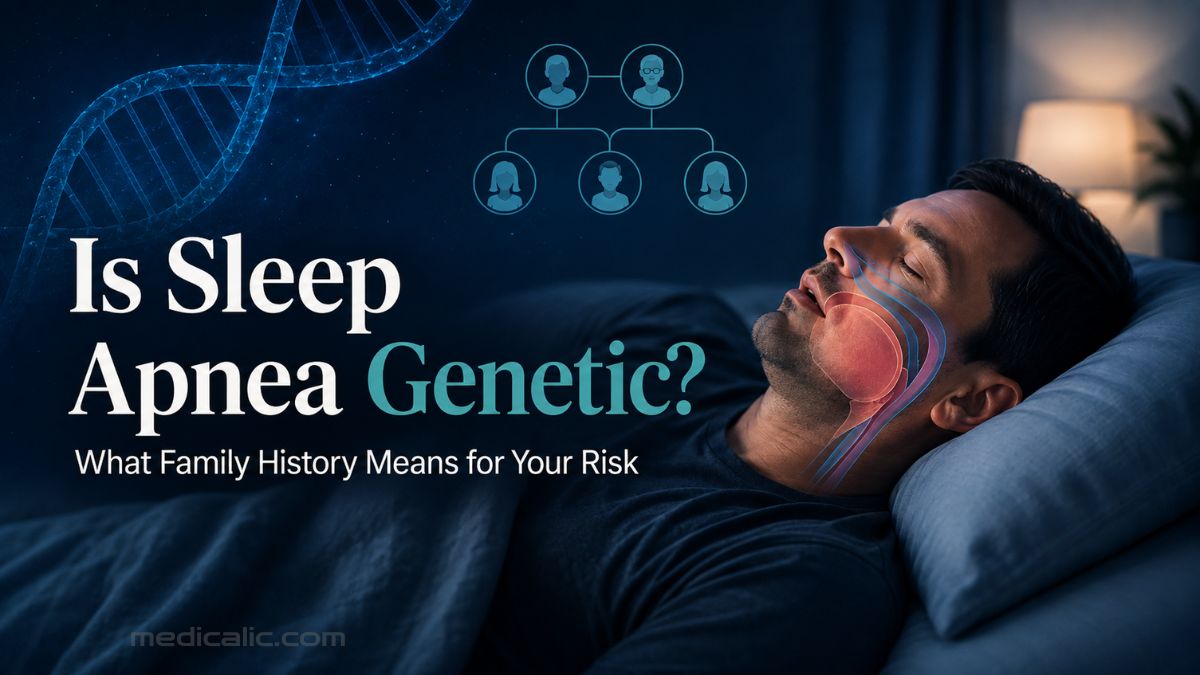
A parent uses a CPAP machine. A sibling snores loudly and wakes feeling exhausted. So when you begin struggling with unrefreshing sleep or daytime fatigue, an uncomfortable question may arise: Is sleep apnea in my genes, and am I destined to develop it too?
Sleep apnea can run in families, but DNA is not destiny.
There is no single, inevitable “sleep apnea gene.” Instead, you may inherit traits such as a narrower airway, a smaller jaw, differences in breathing control, or how your body tends to store fat—factors that can make obstructive sleep apnea (OSA) more likely to develop.
A family history of OSA may increase your risk, but it does not mean that you will inevitably develop the condition or require CPAP treatment. Here is what research shows about the genetics of sleep apnea, which symptoms to watch for, and when an evaluation may be helpful.
How Genes May Raise Obstructive Sleep Apnea Risk
OSA occurs when the upper airway repeatedly narrows or closes during sleep, reducing or temporarily stopping airflow despite continued efforts to breathe. These events can disrupt sleep and lower oxygen levels.
Several inherited traits can make the airway more vulnerable to collapse.
Jaw, face, and airway structure
Inherited physical traits can affect the size and shape of the skull, face, jaw, tongue, and upper airway.
A smaller or recessed lower jaw, a relatively large tongue, or a naturally narrow throat may leave less room for air to move. When the throat muscles relax during sleep, the airway may then collapse more easily.
The National Heart, Lung, and Blood Institute lists family history and inherited craniofacial and airway features among sleep apnea risk factors.[1]
This is one reason a teen or adult can have OSA without having obesity. Weight matters for many people, but it is not the whole story.
Body weight and fat distribution
Obesity is an important risk factor for OSA, and genetic differences can influence appetite, metabolism, and where the body tends to store fat.
Tissue around the neck and tongue may crowd the airway, while abdominal fat may affect breathing mechanics. Genetic studies also show considerable overlap between the biology of body mass index and OSA.[2]
That does not make OSA a personal failure. Two people with similar body weights may have very different airway anatomy and levels of risk.
An inherited vulnerability may remain unnoticed for years. Weight changes, aging, menopause, alcohol, sedating medications, or persistent nasal obstruction may later make an already vulnerable airway more likely to collapse.
Still, airway anatomy and body weight are only part of the story.
Breathing control and airway-muscle response
The brain and nervous system continually adjust breathing during sleep. They also help activate the muscles that keep the throat open.
Inherited differences may affect breathing stability, how easily a person wakes when airflow falls, and how strongly the upper-airway muscles respond to narrowing. Together, these pathways help explain why inherited risk is real but difficult to reduce to a single gene or number.
Is Sleep Apnea a Genetic Disorder—and How Hereditary Is It?
Common OSA is not a single-gene disorder. Its risk reflects the combined effects of many genetic variants and non-genetic influences.
Researchers use heritability to estimate how much variation in a trait across a particular population is associated with genetic differences.
One large family study estimated that inherited differences explained roughly 33% to 37% of variation in the apnea-hypopnea index, or AHI. This measurement reflects how many times breathing stops or becomes substantially reduced per hour of sleep.[2] Other family and twin studies have produced different estimates because they used different populations, definitions, measurements, and statistical methods.
These percentages do not mean that a certain share of one person’s sleep apnea was “caused by genes.” Heritability is a population statistic, not a personal risk score.
Large genomic studies have identified many genetic regions associated with OSA rather than one dominant “sleep apnea gene.” An emerging 2025 preprint involving more than 1.6 million participants reported 147 OSA-associated genetic loci, further supporting a complex genetic basis.[3] The findings had not undergone formal journal peer review at the time of writing.
Is Central Sleep Apnea Genetic?
Most of the familial evidence above applies to obstructive sleep apnea. Central sleep apnea is different: its common forms are not usually inherited like a classic genetic disorder.
Central sleep apnea occurs when respiratory drive becomes unstable or inadequate during sleep. It may be associated with heart failure, stroke, high altitude, certain neurological conditions, advanced kidney disease, or medications and substances that suppress breathing—particularly opioids.[4]
A rare inherited breathing-control disorder sometimes discussed alongside central sleep-related breathing disorders is congenital central hypoventilation syndrome (CCHS). It is usually linked to disease-causing changes in the PHOX2B gene and affects automatic breathing, often beginning in infancy, although later-onset cases can occur. The condition generally follows an autosomal dominant inheritance pattern, although many cases result from a new (de novo) genetic change and therefore occur without an obvious family history.[5]
PHOX2B-related hypoventilation is distinct from ordinary OSA and from the central sleep apnea typically diagnosed in adults.
Is Sleep Apnea Genetic in Babies, Children, and Teens?
Family history can still matter in children, but pediatric OSA often has different drivers than adult OSA. Mention it to the child’s pediatrician, especially when symptoms are present.
In children, enlarged tonsils or adenoids are common contributors to OSA. Other risk factors include obesity, a small jaw or narrow airway, reduced muscle tone, and certain craniofacial, neuromuscular, or genetic conditions.
Possible signs in children and teens include:
- Frequent, loud snoring
- Pauses in breathing, gasping, or choking during sleep
- Mouth breathing
- Restless or sweaty sleep
- Bedwetting after a child had previously stayed dry
- Morning headaches
- Irritability, hyperactivity, or difficulty paying attention
- Daytime sleepiness, which may be especially noticeable in teens
- Learning, school-performance, or growth concerns
Not every child who snores has sleep apnea. Clinical guidelines recommend further evaluation when a child regularly snores and has other signs or symptoms suggesting OSA. Polysomnography is generally used when pediatric OSA is suspected, while snoring recordings and online symptom checkers cannot confirm the diagnosis.[6]
Seek urgent medical care if a baby turns blue, appears to stop breathing, struggles to breathe, or is unusually difficult to wake. Recurrent feeding problems, shallow breathing, or unusual pauses also require prompt pediatric evaluation.[7,8]
Can a DNA Test Diagnose Sleep Apnea?
Even with a strong family history, common obstructive sleep apnea cannot be diagnosed with a consumer DNA test.
Researchers have developed polygenic risk scores that combine information from many genetic variants, but these are primarily population-level research tools.[9] They cannot show whether your airway is currently closing during sleep, how often breathing is interrupted, or how much your oxygen level changes.[9,10]
Diagnosis starts with a medical and sleep history, including symptoms, risk factors, medications, and family history. A sleep study helps determine whether sleep apnea is present, which type it is, and how severe it may be.
In adults, polysomnography is the standard diagnostic test. A properly ordered home sleep apnea test may be appropriate for selected adults with a high likelihood of moderate to severe OSA, but it is not suitable for every patient. If a home test is negative or inconclusive despite concerning symptoms, further evaluation with an in-lab sleep study may still be needed.[10]
Genetic testing may be considered only when a clinician suspects a specific inherited syndrome, such as PHOX2B-related congenital central hypoventilation syndrome.
What to Do When Sleep Apnea Runs in Your Family
The practical takeaway is simple: family history should make you more observant, not more afraid.
Watch for symptoms that matter now:
- Habitual loud snoring
- Witnessed breathing pauses or waking with gasping or choking
- Unrefreshing sleep or excessive daytime sleepiness
- Morning headaches or dry mouth
- Falling asleep during work, conversations, or driving
Talk with a healthcare professional when these symptoms are present, particularly if a close relative has OSA.
Do not drive when you are dangerously sleepy. Sleep apnea-related drowsiness is associated with a higher risk of crashes and other accidents.
While genes cannot be changed, some contributors can be addressed. Depending on the person, helpful steps may include:
- Getting regular physical activity
- Reaching or maintaining a healthy weight where appropriate
- Limiting alcohol near bedtime
- Avoiding smoking and secondhand smoke
- Treating persistent nasal obstruction
- Changing sleep position when recommended
Do not stop a prescribed sedating medicine or opioid without speaking with the prescriber.
Treatment is not one-size-fits-all. Options may include positive airway pressure such as CPAP, a custom oral appliance, positional therapy, weight-management support, treatment of enlarged tonsils or adenoids, or selected surgical procedures.
The right approach depends on age, airway anatomy, OSA severity, other health conditions, and personal preferences.
Frequently Asked Questions
It can appear unevenly across generations because relatives may inherit different combinations of risk traits and have different health or environmental exposures. This is not a predictable genetic “skipping” pattern.
No. Testing is generally guided by symptoms, clinical risk factors and a healthcare professional’s assessment—not family history alone.
The Bottom Line
So, is sleep apnea genetic?
Obstructive sleep apnea is partly hereditary, but it usually develops through the combined effects of many genes and non-genetic factors, not a single gene with a predictable outcome. A family history should prompt earlier attention to symptoms and evaluation when needed; it does not mean that you or your child will inevitably develop OSA.
Medical References
Update History
Originally written by Haikal Rayyan.
Your answer helps us improve the clarity and usefulness of our health content.