Learning how to get rid of ants starts with an important distinction: removing the ants you can see is not the same as controlling the colony.
A spray may clear a kitchen counter within minutes, but the queen and most of the workers can remain protected in a wall, beneath a floor, in damp wood, or outdoors. A more effective approach is to clean the active trail, remove food and water, use an appropriate slow-acting bait, and seal entry points once activity has declined.
This combination is part of integrated pest management, or IPM. This practical approach uses identification, prevention, monitoring, and targeted treatment while minimizing unnecessary risks to people, pets, property, and the environment. [1]
Quick Answer: How to Get Rid of Ants Fast
To get rid of ants quickly:
- Remove visible ants and clean the trail: Vacuum or wipe up ants, then clean their path with soap and water to remove the scent trail.
- Remove food and moisture sources: Eliminate crumbs, grease, spills, pet food, and standing water that attract ants.
- Use slow-acting ant bait: Place bait beside active trails or entry points. Avoid spraying insecticide nearby so workers can carry the bait back to the colony.
- Monitor activity: Ant bait works slowly because workers need time to carry it back to the colony and share it with other colony members. A temporary increase in ants near the bait can be normal.
- Seal entry points after activity decreases: Seal cracks and gaps once ant activity has declined to help prevent future infestations.
Identify the Ant Before Choosing a Treatment
Different ant species require different treatments. Since color alone isn’t a reliable identifier, pay attention to their size, physical features (like wings), nesting location, and food preferences.
| Ant type | How to recognize | Why it matters |
|---|---|---|
| Carpenter ants | Large black/red-black near damp wood | Damages wood; indicates moisture problems |
| Sugar ants | Small; attracted to sweets | Requires sweet-formulated bait |
| Ghost ants | Tiny; dark head, pale body | Multiple nests make control difficult |
| Pavement ants | Small, dark; near pavement/cracks | Exploit tiny structural gaps to enter |
| Flying ants | Winged; bent antennae, narrow waist | Indoor swarming implies an inside nest |
| Fire ants | Reddish; builds outdoor mounds | Delivers painful stings; allergic risks |
Use the quick visual guide below to help recognize the most common ants found around homes:
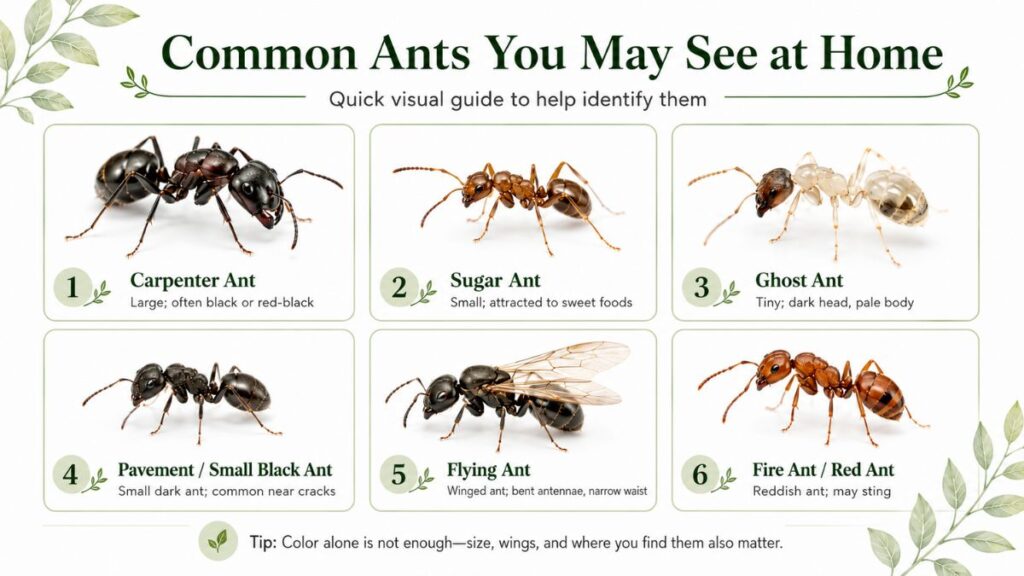
General terms like “black ants” or “sugar ants” are too broad and can lead to the wrong treatment. Use the clues above to choose the right strategy. However, seek professional help immediately if you suspect structural wood damage, face painful stinging risks, or if the infestation continues despite correct baiting.
How to Get Rid of Ants in the House Quickly
The following steps provide immediate relief while addressing the colony behind the visible trail.
1. Remove the ants you can see
Vacuum the ants or wipe them up with a damp cloth or paper towel. Empty the vacuum canister or bag promptly, preferably into a secured outdoor trash container.
For a small trail, ordinary dish soap and water are generally sufficient. The purpose is not only to remove the ants but also to clean the chemical trail used by other workers to find the same food source.
2. Follow the trail before cleaning it completely
Watch the ants for a few minutes. They may lead you to:
- A crack around a window or door
- A plumbing or cable opening
- A gap beneath a baseboard
- A foundation crack
- A plant touching the building
- A nest beneath a pot, stone, board, or landscaping material
Finding the route helps you choose a better bait location and shows you which opening should eventually be sealed.
3. Clean the entire route
Clean along counters, cabinet edges, baseboards, appliance cords, window frames, plumbing lines, door thresholds, and other surfaces the ants have crossed.
Soap and water are usually more useful than strongly scented cleaners. Vinegar may temporarily disturb a trail, but it should not be treated as dependable colony control.
Never mix vinegar with bleach or other household cleaners. Doing so creates toxic chlorine gas which can cause severe respiratory damage [2]
4. Remove food and water sources
Ants are less likely to take bait when other food is readily available. Before baiting:
- Wipe up sugar, syrup, juice, grease, and cooking oil
- Vacuum crumbs beneath appliances and furniture
- Store dry foods in sealed containers
- Clean sticky residue from jars and bottles
- Rinse cans and bottles before recycling
- Remove pet food after meals
- Dry sinks and counters overnight
- Repair dripping faucets and leaking pipes
Interestingly, eliminating these sweet spills and excess moisture is also the most effective way to get rid of gnats if you are simultaneously dealing with tiny flying insects in your kitchen.
5. Place slow-acting bait near the trail
Ant bait combines an attractive food source with a delayed-action insecticide. Workers carry it back toward the nest where it may be shared with other colony members.
- Place bait beside active trails
- Keep it near suspected entry points
- Keep it away from food-contact surfaces
- Place it where children and pets cannot reach it
6. Match the bait to what the ants will eat
No single bait works equally well for every ant colony.
Sweet liquid or gel baits may work better for ants feeding on sugar sources, while protein- or grease-based baits may work better for colonies seeking fats or proteins.
7. Do not spray around the bait
Contact sprays can kill workers before they carry bait back to the colony. Spray residue may also contaminate bait or cause ants to avoid the area.
Avoid applying insecticide sprays or strong cleaners around active bait stations.
8. Monitor and refresh the bait
Replace bait when it is empty, dried out, dirty, spoiled, or no longer attracting ants.
A temporary increase in ants near the bait can be normal. Allow workers to continue feeding while monitoring activity.
9. Seal entry points after activity declines
- Caulk cracks around windows, walls, and foundations
- Seal openings around pipes and utility lines
- Repair damaged screens
- Replace worn door sweeps
- Trim branches and vines touching the building
- Move damp mulch, leaves, boards, and debris away from foundations
Sealing alone may not solve an active infestation if food, moisture, and a nearby colony remain available.
How to Get Rid of Ants Permanently
No treatment can guarantee that ants will never return. New colonies can develop outdoors, weather can change foraging patterns, and buildings naturally develop new gaps.
In practical terms, how to get rid of ants permanently means eliminating or suppressing the current colony and making the property much less attractive to future ants.
Remove recurring food sources
Small amounts of grease, drink residue, and pet food left out overnight can sustain a colony. Store food in sealed containers and wipe down surfaces regularly.
Correct moisture problems
Ants need water to survive, and some species build nests in damp wood or wall voids. Fix dripping faucets, dry your sinks overnight, and repair leaks promptly.
Reduce outdoor access
Trim shrubs, vines, and tree branches so they do not touch the house. Move firewood away from the structure and keep mulch from resting directly against siding.
Ants may also feed on honeydew produced by aphids, scale insects, mealybugs, and similar plant pests. Managing those insects can reduce ant activity around plants and buildings.
Maintain a simple prevention routine
A manageable routine is more effective than occasional intensive cleaning:
- wipe food-preparation surfaces daily;
- sweep or vacuum eating areas;
- remove pet food after feeding;
- dry sinks overnight;
- rinse recycling;
- empty food waste regularly;
- inspect plumbing for leaks;
- check exterior gaps seasonally.
What Kills Ants and What Does Not Control the Colony
A method that kills individual ants is not necessarily capable of controlling the nest.
| Method | What it may accomplish | Main limitation |
|---|---|---|
| Soap and water | Removes visible ants and cleans the trail | Does not reach a hidden colony |
| Slow-acting bait | Allows workers to carry treatment toward the nest | Requires patience and a bait the ants will accept |
| Contact spray | Quickly kills exposed ants | Usually misses the queen and may interfere with bait |
| Vinegar | Cleans suitable surfaces and may disturb trails temporarily | Not reliable colony control |
| Diatomaceous earth | Damages insects that cross a dry, properly applied layer | Must remain dry and may not reach a hidden nest |
| Essential-oil product | May repel or kill ants on contact, depending on the formulation | Effects may be temporary; “natural” does not mean risk-free |
| Homemade borax bait | May affect a colony when formulated correctly | Concentration and exposure are difficult to control |
| Professional IPM | Combines identification, exclusion, baiting, and targeted treatment | Costs more but may be necessary for hidden or structural nests |
DIY Ant Control: What Actually Works and What to Avoid
Many DIY ant treatments can help remove visible ants or disturb trails, but most do not reliably eliminate the colony. Understanding their limitations can help you avoid ineffective methods and unnecessary risks.
Does vinegar kill ants?
Vinegar may kill some ants that are directly soaked and can help clean ant trails from certain surfaces. However, it does not reliably eliminate the queen, brood, or the entire colony.
Use vinegar as a cleaning tool rather than your primary ant-control method.
Does diatomaceous earth work on ants?
Diatomaceous earth can damage an insect’s protective outer layer, causing it to lose moisture. It works only while the material remains dry and undisturbed.
Avoid creating airborne dust because concentrated diatomaceous-earth dust can irritate the nose and respiratory system. Use only products labeled for the intended pest and location, and follow all application directions.
Are essential oils safer than conventional ant products?
Not necessarily. Safety depends on the specific ingredient, concentration, application method, and potential exposure.
Concentrated oils may irritate skin or airways, damage surfaces, or create risks for certain animals. Do not assume that a “natural” treatment is automatically safer. [5]
Should you make homemade borax bait?
Boric acid and borates are active ingredients in some commercial ant products. However, homemade recipes make it difficult to control the concentration and placement.
A mixture that is too strong may kill workers before they return to the colony, while a weak or unattractive mixture may fail to work. Open containers and loose powder can also create unnecessary exposure risks for children and pets. [4]
Ready-to-use, enclosed bait stations provide more controlled placement than uncovered homemade mixtures.
Some situations are too risky or complex for DIY methods. Check our section below on When to Call a Professional to see when you need expert help.
Safety note
Use only ready-to-use products registered for ants and the intended location. Avoid purchasing concentrated agricultural or professional pesticides for home dilution.
Never combine pesticide products, transfer pesticides into unmarked containers, or use indoor products outdoors or outdoor products indoors—unless the label specifically allows it.
How to Get Rid of Ants in Different Areas
Begin by removing competing food:
- clean beneath the refrigerator, toaster, stove, and cabinets;
- transfer cereal, flour, sugar, snacks, and pet food to sealed containers;
- wipe residue from syrup, honey, soda, and oil containers;
- clean recycling and trash bins;
- dry the sink overnight.
Follow the trail to its entry point, clean it, and place bait nearby. Do not put pesticide bait directly on a food-preparation surface unless the product label specifically permits that use.
Ants in a bathroom may be searching for water.
Inspect:
- dripping faucets;
- pipe connections;
- gaps around plumbing;
- damp cabinets;
- deteriorating grout;
- condensation;
- leaking toilets or showers;
- wet window frames.
Repair the source and keep the area dry.
Remove food wrappers, cups, crumbs, pet treats, and sticky spills. Vacuum:
- beneath the seats;
- under floor mats;
- around child car seats;
- inside door pockets;
- beneath the trunk liner.
Check the parking area. Ants may be climbing into the vehicle from a mound, curb, branch, or infested landscaping.
Do not casually spray pesticide throughout the enclosed passenger cabin. Use a bait or other product only when its label specifically allows that application, and keep it secured from children and animals.
Not every outdoor ant colony requires treatment. Non-stinging ants away from the house, walkways, play areas, and gardens often do not need control. Ants play important roles in soil health, decomposition, and natural pest control.
Treatment is more appropriate when ants:
- repeatedly enter your home;
- damage or nest in structural wood;
- create dangerous stinging risks;
- build disruptive mounds near high-use areas.
For outdoor ants that require control:
- Remove attractants: Clear fallen fruit, outdoor pet food, and manage honeydew-producing pests such as aphids and scale insects.
- Reduce nesting conditions: Move damp boards, leaf litter, mulch, and overgrown vegetation away from the foundation.
- Use targeted bait: Place outdoor-rated bait near active trails or nests according to the product label. Outdoor control may take more than a week because ants must carry bait back to the colony.
How to Get Rid of Common Types of Ants
How to get rid of carpenter ants
Carpenter-ant control begins with locating and correcting moisture. Specifically, look for:
- coarse, sawdust-like debris;
- ants emerging from damp wood;
- hollow-sounding or damaged wood;
- activity near roof leaks, windows, bathrooms, or plumbing;
- numerous large worker ants indoors;
- winged ants appearing inside.
Carpenter ants may maintain a main nest and one or more satellite nests. Repair leaks, remove decayed wood, and replace structurally damaged material.
Professional help is often appropriate when the ants are nesting in structural wood or the nest cannot be located.
How to get rid of sugar ants
“Sugar ants” is commonly used for small ants attracted to sweet food rather than one reliably identified species.
Clean syrup, fruit juice, soda, candy, honey, and other sugary residue. Remove competing food and place a sweet liquid or gel bait beside the trail.
If they do not feed, try another location or a different formulation. Their nutritional preference may change.
How to get rid of flying ants
Vacuum visible swarmers and inspect one carefully.
Flying ants generally have:
- bent or elbowed antennae;
- a narrow waist;
- front wings that are longer than their rear wings.
Termites generally have straighter antennae, a broad waist, and four wings of roughly equal length.
A few flying ants outdoors may be part of a normal seasonal mating flight. Repeated swarming inside a building suggests an indoor nest and deserves further inspection.
How to get rid of black ants or tiny ants
“Black ant” and “tiny ant” are physical descriptions, not precise identifications.
Observe what the ants are eating and where they emerge. Clean the trail, remove food and water, and test a suitable bait.
A large black ant near damp wood requires a different response from a tiny dark ant entering around a foundation or sugar container. Seek identification when activity persists despite correct baiting.
How to get rid of ghost ants
Ghost ants are extremely small. They have a dark head and middle body section with pale, almost translucent legs and abdomen. Their colonies may include multiple queens and connected nesting sites, which can make them persistent.
Remove sweets, moisture, and food particles. Check kitchens, bathrooms, wall gaps, cabinets, and potted plants.
Place bait near an active trail and avoid repellent sprays around it. If the ants do not feed, relocate the bait or try a different formulation. Widespread activity in several rooms may require professional treatment.
How to get rid of fire ants or red ants
Not every red ant is a fire ant. Correct identification is important before treating a mound.
Do not kick, dig into, or stand on a suspected fire-ant mound. Keep children and pets away, and use only a product specifically labeled for fire ants and the site being treated. Some baits produce results within a week, while insect-growth-regulator baits may require several weeks.
Fire-ant stings can cause painful local reactions. Call 911 or the local emergency number when a person develops trouble breathing, facial or mouth swelling, throat tightness, difficulty swallowing, faintness, or other widespread symptoms after a sting. [3]
How to Use Ant Products Safely Around Children and Pets
The safest option is not automatically the product marketed as “natural.” It is the effective method that creates the least realistic exposure when used correctly.
For safer use:
- choose enclosed bait stations when appropriate;
- place products where children and pets cannot touch, lick, or move them;
- keep pesticides in their original packaging;
- follow every label direction and restriction;
- do not transfer bait or pesticide into food or drink containers;
- avoid loose powders on accessible floors;
- wash your hands after handling a product;
- keep people and animals out of treated areas for the period stated on the label.
Do not place bait beside pet bowls, toys, children’s snacks, or food-preparation surfaces. [7]
Keep the product packaging available so the poison specialist, clinician, or veterinarian can identify the active ingredient and concentration.
Which Ant-Killing Ingredient Should You Choose?
You do not need to memorize brand names. Instead, check the product label for the active ingredient, the type of bait, and the locations where the product is approved for use.
For most household infestations, choose a ready-to-use, slow-acting bait rather than a pesticide concentrate or a spray. Common active ingredients in ant baits include boric acid or borates, fipronil, hydramethylnon, and abamectin, also listed as avermectin B1. These ingredients are mixed with sugar, protein, fat, or oil to attract foraging ants.
| Active ingredient | When it may be useful |
|---|---|
| Boric acid or borates | Often used for small household ants attracted to sweet foods |
| Fipronil | May be used for persistent household colonies when the ants accept the formulation |
| Hydramethylnon | Commonly used for ants attracted to fats or proteins and in some outdoor ant baits |
| Abamectin or avermectin B1 | Another slow-acting option for common household ants |
The active ingredient is only part of the decision. The food attractant must also appeal to the ants. A borate-based sweet liquid may work well for ants feeding on syrup or fruit but perform poorly when the colony is seeking protein or grease. If the ants do not feed, try another bait formulation or move it closer to the trail rather than applying more pesticide. Ant preferences can change by species, season, and colony needs.
A practical choice for common indoor ants
For ants repeatedly entering a kitchen, pantry, or bathroom, start with an enclosed station or gel bait labeled for indoor ant control. Choose:
- a sweet liquid or gel bait when the ants are visiting sugar, juice, syrup, or fruit;
- a protein- or grease-based bait when they are visiting meat, cooking oil, or pet food;
- a different formulation when they inspect the bait but do not feed.
Place the product beside the trail and outside the reach of children and pets. Do not spray insecticide or strong cleaner around an active bait station. The workers need to remain alive long enough to carry the bait toward the colony. Properly used baits are generally more effective and create less unnecessary pesticide exposure than routine indoor spraying.
What pest-control professionals may use
Professionals often use the same general active ingredients, but they may have access to different concentrations, formulations, refillable stations, application equipment, and products restricted to licensed applicators.
Depending on the species and nest location, a professional treatment may include:
- fipronil, hydramethylnon, abamectin, or borate-based gel and liquid baits;
- refillable outdoor bait stations for large or persistent colonies;
- silica aerogel dust, sometimes combined with pyrethrins, in accessible wall voids before the opening is sealed;
- a carefully targeted residual treatment around specific exterior entry areas;
- moisture repair, sanitation, exclusion, and nest-location work.
Professional perimeter treatments may contain pyrethroids such as bifenthrin, cypermethrin, or lambda-cyhalothrin. However, these sprays mainly kill exposed foraging ants and may not eliminate the queen or colony. Broad or repeated perimeter spraying may also create greater environmental exposure than a targeted, bait-based IPM program. [6]
When to Call a Pest-Control Professional
Arrange a professional inspection when:
- Carpenter ants or sawdust-like debris suggest a possible hidden nest;
- Ants repeatedly emerge from walls, ceilings, electrical areas, or other inaccessible spaces;
- Large numbers of winged ants swarm indoors;
- Stinging ants pose a risk to children, pets, or people with sting allergies;
- Multiple rooms have active trails;
- Properly placed bait does not reduce activity;
- Structural moisture or wood damage is suspected;
- The ant species or nest location cannot be identified;
- Treatment cannot be applied safely.
Ask whether the provider uses an integrated pest-management (IPM) approach. A reliable plan should include identification, inspection, food and moisture correction, exclusion, and targeted treatment instead of relying only on routine whole-house spraying.
Frequently Asked Questions
Vacuum visible ants, clean the trail, remove food and moisture sources, and place a suitable slow-acting bait near the activity. This provides immediate relief while targeting the colony.
You may notice fewer ants within several days, but complete control can take several weeks depending on the species, colony size, nest location, and bait acceptance.
More ants near bait can be normal. Workers may recruit additional colony members to the food source. Leave the bait undisturbed while ants are feeding.
The bait may not match the ants’ food preference, may be poorly placed, or competing food sources may be available. Try another formulation or move it closer to the trail.
Enclosed bait stations placed out of reach generally reduce exposure risk. Always follow the product label and keep pesticides away from food, toys, and pet areas.
Check for remaining food sources, moisture problems, entry points, and possible hidden nests. Persistent infestations may require professional inspection.
The most reliable answer to how to get rid of ants is not repeated spraying. Remove the trail and attractants, use the right bait when treatment is necessary, repair moisture problems, and seal access points. This targeted approach is usually more effective, more sustainable, and easier to maintain.
Medical References
Update History
Medically reviewed by Dr. Neelam Mehta.
Originally written by Medicalic.
Your answer helps us improve the clarity and usefulness of our health content.