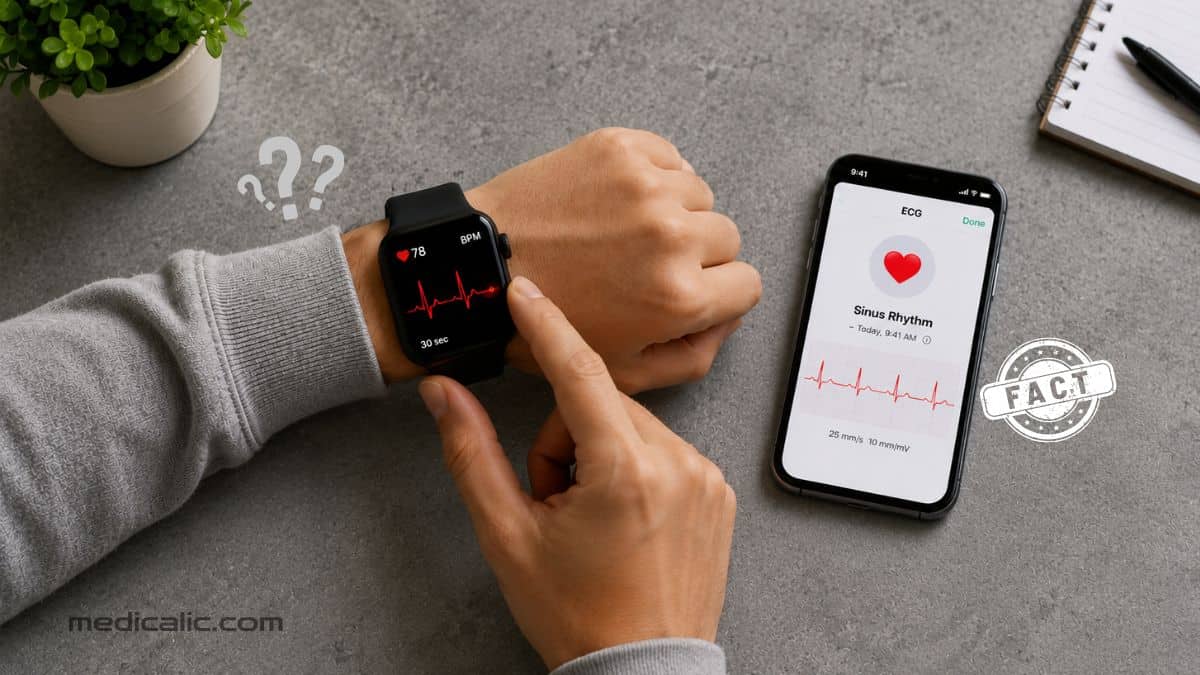
Millions of people now wear a mini ECG machine on their wrist. But does that blinking sensor and squiggly line on your smartwatch actually mean anything medically? This article breaks down the science, the limitations, and what your doctor really thinks about your smartwatch heart data.
What Is a Smartwatch ECG, and How Does It Work?
An electrocardiogram (ECG or EKG) measures the electrical activity of your heart. Traditional hospital ECGs use 10 electrodes placed across your chest, limbs, and torso to record 12 different electrical views of your heart simultaneously.
Smartwatch ECGs use a single electrical circuit: you press your finger on the watch crown while the watch sits on your wrist, completing a circuit that measures a single-lead ECG — equivalent to Lead I in a clinical setting. This 30-second recording captures your heart’s rhythm but gives a much narrower electrical view than hospital equipment.
Smartwatch ECG vs. Clinical ECG: What’s the Real Difference?
Smartwatch ECG (1-Lead)
Think of a smartwatch ECG as looking at a house through a single window. It uses only one electrical pathway (a 1-Lead system) and therefore captures just one viewpoint of your heart’s activity.
It excels at analyzing rhythm and timing. It can clearly detect whether your heart is beating evenly or showing an irregular pattern like arrhythmia.
However, its usefulness ends there. Because it tracks only one angle of electrical flow, it cannot detect ischemia (lack of blood flow or oxygen to the heart muscle) or structural abnormalities in the heart chambers. As a result, it misses most structural heart conditions and blood-flow-related problems that require a broader view of the heart’s electrical activity.
Clinical ECG Machine (12-Lead): The 3D Panoramic View
In contrast, a clinical ECG at a hospital is like walking through every room of that house with a team of cameras. By placing 10 electrodes across your chest and limbs, it simultaneously creates 12 different electrical pathways (or “leads”). Tracking how electrical signals move vertically, horizontally, and deep within the chest provides a comprehensive, three-dimensional view of the heart, allowing cardiologists to evaluate its overall health.
Doctors rely on this detailed information to diagnose critical conditions such as active heart attacks, dangerous conduction blocks, chamber enlargement, and certain inherited heart disorders.
While a 1-lead ECG is primarily limited to detecting irregular heart rhythms, a 12-lead clinical ECG can reveal far more. It can pinpoint where a heart attack is occurring, identify signs of heart muscle damage, assess whether the heart’s chambers or walls have enlarged, and detect subtle electrical abnormalities that might otherwise go unnoticed.
How Accurate Is a Smartwatch ECG for Detecting Heart Conditions?
We already know that smartwatch ECGs can be effective for detecting certain heart conditions, but they come with significant limitations. The question is: how accurate are they in real-world medical practice?
Let’s take a closer look at how well smartwatch ECGs actually perform according to current research and evidence.
Heart Conditions a Smartwatch ECG Can Detect
Detecting Atrial Fibrillation (AFib): The biggest medically proven success of smartwatch ECGs is their ability to detect Atrial Fibrillation (AFib); a dangerous irregular heart rhythm.
The landmark Apple Heart Study, published in the New England Journal of Medicine (NEJM) in 2019, monitored over 400,000 participants and showed that the Apple Watch could reliably identify irregular pulse patterns linked to AFib.[1] The Fitbit Heart Study later confirmed similar results. Since AFib often stays silent until it causes a stroke, this feature on your wrist can truly be a lifesaver.
Heart Rate Alerts: When Your Pulse Crosses the Line: Is your heart suddenly racing without reason, or dropping too low? Smartwatches continuously monitor your heart rate in the background. If your pulse spikes too high (tachycardia: usually above 100–120 bpm) or falls too low (bradycardia: below 40–50 bpm) at rest, the watch immediately detects it and sends an alert.
This real-time notification gives you a vital opportunity to seek medical help before a small problem becomes a serious emergency.
Monitoring Existing Conditions: For patients already diagnosed with heart arrhythmias, a smartwatch acts as an incredibly convenient digital diary. Because symptoms can happen unexpectedly at home or work, having a watch allows users to log sporadic episodes the exact moment they feel them.
These saved readings capture crucial real-world data that can easily be shared with cardiologists during the next checkup, taking the guesswork out of long-term care.
In short, smartwatch ECGs are most useful for rhythm-related monitoring, particularly when symptoms are intermittent and difficult to capture during a clinic visit.
What a Smartwatch ECG Cannot Detect
A smartwatch is not an emergency medical device. If you or someone around you is experiencing chest pain, crushing pressure, shortness of breath, or sudden dizziness, do not waste time taking a smartwatch ECG. Call emergency services immediately.
It is vital to understand that a smartwatch ECG has massive blind spots. Because it only looks at your heart from a single angle, it cannot detect a heart attack (myocardial infarction), coronary artery disease, heart failure, leaky heart valves, or chamber hypertrophy (enlargement). It also misses the vast majority of complex electrical conduction disorders. Your watch might tell you your rhythm is “normal” even in the middle of a massive heart attack because it simply isn’t designed to look for blocked arteries. When severe symptoms strike, forget the screen and seek emergency care.
Smartwatch ECG vs Hospital ECG: A Direct Comparison
| Feature | Smartwatch ECG (1-Lead) | 12-Lead Hospital ECG |
| Number of Leads | 1 (Lead I equivalent) | 12 distinct leads |
| AFib Detection | High accuracy (Screening) | Gold standard (Diagnostic) |
| Heart Attack (STEMI) Detection | Not possible | Definitive and immediate |
| Bradycardia / Tachycardia | Good | Excellent |
| Conduction Blocks (LBBB/RBBB) | Cannot detect | Clear and precise |
| Ischemia / ST-Segment Changes | Not reliable | Fully reliable |
| Accessibility | Anytime, anywhere (On your wrist) | Hospital or clinic settings only |
| Cost per Reading | Near zero (One-time device cost) | Clinic or insurance fees apply |
| Susceptibility to Motion Artifacts | High (Even slight movement ruins it) | Moderate (Controlled clinical setting) |
| Admissible for Medical Diagnosis | No (Screening & trend tracking only) | Yes (Standard clinical diagnostic) |
The Pros and Cons of Smartwatch ECGs
To get the most out of your wearable, it helps to understand exactly what it excels at—and where it falls completely short.
The Advantages:
- Long-Term Rhythm Tracking: Supports long-term rhythm tracking outside clinical settings, helping users document changes over time.
- FDA-Cleared for Peace of Mind: Major brands use FDA-cleared algorithms specifically designed to screen for rhythm irregularities.
- Continuous Passive Tracking: It runs 24/7 background checks on your heart rate, alerting you to silent spikes or drops.
- Seamless Data Sharing: You can easily export PDF graphs of your symptoms to share directly with your cardiologist.
- Proven Lifesaver: There are countless documented cases where a watch alert prompted a life-saving ER visit.
- Boosts Health Awareness: It encourages users to actively engage with and understand their daily cardiovascular health.
The Limitations:
- Never a Clinical Replacement: A smartwatch can never substitute for a comprehensive hospital diagnostic setup.
- Can Spark “Cyberchondria”: High false-positive rates or inconclusive readings often trigger immense, unnecessary health anxiety.
- Rhythm Only, No Structure: It only looks at the timing of your heartbeat—it is entirely blind to heart valve issues, leaks, or muscle damage.
- Limited Diagnostic Scope: Its single-lead design cannot evaluate many conditions that require multi-lead clinical assessment.
- Prone to Human Error: A slight movement, a loose watch strap, or sweaty skin can completely ruin the accuracy of a reading.
- Adults Only: These algorithms are strictly designed for adults and have not been medically validated for children or pediatric patients.
What Do Cardiologists Say About Smartwatch ECGs?
The medical community’s response to wearable heart tech is a mix of genuine optimism and cautious realism. Most cardiologists welcome smartwatch data as a valuable supplement to patient care, particularly when symptoms occur outside a clinical setting.
A major, shared concern among doctors is the rise of “cyberchondria.” Because smartwatches frequently flag benign heart rhythm variants or generate messy lines due to simple arm movement, patients often experience intense anxiety, self-diagnosing severe conditions based on a flawed screen reading.
A landmark 2023 review published in the Journal of the American College of Cardiology (JACC) highlighted this exact duality. The review noted that while consumer ECG devices serve as a “powerful screening adjunct,” physician interpretation remains completely non-negotiable before making any clinical decisions.
Tips to Get the Most Accurate Reading From Your Smartwatch ECG
Getting an “Inconclusive” result on your watch can be frustrating, but it’s usually caused by poor technique rather than a faulty device. To ensure your smartwatch captures the cleanest, most medically useful reading possible, follow these best practices:
Prep Your Posture: Sit down comfortably and let your arm rest completely flat on a table or desk. Relax your shoulder—tension in your arm muscle can distort the electrical signal.
Check the Fit: Make sure your watch band is snug against your wrist, sitting just above the wrist bone. If it’s too loose, the back sensor loses contact; if it’s too tight, it can restrict blood flow and alter the pulse data.
The Perfect Touch: Place your opposite index finger firmly on the Digital Crown or the designated metallic sensor. You don’t need to press down aggressively, just maintain a steady, continuous touch.
Embrace the Silence: Remain completely still and avoid talking or swallowing during the 30-second countdown. Even minor jaw movements can introduce “noise” into the reading.
Cool Down First: Never take an ECG immediately after a workout or a sprint up the stairs. Heavy breathing and rapid sweat buildup create massive motion artifacts that ruin reliability. Wait until your breathing returns to normal.
Keep Conditions Consistent: If you are tracking a known condition, try to take your readings at the same time and under the same circumstances each day (e.g., first thing in the morning while resting) for an accurate baseline comparison.
Who Should Actually Use Smartwatch ECG Monitoring?
While anyone with a compatible wearable can take an ECG, the technology isn’t equally valuable for everyone. In fact, it is highly beneficial for specific groups, while being largely unnecessary and even counterproductive for others.
The ideal candidates for smartwatch ECG tracking include:
Adults Over 50 with Risk Factors: For individuals in this age bracket who manage conditions like hypertension, diabetes, obesity, or have a family history of heart disease, a smartwatch serves as an excellent early warning system for silent arrhythmias.
People with Mystery Symptoms: If you frequently experience unexplained heart palpitations, a racing pulse, or brief bouts of dizziness, having an ECG on your wrist allows you to capture those fleeting moments in real-time for your doctor.
People Requiring Ongoing Rhythm Monitoring: Individuals with previously diagnosed rhythm disorders may benefit from tracking patterns between medical visits.
Post-Procedure Recovery: Patients recovering from recent cardiac procedures can use interim wearable monitoring to keep a close eye on their heart rhythms as they heal.
Who should skip the obsession? On the flip side, routine ECG scanning is far less useful—and potentially misleading—for young, healthy individuals with no underlying symptoms. In this group, the watch is highly likely to flag completely benign heart variations or motion artifacts, triggering unnecessary medical panic and endless loops of Google searching.
Who Should Not Rely on a Smartwatch ECG?
Smartwatch ECGs are designed for screening and long-term monitoring, not emergency diagnosis. Anyone experiencing chest pain, severe shortness of breath, fainting, or other urgent symptoms should seek immediate medical attention regardless of smartwatch results.
Frequently Asked Questions (FAQs)
The Apple Watch ECG feature has received FDA clearance (USA) and CE marking (Europe) specifically for atrial fibrillation screening. This is not the same as full diagnostic approval. It means the device can flag possible AFib to prompt a doctor’s visit, not that it can replace clinical ECG interpretation.
No. A heart attack (myocardial infarction) is detected by looking for ST-segment elevation or depression across multiple leads. A single-lead smartwatch ECG cannot provide this information. If you have chest pain, jaw pain, left arm pain, or breathlessness, call emergency services immediately regardless of what your smartwatch shows.
Studies report sensitivity of approximately 87–98% and specificity of 83–99% for AFib detection depending on the device and study population.[2] The Apple Heart Study found that irregular pulse notifications had a positive predictive value of about 84% for concurrent AFib on clinical monitoring. This is a strong result for a screening tool. However, roughly 1 in 7 alerts may still turn out to be a false positive.
Apple Watch Series 4 and later, Samsung Galaxy Watch (select models), Fitbit Sense, Withings ScanWatch, and Garmin Venu 3 all feature ECG capabilities. Apple Watch has the most peer-reviewed research behind its algorithm. Withings ScanWatch is often praised for clinical-grade accuracy in smaller independent studies.
No. Never start, stop, or adjust cardiac medications based solely on smartwatch readings. This is potentially dangerous. Always consult your cardiologist or treating physician before any medication change. Smartwatch data can be shared as supporting evidence but must not be the sole basis for treatment decisions.
Real-World Case Study: Putting the Tech to the Test
To better understand the practical difference between a smartwatch ECG and a hospital ECG, let’s examine a real-world comparison.
This comparison highlights what a single-lead wearable can capture and what remains visible only on a clinical 12-lead ECG. By analyzing a standard smartwatch ECG printout alongside a comprehensive hospital report, the practical difference between rhythm monitoring and comprehensive cardiac evaluation becomes immediately clear.
Case File A: The Smartwatch ECG (1-Lead)
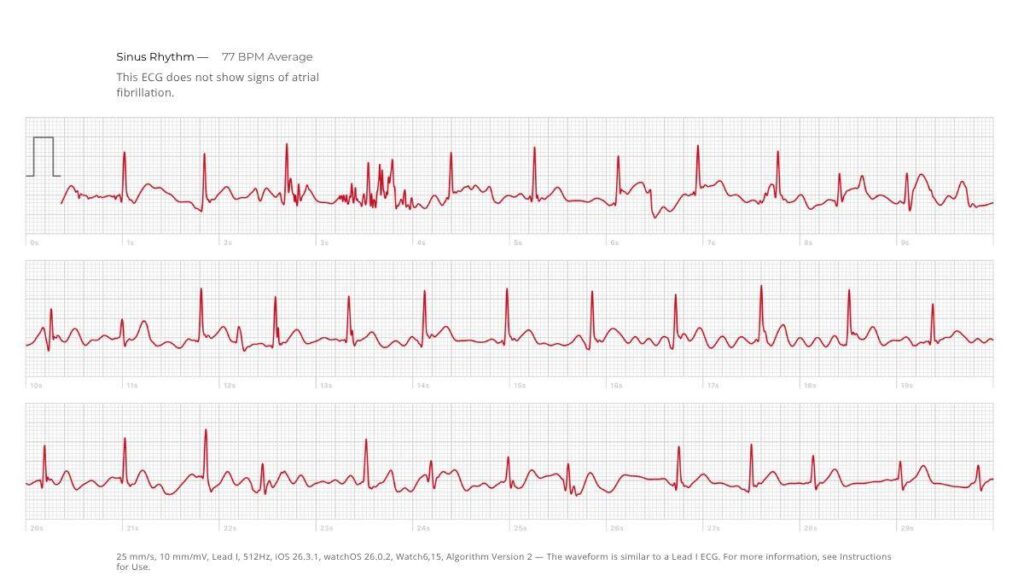
- Technical Specifications: Lead I equivalent, 25 mm/s, 10 mm/mV, 512Hz
- The Findings: This reading offers a single, continuous electrical tracing of the heart. At first glance, you can spot minor jagged lines between the 3-second and 5-second marks. In the tech world, this is a classic example of “motion artifact”—minor electrical interference caused by slight muscle movement, which we warned about earlier.
- The Automated Diagnosis: Once the tracing stabilizes, the watch’s internal algorithm accurately calculates an average heart rate of 77 BPM and flags the rhythm as a normal “Sinus Rhythm,” confirming no immediate signs of Atrial Fibrillation (AFib).
Case File B: The Clinical Hospital ECG (12-Lead)
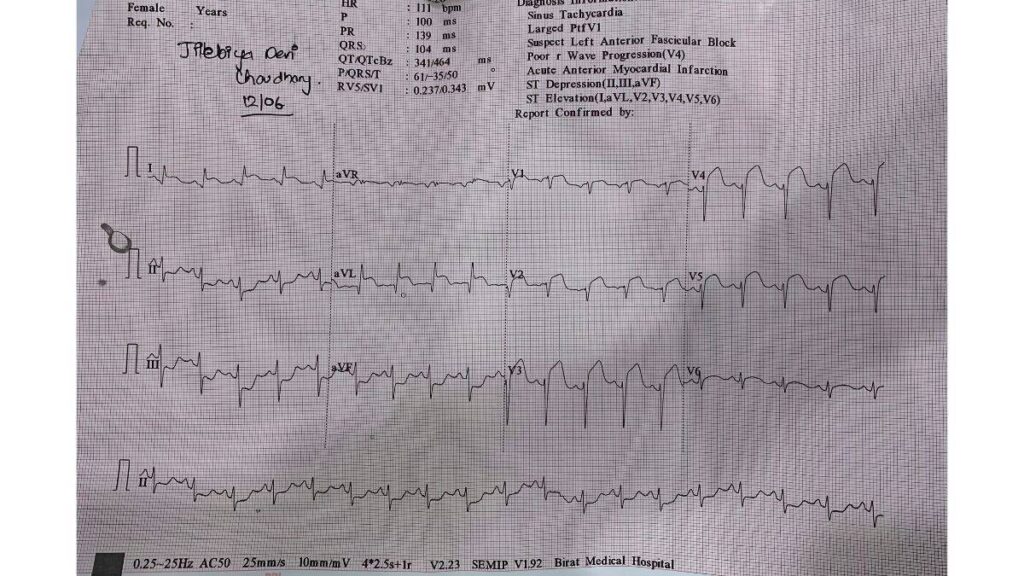
- Technical Specifications: Standard 12-Lead Clinical Printout (Leads I, II, III, aVR, aVL, aVF, and V1–V6)
- The Findings: Looking at this clinical paper, the massive leap in diagnostic power becomes instantly clear. Instead of a single line, we are given 12 entirely different, simultaneous viewpoints of the heart’s electrical activity.
- The Clinical Diagnosis: A careful medical evaluation of this specific patient’s graph reveals critical, life-threatening cardiac events that a smartwatch algorithm is fundamentally blind to:
- Sinus Tachycardia: An elevated, racing heart rate of 111 BPM.
- Acute Anterior Myocardial Infarction: The prominent ST-segment elevations visible across the precordial chest leads (V2, V3, and V4) indicate an active, acute heart attack in progress.
- Conduction & Structural Blocks: The printout also catches a Suspected Left Anterior Fascicular Block and signs of chamber enlargement.
The Doctor’s Verdict: The Ultimate Takeaway
This comparison perfectly illustrates the golden rule of health technology: smartwatch ECG findings should always be interpreted alongside symptoms, clinical evaluation, and appropriate diagnostic testing.
While a smartwatch is an excellent and accessible tool for rhythm monitoring, it cannot replace the broader diagnostic capabilities of a clinical 12-lead ECG. Used appropriately, it can provide valuable early warning information; used in isolation, it can create a false sense of reassurance.
The Bottom Line
Smartwatch ECG technology has made heart rhythm monitoring more accessible than ever before. It can help identify patterns that deserve medical attention and provide useful information between medical visits.
However, smartwatch ECGs are best viewed as screening tools rather than standalone diagnostic devices. They can identify patterns that warrant medical attention, but confirmation and diagnosis still require proper clinical evaluation. When used appropriately, they can be a valuable part of ongoing heart health monitoring.
This article is intended for general informational and educational purposes only. It does not constitute medical advice, diagnosis, or treatment. Always seek the advice of a qualified healthcare provider with any questions you may have regarding a medical condition. In case of a cardiac emergency, contact your local emergency services immediately.
Medical References
Update History
Medically reviewed by Medicalic.
Originally written by Dr. Rahul Kushwaha.
Your answer helps us improve the clarity and usefulness of our health content.