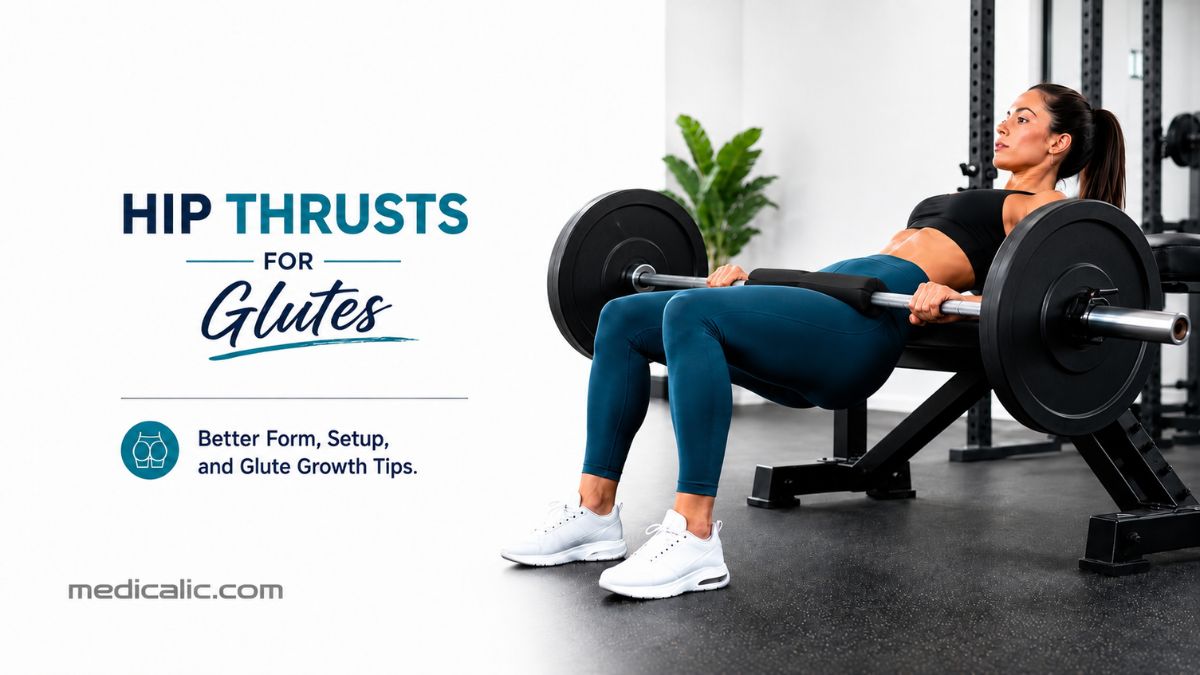
Many people add hip thrusts to their glute workouts but still feel them more in the hamstrings, lower back, or hip flexors than in the glutes. A few small setup mistakes can turn a great glute exercise into the wrong kind of burn.
Hip thrusts for glutes are one of the most popular lower-body exercises because they train hip extension, one of the main jobs of the glute muscles. When your bench height, foot placement, bar position, and lockout are set correctly, hip thrusts can help you build stronger, fuller glutes with a stable and easy-to-progress movement.
They also work for many fitness levels. Beginners can start with bodyweight hip thrusts or glute bridges. Intermediate lifters can use dumbbells, resistance bands, Smith machines, or hip thrust machines. Advanced lifters can progress to heavy barbell hip thrusts, pause reps, B-stance reps, and single-leg variations.
This guide explains how to do hip thrusts for glutes, how to set up the exercise correctly, how to choose foot placement, how many sets and reps to use, and what to do instead if hip thrusts do not feel right for your body.
Are Hip Thrusts Good for Glutes?
Yes, hip thrusts are good for glutes. They directly train the gluteus maximus, the largest glute muscle and a major driver of hip extension. When you lift your hips from the bottom position and finish in a strong lockout, your glutes help extend the hips and control the movement. [1]
Hip thrusts can also involve the hamstrings, quads, adductors, and core depending on your setup. That does not make the exercise bad. It simply means your position matters. The goal is to set up the movement so the glutes do most of the work instead of the lower back, hamstrings, or quads taking over.
Hip thrusts place strong tension on the glutes near the top of the movement, where the hips are fully extended. Squats, lunges, and Romanian deadlifts often challenge the glutes more in a stretched position. For well-rounded glute development, it is smart to train both patterns.
The main benefits of hip thrusts for glutes are direct hip-extension loading, strong glute tension near lockout, easier progression, and better stability than many single-leg exercises. Because your upper back is supported and your feet stay planted, many lifters find hip thrusts easier to control than lunges or step-ups.
What Research Says About Hip Thrusts for Glutes
Research using electromyography, or EMG, suggests that hip thrusts can produce high gluteus maximus activation. A systematic review reported that hip extensor muscles, including the gluteus maximus, showed greater activation in the barbell hip thrust compared with the squat in the studies reviewed. [1]
Another study comparing barbell deadlifts, hex-bar deadlifts, and hip thrusts found the highest gluteus maximus activation in the hip thrust, while the barbell deadlift produced greater biceps femoris activation. [2]
That said, EMG does not prove everything about muscle growth. Muscle activation helps us understand which muscles are working hard during an exercise, but bigger and stronger glutes also depend on training volume, effort, progressive overload, recovery, nutrition, and consistent technique. [1,3,4]
The practical takeaway is simple: hip thrusts are well-supported as a glute-focused movement, but they are not magic by themselves. They work best when you use good setup, train close enough to fatigue, progress gradually, and combine them with other lower-body exercises.
How to Set Up Hip Thrusts Correctly
A good hip thrust starts before the first rep. Bench height, upper-back position, bar placement, foot distance, and shin angle all change how the exercise feels. If one of these is off, you may feel the movement more in your hamstrings, lower back, hip flexors, or knees instead of your glutes.
Choose a stable bench or box that lets your upper back stay supported while your hips move freely. For many lifters, the edge of the bench sits around the lower shoulder blades. Do not place your neck on the bench. Your upper back should stay connected to the bench, but your hips should be able to move up and down smoothly.
For barbell hip thrusts, roll the bar over your legs until it sits across the crease of your hips. Use a thick bar pad, squat pad, foam pad, or folded mat. The goal is to load your hips, not bruise them. Keep both hands on the bar to stop it from rolling, but do not pull the weight up with your arms.
Your feet should start flat on the floor, roughly hip-width to shoulder-width apart. At the top, many lifters feel best when their shins are close to vertical and their knees are roughly stacked over their ankles. If your feet are too far forward, your hamstrings may dominate. If your feet are too close, your quads or knees may take over. Small adjustments can make a big difference. [1]Setup Point What to Check Bench Stable and not sliding Upper back Bench edge near lower shoulder blades Bar Across the hip crease, not stomach or thighs Padding Thick enough to reduce painful pressure Feet Flat, hip-width to shoulder-width Shin angle Close to vertical at the top for many lifters Core Ribs down, pelvis controlled Top position Shoulders, hips, and knees near a straight line
How to Do Hip Thrusts for Glutes Step by Step
Sit on the floor with your upper back against a stable bench. Place your feet flat on the floor, about hip-width to shoulder-width apart. If you are using a barbell, position it across the crease of your hips and use padding for comfort.
Brace your core lightly, keep your ribs down, and keep your chin slightly tucked. Drive through your feet and lift your hips until your shoulders, hips, and knees form a straight line. At the top, squeeze your glutes without over-arching your lower back.
Lower your hips with control until they are close to the floor, then repeat. Do not drop quickly or bounce at the bottom. A controlled lowering phase helps you keep tension on the target muscles and makes each rep easier to repeat with good form.
That is the foundation of how to properly do hip thrusts for glutes: stable upper back, planted feet, controlled hips, and a strong glute squeeze at the top of each rep.
Form Cues and Foot Placement That Help
Good hip thrusts for glutes form is not about lifting the heaviest weight possible. It is about moving with control and keeping tension where you want it.
Think “ribs down.” If your ribs flare up and your back arches hard, your lower back may take over. Think “push the floor away.” Instead of just lifting your hips, drive through your feet and imagine pushing the ground down. Think “lock out with glutes, not your back.” Stop when your body forms a straight line. You do not need to push higher by arching your spine.
Foot placement is one of the biggest factors. At the top, many people feel best when their shins are close to vertical. If you feel mostly hamstrings, move your feet slightly closer. If you feel mostly quads or knee pressure, move your feet slightly farther away.
Your feet can be hip-width or slightly wider, with toes forward or slightly outward. Keep your feet flat and press through the midfoot and heel without lifting your toes completely.
If you do not feel your glutes, change one thing at a time. Move your feet slightly forward, back, wider, or narrower. Reduce the weight, pause at the top, and focus on a clean glute squeeze.
Best Hip Thrust Variations for Glutes
You do not have to start with the barbell version. The best hip thrust variation is the one you can set up safely, feel in your glutes, and progress over time.
Barbell hip thrusts for glutes are popular because they allow you to add weight gradually. Use padding, keep the bar across the hip crease, and make sure the bar moves with your hips instead of rolling toward your stomach or thighs.
Dumbbell hip thrusts are a strong beginner-friendly option. They are easier to set up than a barbell and work well for home or gym training. Smith machine hip thrusts can feel more stable because the bar path is fixed. A dedicated hip thrust machine is often even easier because it usually has a built-in pad and belt or lever system.
Bodyweight and banded hip thrusts work well for warm-ups, home workouts, and high-rep finishers. At home, a sturdy couch, bench, step, or low box can work as upper-back support. Start with bodyweight, then add a dumbbell, band, kettlebell, or loaded backpack only if the setup stays stable.
B-stance and single-leg hip thrusts are useful when one side feels weaker or harder to activate. They train one side more directly without needing as much weight.
| Situation | Best Variation |
|---|---|
| New beginner | Bodyweight hip thrust or glute bridge |
| Simple loading | Dumbbell hip thrust |
| Gym-based glute growth | Barbell hip thrust |
| Awkward setup | Smith machine hip thrust |
| Bar hurts your hips | Machine hip thrust or glute bridge |
| Home workout | Couch hip thrust or banded hip thrust |
| One side feels weaker | B-stance or single-leg hip thrust |
| High-rep finisher | Banded hip thrust |
How Many Hip Thrusts for Glutes?
A common question is, “How many hip thrusts for glutes should I do?” The answer depends on your goal, experience, recovery, and total lower-body volume.
For beginners, 2 to 3 sets of 10 to 15 reps once or twice per week is a strong starting point. For glute growth, many lifters do well with 3 to 5 sets of 8 to 15 reps. For strength, sets of 5 to 8 reps can work if form stays clean.
More reps are not always better. Your glutes need enough challenge to grow, but they also need recovery. General resistance-training guidance supports using progressive overload, appropriate volume, and goal-based training variables for strength and hypertrophy. [3,4]Goal Sets Reps Rest Beginner practice 2–3 10–15 60–90 sec Glute growth 3–5 8–15 90–150 sec Strength 3–5 5–8 2–3 min Burnout 2–3 15–25 45–90 sec
Common Hip Thrust Mistakes and Fixes
One common mistake is over-arching the lower back at the top. This may happen when you try to lift too high or use too much weight. Your goal is full hip extension, not a big backbend. Keep your ribs down and stop when your shoulders, hips, and knees form a straight line.
Another mistake is poor foot placement. Feet too far away can shift work into the hamstrings. Feet too close can make the movement feel quad-dominant. Adjust your stance until your glutes feel like the main driver.
Many lifters also rush their reps. Fast, bouncing hip thrusts reduce control and make it harder to feel the glutes. Slow down, pause at the top, and lower with intention.
Using too much weight too soon is another issue. Heavy hip thrusts can be effective, but only if your form stays strong. If you cannot reach full extension or you feel the movement mostly in your lower back, reduce the load.
| Problem | Common Cause | First Fix |
|---|---|---|
| Hamstrings take over | Feet too far forward | Move feet slightly closer |
| Quads take over | Feet too close | Move feet slightly farther away |
| Lower back takes over | Over-arching at lockout | Keep ribs down and stop at full hip extension |
| Bar hurts | Poor padding or bar position | Use thicker padding or change variation |
| Hips pinch | Stance or range mismatch | Adjust stance, toe angle, or range |
| Knees cave inward | Too much load or poor tracking | Reduce weight and track knees over toes |
If pain is sharp, persistent, or related to a previous injury, stop and get guidance from a qualified professional.
Hip Thrusts vs. Other Glute Exercises
Hip thrusts, squats, step-ups, Romanian deadlifts, and leg presses can all support glute growth, but they train the glutes in different ways.
Squats train the glutes, quads, core, and lower body as a system. Hip thrusts are more targeted because they focus heavily on hip extension and are usually easier to feel directly in the glutes.
Step-ups are single-leg exercises. They train the glutes while challenging balance and coordination. Romanian deadlifts train the glutes and hamstrings in a lengthened position. Leg presses can support glute training when you use a higher foot position, controlled depth, and steady pressure through the midfoot and heel.
For most people, the best answer is not choosing only one. A strong glute routine can use hip thrusts as a main lift and use squats, step-ups, Romanian deadlifts, leg presses, or isolation work as support.
Best Alternatives to Hip Thrusts for Glutes
Hip thrusts are effective, but they are not required. Some people find them awkward, uncomfortable, or difficult to set up. Good alternatives include glute bridges, Romanian deadlifts, leg presses, step-ups, Bulgarian split squats, cable pull-throughs, cable kickbacks, back extensions, and hip abduction work.
Glute bridges are the closest alternative because they use a similar hip extension pattern from the floor. Romanian deadlifts train the glutes and hamstrings in a lengthened position. Step-ups and Bulgarian split squats are excellent when you want single-leg glute strength, balance, and side-to-side control.
The right replacement depends on why you are avoiding hip thrusts. If setup is the problem, try a dumbbell hip thrust, Smith machine hip thrust, or glute bridge. For bar discomfort, a machine hip thrust or cable pull-through may be a better option. When training at home, use glute bridges, couch hip thrusts, step-ups, or banded kickbacks.
Sample Hip Thrust Workouts and Progression
A simple glute-focused gym workout can include hip thrusts, Romanian deadlifts, high-foot leg presses, cable kickbacks, and hip abduction work. Perform hip thrusts first for 3 to 4 sets of 8 to 12 reps, then use hinge, press, and isolation exercises for moderate to higher reps.
For a home workout, use bodyweight or weighted hip thrusts, glute bridges, step-ups, banded lateral walks, and single-leg glute bridges. Without equipment, pause longer at the top, lower slowly, and use higher reps.
To progress, you do not always need to add weight. You can also improve reps, range of motion, tempo, pauses, control, or total training volume. Track your workouts and check recovery, sleep, protein, and consistency if progress stalls.
Safety Tips for Hip Thrusts
Hip thrusts should feel challenging in your glutes, but they should not cause sharp pain. If you feel pinching in your hips, pressure in your lower back, or discomfort in your knees, stop and adjust your setup.
Use padding when placing weight across your hips. Make sure your bench is stable and does not slide or tip during the movement. Avoid maxing out too often, because repeated all-out sets can increase fatigue and reduce form quality.
If you have a history of hip, back, knee, or pelvic pain, consider working with a certified trainer, physical therapist, or qualified healthcare professional before loading the exercise heavily.
Frequently Asked Questions
Yes. Hip thrusts are a strong glute-focused exercise because they train hip extension and allow you to load the gluteus maximus directly. Research suggests hip thrusts can produce high gluteus maximus activation, especially near the top of the movement. [1,2]
Start with your feet hip-width to shoulder-width apart. At the top, many lifters feel best when their shins are close to vertical. If you feel mostly hamstrings, move your feet slightly closer. If you feel mostly quads or knee pressure, move your feet slightly farther away.
Your feet may be too far forward, or you may be losing glute tension at the top. Move your feet slightly closer, reduce the weight, pause at the top, and focus on squeezing your glutes without cramping your hamstrings.
You may be over-arching at the top or using too much weight. Keep your ribs down, stop at full hip extension, and avoid turning the lockout into a lower-back movement.
Yes. You can do hip thrusts at home using a couch, sturdy bench, step, or low box. Start with bodyweight, then add a dumbbell, resistance band, kettlebell, or loaded backpack if it is safe and stable.
Good alternatives include glute bridges, Romanian deadlifts, step-ups, Bulgarian split squats, high-foot leg press, cable pull-throughs, cable kickbacks, back extensions, and hip abduction exercises. Choose the option that matches your equipment, comfort, and training goal.
Conclusion
Hip thrusts for glutes are one of the most useful exercises for direct glute training, hip extension strength, and focused lower-body volume. They are beginner-friendly, easy to progress, and adaptable for home or gym training.
The most important part is learning how to properly do hip thrusts for glutes. Keep your upper back stable, your feet planted, your ribs down, and your movement controlled. Use smart foot placement, squeeze at the top, and avoid turning the exercise into a lower-back movement.
Hip thrusts are excellent, but they are not the only path to stronger glutes. Squats, step-ups, Romanian deadlifts, leg presses, glute bridges, and cable exercises can all help. Train patiently, progress gradually, and choose exercises that feel strong and sustainable for your body.
Medical References
Update History
Originally written by Medicalic.
Your answer helps us improve the clarity and usefulness of our health content.