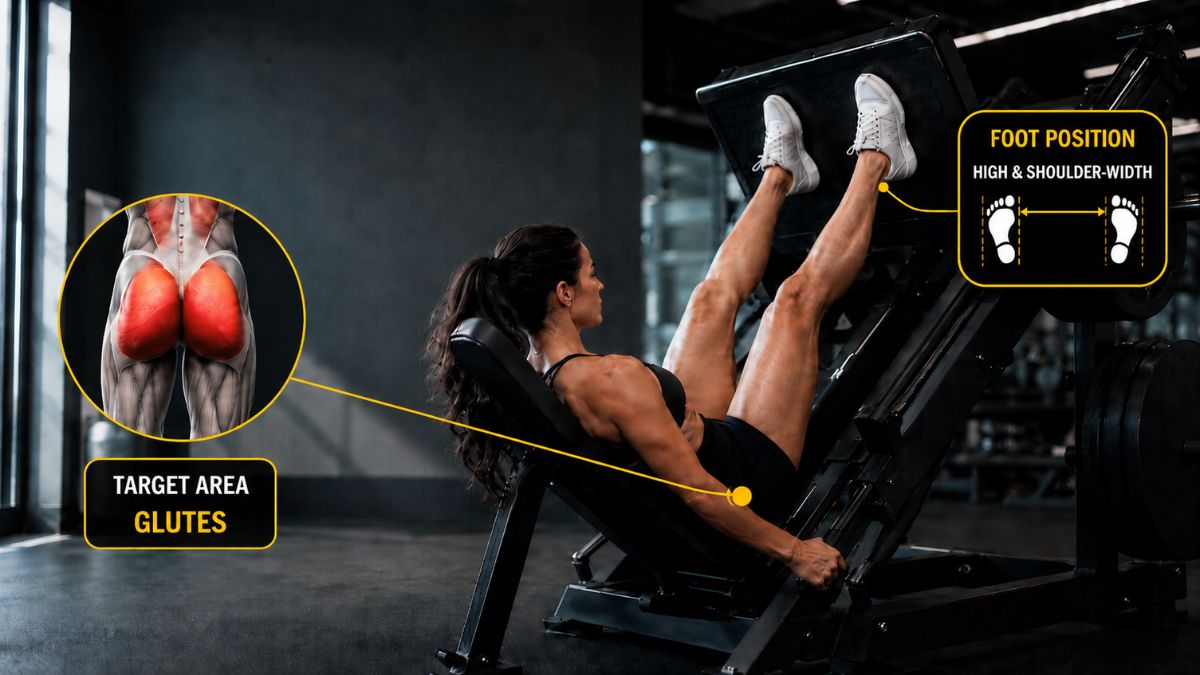
The leg press for glutes can be a useful lower-body exercise when you set it up with your hips, not just your knees, in mind. Many people think of the leg press as a quad machine, and it often is. But a higher foot position, controlled depth, and steady pressure through the midfoot and heel can shift more work toward the glutes and hamstrings.
The leg press is especially helpful if you want a stable, machine-based exercise that lets you train your legs hard without the balance demands of squats or lunges. It can work for beginners learning lower-body strength, gym-goers adding glute volume, and advanced lifters who want a joint-friendly accessory movement.
The key is intention. Glute-focused leg pressing is not about loading the heaviest plates possible. It is about choosing a foot position you can control, keeping your hips supported, and pressing with clean, steady form.
Is Leg Press Good for Glutes?
Yes, the leg press can be good for glutes, especially when you use a setup that increases hip involvement. The gluteus maximus is a primary hip extensor, meaning it helps straighten the hip as you press the platform away. Because the glutes help extend the hips, exercises that train hip extension can support glute strength and growth when they are programmed well. [1,3]
That said, the leg press does not automatically target the glutes. A low, narrow foot position usually makes the movement more knee-dominant and quad-focused. A higher, slightly wider foot position typically increases the hip contribution, which can make the exercise more useful for glute training. [2]
The leg press also gives you more external stability than many free-weight lower-body exercises. Since your back is supported, you can focus on controlled reps, consistent foot pressure, and training close to fatigue without worrying as much about balance.
For best results, use the leg press as one part of a complete glute program. Hip thrusts, squats, lunges, step-ups, Romanian deadlifts, cable kickbacks, and hip abduction exercises can all contribute to glute development in different ways. [1]
What Muscles Does the Leg Press Work?
The leg press mainly works the quadriceps, glutes, hamstrings, and adductors. Your calves help stabilize the ankle and foot position, while your core helps keep your body steady against the seat. [2,4]
These muscles do not work equally in every setup. Foot height, stance width, depth, machine type, load, and anatomy can change where you feel the exercise most.
Your exact muscle emphasis depends on how you set up the machine. Studies comparing leg press variations suggest that higher foot placement can increase gluteus maximus activity compared with lower placement, while lower placement tends to emphasize the quadriceps more. [2,4]
How the Leg Press Works Your Glutes
Your glutes work hardest when your hips move through a meaningful range of motion. As you lower the sled, your hips flex. As you press back up, your glutes help extend the hips and move the platform away. [1]
A few setup and technique choices can make this easier: higher foot placement, controlled depth, a stance that lets your knees track naturally, slower lowering, and steady pressure through the whole foot.
A deeper range of motion can be helpful, but only if your pelvis stays stable. If your lower back rounds or your hips lift off the pad, you have gone deeper than your current setup or mobility allows.
Best Foot Placement on Leg Press for Glutes
For most people, a good glute-focused starting point is placing the feet higher on the platform, about shoulder-width to slightly wider, with the toes turned out slightly. This position usually allows more hip flexion and encourages the glutes and hamstrings to contribute more. [2]
Use this as your starting point:
| Setup Detail | Glute-Focused Recommendation |
|---|---|
| Foot height | Higher on the platform |
| Stance width | Shoulder-width or slightly wider |
| Toe angle | Slightly turned out |
| Foot pressure | Midfoot to heel, with the whole foot planted |
| Depth | As deep as you can control without lower-back rounding |
Your feet should not be so high that your range of motion becomes short or awkward. If your feet are too high, you may feel strain behind the knees, lose control at the bottom, or reduce the amount of useful work your glutes can do.
The goal is not the highest possible foot placement. The goal is a position where you can lower smoothly, feel a strong stretch through the glutes and hamstrings, keep your hips down, and press without pain.
Leg Press for Glutes Foot Placement: What to Avoid
Avoid placing your feet too low if your main goal is glute growth. A low foot position usually increases knee bend and shifts more work toward the quadriceps. That is not wrong, but it is not the best setup when you want to bias the glutes. [2]
Avoid locking your knees aggressively at the top. Press until your legs are almost straight, then keep a soft bend in the knees so tension stays on the muscles instead of shifting into the joints.
Avoid letting your knees collapse inward. Your knees should generally track in the same direction as your toes. If they cave in, reduce the weight and focus on control.
Avoid lifting your hips off the pad. If your pelvis rolls up at the bottom, shorten the range of motion, adjust the seat, or move your feet slightly until your back stays supported.
Avoid turning foot placement into a rigid rule. Your height, hip structure, ankle mobility, and machine design all affect what feels best. Use the glute-focused setup as a starting point, then adjust by feel and control.
How to Use Leg Press for Glutes Step by Step
Sit on the machine with your back and hips firmly against the pad. Use your glute-focused foot setup: feet higher on the platform, about shoulder-width or slightly wider, with a slight toe-out if comfortable.
Brace your core lightly before you begin. You do not need to over-arch your back. Keep your ribs down and your pelvis stable against the seat.
Unlock the safety handles and take control of the sled. Lower the platform slowly, allowing your knees to travel toward the sides of your torso rather than straight into your chest. Stop when you feel a strong stretch in your glutes and hamstrings without your hips lifting.
Press the platform away through your midfoot and heel. Keep your whole foot planted, your knees tracking over your toes, and your movement smooth.
At the top, stop before a hard knee lockout. Keep tension in your legs and glutes, then begin the next rep with the same control.
Leg Press for Glutes Form: Key Cues That Actually Help
Think “hips stay heavy.” Your hips should stay pressed into the seat throughout the rep. If they lift, reduce the depth or adjust your foot position.
Think “slow down, then drive.” Lowering too quickly makes it harder to control the sled and feel your glutes. A two- to three-second lowering phase works well for many lifters.
Think “whole foot, heel bias.” You can emphasize the heel and midfoot, but do not lift your toes completely. A stable foot gives you better control.
Think “knees follow toes.” If your toes point slightly outward, your knees should move in that same direction.
Think “deep but clean.” More depth can increase hip involvement, but only if your lower back stays supported and your pelvis does not roll under.
How to Position Legs on Leg Press for Glutes
Learning how to position legs on leg press for glutes takes some experimentation. A tall person with long femurs may need a different setup than a shorter person. Someone with tight hips or sensitive knees may also need small adjustments.
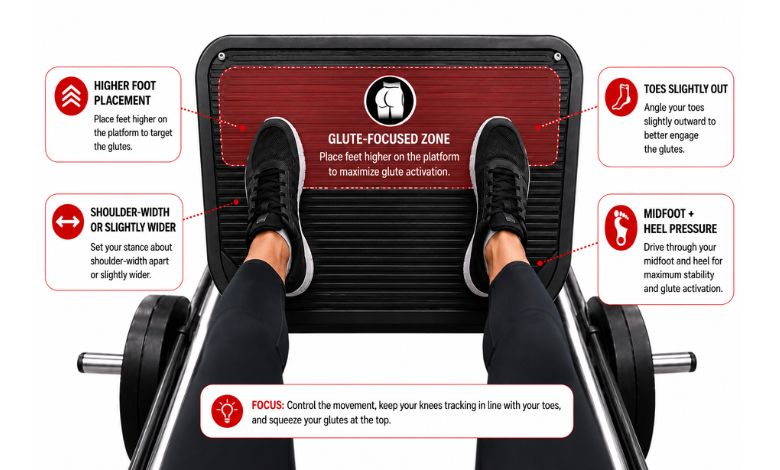
Start with a light weight and test your setup. Try a high, shoulder-width stance first. Then move slightly wider if your hips feel better that way. Finally, adjust your feet a few inches higher or lower until the movement feels strong and controlled.
The best position is the one that lets you train hard, keep your joints comfortable, maintain clean form, and repeat the same movement rep after rep.
The leg press can look different depending on the machine. The same glute-focused rules apply across most versions: keep your feet higher, use controlled depth, keep your hips supported, and press through the midfoot and heel.
Seated Leg Press for Glutes
The seated leg press for glutes usually refers to a horizontal or slightly angled machine where you sit more upright and push the platform forward. This version often feels beginner-friendly because the movement path is controlled and the machine is easy to set up.
To make the seated leg press more glute-focused, place your feet higher on the platform and lower the weight slowly. Some seated machines have a shorter range of motion than 45-degree machines, so seat adjustment matters.
Set the seat so you can bend your knees and hips enough to feel your glutes without feeling cramped. Keep your hips against the pad and avoid rounding your lower back as the platform comes toward you.
The seated leg press can work well for higher-rep sets. Sets of 10 to 20 reps often provide enough time under tension without requiring very heavy loads.
Single Leg Press for Glutes
The single leg press for glutes is useful when one side feels stronger, more coordinated, or easier to activate than the other. Training one leg at a time can help you notice and correct those differences.
Place one foot high on the platform, usually near the same line you would use for a two-leg glute-focused press. Keep your working knee tracking over your toes. Your non-working leg can stay off the platform, depending on the machine and what feels safe.
Lower slowly and avoid letting your hip twist. Press through the midfoot and heel of the working leg. Use less weight than you use for your regular two-leg press.
Single-leg presses work well after your main sets. For example, you might perform regular leg press first, then finish with two or three sets of single-leg presses for extra glute-focused volume.
Angled Leg Press for Glutes
The angled leg press for glutes usually refers to the 45-degree leg press machine. This is one of the most common versions in gyms. Because the platform is often larger, many lifters find it easier to use a higher and wider stance.
For glute training, the angled leg press can be very effective. The larger platform gives you room to adjust foot height, stance width, and toe angle.
Set your feet high enough that the movement feels hip-driven, but not so high that your range of motion becomes short. Lower the sled until you feel a controlled stretch through the glutes, then press up without bouncing.
Because the angled leg press can handle heavy loads, ego lifting is common. Heavy weight is only useful if you can control it. Short, rushed reps with limited knee and hip movement are unlikely to build your glutes as effectively as clean reps through a strong range of motion.
Horizontal Leg Press for Glutes
The horizontal leg press for glutes is common in commercial gyms, beginner training areas, and physical therapy settings. Instead of pressing a sled upward at an angle, you push the platform forward while seated.
This version may feel less intense than the angled leg press, but it can still train the glutes well. The main limitation is that some horizontal machines restrict depth. Since glute involvement often improves when you can control more hip flexion, seat setup is important.
Choose a seat position that allows your knees to bend comfortably while your back stays supported. Place your feet higher on the platform if the machine allows it. Use slower reps and focus on pressing smoothly through the midfoot and heel.
Linear Leg Press for Glutes
A linear leg press for glutes moves along a fixed track. Many 45-degree machines are linear because the sled travels in a straight path. This fixed path can make the exercise feel stable and predictable.
The same glute-focused principles apply: place your feet higher, use a shoulder-width to slightly wider stance, lower with control, and keep pressure through the midfoot and heel.
Because the track is fixed, you may need to adjust your foot position carefully so your knees and hips move comfortably. If your knees feel awkward, change your stance, adjust your toe angle, reduce the load, or shorten the range slightly.
Common Mistakes That Reduce Glute Activation
Using too much weight is one of the biggest mistakes. If the load is so heavy that you can only move through a short range of motion, your glutes will not get the full benefit.
Bouncing at the bottom is another common problem. It uses momentum instead of muscle control and may increase stress on the knees, hips, or lower back.
Some lifters place their feet high but still push mostly through the toes. This can shift tension forward. Keep your whole foot planted and drive through the midfoot and heel.
Poor depth control can also reduce results. Going too shallow may limit glute involvement, but going too deep with a rounded lower back is not better. Your best depth is the deepest position you can control while keeping your hips and back stable.
Skipping warm-up sets can make it harder to feel your glutes. A few lighter sets, bodyweight bridges, or lateral band walks can help you find the target muscles before heavier work.
Best Sets and Reps for Glute Growth
For glute growth, the leg press usually works best with moderate to higher reps and clean control. You can use heavier sets, but most lifters get better glute tension when they prioritize range of motion, tempo, and consistent effort.
A good starting plan:
| Goal | Sets | Reps | Rest |
|---|---|---|---|
| Beginner strength | 2–3 | 10–12 | 60–90 seconds |
| Muscle growth | 3–5 | 8–15 | 90–150 seconds |
| Glute burnout | 2–3 | 15–25 | 45–90 seconds |
| Single-leg control | 2–4 per side | 8–12 | 60–120 seconds |
Train close to fatigue, but do not let your form fall apart. A good set should feel challenging near the end while still allowing you to control the sled. The 2026 ACSM resistance training position stand emphasizes that progressive resistance training and appropriate manipulation of training variables can improve muscle function, hypertrophy, and physical performance. [3]
Sample Glute-Focused Leg Press Workouts
Beginner Glute Leg Press Workout
Warm up with five to ten minutes of light cardio, then perform two light leg press sets before your working sets.
Use a high, shoulder-width foot position. Perform three sets of 10 to 12 reps, resting about 90 seconds between sets. Keep each rep slow and controlled.
Pair the leg press with bodyweight glute bridges, walking lunges, or cable abductions for a more complete lower-body session.
Intermediate Glute Leg Press Workout
Start with three to four working sets of 8 to 12 reps on an angled or seated leg press. Use a high, slightly wide stance.
Then perform two to three sets of single-leg presses for 10 to 12 reps per side. Keep the weight lighter and the movement controlled.
Finish with a hip hinge movement, such as Romanian deadlifts, and a glute isolation exercise, such as cable kickbacks or hip abductions.
Advanced Glute Leg Press Workout
Use the leg press as a high-volume glute builder after your main compound lift. For example, after squats or hip thrusts, perform four sets of 10 to 15 reps on the leg press.
On the last set, reduce the weight and continue with a controlled drop set. Keep the same foot placement and avoid turning the reps into short, rushed presses.
Advanced lifters can also use pauses at the bottom, slow lowering phases, or single-leg variations to increase difficulty without constantly adding more weight.
Safety Tips for Training Glutes on the Leg Press
The leg press is stable, but it still requires careful setup. Always use the machine’s safety stops correctly. Do not lower the sled farther than you can control. Avoid twisting your torso or turning your head during the set.
Keep your lower back against the pad. If you feel pressure in your lower back, reduce the depth, adjust the seat, or lower the weight.
Stop if you feel sharp pain, numbness, tingling, or joint pain. Muscle effort and burning are normal during challenging sets, but pain is not a cue to push harder.
People with knee, hip, or back injuries should ask a qualified healthcare professional, physical therapist, or certified fitness professional for guidance before using heavy loads.
Wear stable shoes. Very soft running shoes can make it harder to press evenly through your feet. Flat trainers, lifting shoes, or barefoot-style shoes may feel more stable, depending on your preference and gym rules.
Why You Feel Leg Press More in Quads Than Glutes
You may feel the leg press more in your quads because your setup is too knee-dominant. A low foot position, narrow stance, shallow depth, or toe-heavy pressure can all shift the work forward into the thighs. [2]
You may also be stopping before your hips move through enough range of motion. If the sled barely lowers, your glutes do not get much opportunity to stretch and extend the hips.
Another reason is load. When the weight is too heavy, many lifters shorten the rep and push through the easiest path. That often turns the movement into a partial quad press.
Your anatomy matters too. Some people naturally feel more quad involvement on the leg press because of limb length, hip structure, ankle mobility, or the machine angle. That does not mean you are doing it wrong. It means you may need more setup experimentation.
How to Feel Your Glutes More During Leg Press
Start by reducing the weight. A lighter load makes it easier to control the movement and find the right position.
Move your feet higher on the platform and slightly wider if that feels comfortable. Turn your toes out just enough that your knees can track naturally.
Slow the lowering phase. Aim for two to three seconds on the way down, then pause briefly at the bottom without relaxing. Press up through your midfoot and heel.
Before your working sets, try one or two glute activation movements, such as bodyweight hip thrusts, banded glute bridges, or lateral band walks. These exercises are not magic, but they can help you connect with the target muscles before heavier leg press sets.
Focus on the stretch at the bottom and a smooth drive out of it. You do not need to force a hard glute squeeze at the top if it causes you to lock your knees or lose position.
Leg Press vs. Hip Thrusts, Squats, Lunges, and RDLs for Glutes
The leg press can support glute growth, but it works best when combined with other movement patterns.
| Exercise | Best Use for Glutes | Main Advantage | Main Limitation |
|---|---|---|---|
| Leg press | Machine-based glute and leg volume | Stable, easy to load, beginner-friendly | Can become quad-dominant with poor setup |
| Hip thrust | Direct hip extension | Strong glute emphasis with less balance demand | Less stretch in the lengthened position |
| Squat | Full lower-body strength | Trains glutes, quads, core, and coordination | More technical and more spine loading |
| Lunges | Single-leg glute and hip control | Trains balance and side-to-side differences | More demanding on coordination |
| Romanian deadlift | Glutes and hamstrings in a lengthened position | Strong hip hinge pattern | Requires good hinge technique |
A systematic review found that step-ups, hip thrusts, deadlifts, lunges, and squats can all produce high or very high gluteus maximus activation, depending on technique, load, velocity, fatigue, and stabilization demands. [1]
Hip thrusts are often more directly glute-focused because they emphasize hip extension. Squats and lunges are excellent compound movements because they train the glutes along with the quads, adductors, and trunk. Romanian deadlifts train the glutes and hamstrings through a hip-hinge pattern, especially in the lengthened portion of the movement.
For most people, the best glute program includes more than one exercise. Use the leg press for stable, high-quality lower-body volume, then combine it with hip thrusts, hinges, lunges, step-ups, or abduction work for fuller glute development. [1]
Quick Checklist: Leg Press for Glutes Form
Before each set, run through this checklist:
| Form Check | What to Do |
|---|---|
| Feet | High on the platform, shoulder-width to slightly wider |
| Toes | Slightly turned out if comfortable |
| Knees | Track in the same direction as the toes |
| Hips | Stay heavy against the pad |
| Back | Remains supported without rounding |
| Depth | Deep enough to feel glutes, not so deep that hips lift |
| Pressure | Whole foot planted, with emphasis through midfoot and heel |
| Tempo | Slow lowering phase, controlled press |
| Top position | Stop before aggressive knee lockout |
Save This Form Checklist
- Feet high on the platform
- Hips stay against the pad
- Knees follow toes
- Lower with control
- Press through midfoot and heel
- Stop before hard lockout
FAQs of Leg Press for Glutes
Place your feet higher on the platform, about shoulder-width to slightly wider, with your toes turned out slightly. Keep pressure through your midfoot and heel and lower only as far as you can control without your hips lifting.
A higher foot placement usually increases hip involvement and may help you feel your glutes more. Research comparing leg press variations has found higher gluteus maximus activity with higher foot placement than lower foot placement.
A slightly wider stance can help some people feel more glute involvement, especially if it allows the hips to open comfortably. Avoid going so wide that your knees cave in, your hips lift, or your range of motion becomes awkward.
You may be placing your feet too low, pressing through your toes, using too much weight, or stopping before your hips move through enough range of motion. Try moving your feet higher, slowing down the lowering phase, and reducing the load. [2]
Single-leg press is not automatically better, but it is useful for improving side-to-side balance and increasing focus on one glute at a time. Use lighter weight and keep your hips level throughout the rep.
The leg press can support glute growth, but it should not fully replace hip thrusts if your main goal is glute development. Hip thrusts train direct hip extension, while the leg press trains a combined hip-and-knee extension pattern. Using both can give you a stronger overall program.
Most people can train glutes with the leg press one to two times per week, depending on total lower-body volume, recovery, and exercise selection. More is not always better; progress comes from consistent effort, enough recovery, and gradual overload.
Avoid aggressive knee lockout. Press until your legs are nearly straight, then keep a soft bend in the knees to maintain tension and reduce joint stress.
Conclusion
The leg press for glutes works best when you train with purpose. A higher foot position, shoulder-width to slightly wider stance, controlled depth, and steady pressure through the midfoot and heel can help shift more work toward your glutes.
Whether you use a seated, angled, horizontal, linear, or single-leg variation, the same principles apply: keep your hips supported, lower with control, press smoothly, and avoid ego lifting.
The leg press is not a magic glute builder by itself, but it can be a valuable part of a well-rounded lower-body routine. Use it alongside hip thrusts, hinges, lunges, step-ups, and abduction work to build stronger, more capable glutes.
Medical References
Update History
Originally written by Medicalic.
Your answer helps us improve the clarity and usefulness of our health content.