You can spend hours perfecting a homemade dish. The seasoning is just right, the aroma is irresistible, and the flavor is every bit as good as you’d hoped. Yet something still feels different from the food you’d get at a restaurant.
Maybe the sauce isn’t quite as silky, the ice cream lacks that smooth, creamy finish, or your gluten-free bread doesn’t have the satisfying texture you were aiming for.
So what’s the secret behind that professional-quality texture?
Guar gum and xanthan gum are two game-changing ingredients. Just a pinch can transform the texture of a batter, sauce, or frozen dessert without changing the flavor you’ve worked so hard to perfect.
But here’s where the choice gets interesting: they don’t work the same way in every recipe. Knowing when to reach for each one is what makes the difference.
Guar Gum vs Xanthan Gum: What’s the Real Difference?
Both are hydrocolloids, ingredients that interact with water to change a food’s thickness and texture.[1] Both can thicken hot or cold mixtures without needing heat to activate.
Guar gum comes from the inner part of guar seeds. The guar plant is a legume grown mainly in India and Pakistan. Xanthan gum is produced by fermenting sugar with a bacterium called Xanthomonas campestris.
Here’s how their properties compare:
| Guar gum | Xanthan gum |
|---|---|
| Source: Inner part of guar seeds | Source: Fermented sugar |
| Mouthfeel: Soft, creamy, and full-bodied | Mouthfeel: Smooth, with good flow and binding properties |
| Heat and acid: Can lose thickness during prolonged heating or in highly acidic foods | Heat and acid: Generally maintains its thickness better |
| Cost: Often less expensive | Cost: Often more expensive |
Which One Creates a Better Texture?
Think about a spoonful of vanilla pudding and a glass of iced chocolate coffee. You want the pudding to feel rich, smooth, and creamy. The coffee has a different job: it should be easy to sip, but not so thin that the chocolate settles at the bottom of the glass.
Guar gum is well suited to giving puddings and other creamy desserts a soft, full-bodied mouthfeel. Xanthan gum can help iced chocolate coffee stay smooth and evenly mixed, while adding enough body that it doesn’t feel watery as quickly when the ice begins to melt.
The trick isn’t just to make the pudding or coffee thicker. It’s to give each one the texture it needs.
Which Is Better for Gluten-Free Bread and Pizza?
In regular bread dough, gluten forms a stretchy network that traps the gas bubbles released by yeast. As those bubbles expand, the dough rises, while the gluten network helps it hold its shape.
Gluten-free dough doesn’t have that natural support. It can struggle to hold onto the gas as it rises, leaving the finished bread dense or crumbly. Pizza dough can be difficult to stretch and shape without breaking apart.
This is where guar gum and xanthan gum help. Both bind water and improve dough cohesion, helping the ingredients stay together and giving the dough more support as it rises and bakes.[2] They don’t recreate gluten, but they can make a noticeable difference to the finished texture.
Xanthan gum is a common choice for gluten-free yeast bread and pizza because it helps the dough maintain its structure. Guar gum also improves binding and moisture retention, although it may produce a different texture. How well either one works depends on the flour blend, water content, and overall recipe.
For gluten-free yeast bread and pizza, xanthan gum is usually the better starting point.
Before adding either gum, check your flour blend. Many ready-made gluten-free blends already contain a binder, and adding more can throw off the texture.
Which Works Better in Cakes, Muffins, and Cookies?
Nobody wants a muffin that chews like pizza crust. Cakes and muffins should have a soft, tender crumb that holds together without feeling heavy or rubbery.
In gluten-free baking, getting that balance can be tricky. Without the binding properties of wheat flour, batters may struggle to hold together, leaving cakes crumbly or muffins dry. Gums can help by binding water and improving the batter’s consistency, so the finished treats stay moist and hold their shape.
Guar gum is a useful choice for soft cakes and muffins. It helps retain moisture and adds body to the batter, supporting a tender crumb. Xanthan gum can also work well, especially in recipes that need stronger binding to keep everything together.
Cookies are a little different. A delicate, tender cookie doesn’t need the same structure as one that should hold its shape. Either gum can work, depending on the flour blend and the texture you’re after.
But more gum doesn’t mean better baking. Too much can make cakes heavy or cookies unpleasantly tough, while flour, starch, fat, sugar, and eggs still play important roles in the finished texture.
For soft cakes and muffins, guar gum is a reasonable first choice. For cookies, either can work; xanthan may be more useful when stronger binding is needed.
Guar Gum vs Xanthan Gum for Ice Cream: Which Makes It Creamier?
You scoop into a container of homemade ice cream, expecting something silky. Instead, you get little icy crystals that crunch between your teeth.
Ice cream contains water, which forms tiny ice crystals as the mixture freezes. Those crystals can grow larger during storage, especially when temperatures fluctuate. That’s when a smooth, creamy dessert starts to feel icy and grainy.
Guar gum and xanthan gum help manage that water, slowing ice crystal growth and improving how the ice cream feels and melts. Guar gum is widely used in commercial ice cream because it adds body to the base and helps create a smooth, creamy mouthfeel.[3] Xanthan gum can also improve texture and stability, including in some lower-fat frozen desserts.
Of course, gums aren’t the whole story. Sugar, fat, milk proteins, and freezing conditions also influence how creamy the final scoop turns out.
A Ninja CREAMi works a little differently. Instead of churning ice cream as it freezes, it processes a base that’s already frozen solid. That means a protein-heavy base may need a different balance of ingredients than traditional full-fat ice cream. Some CREAMi recipes use guar gum, some use xanthan gum, and others combine both.
For conventional ice cream, guar gum is often a sensible place to start. For Ninja CREAMi, choose a tested recipe that matches your base.
Which Is Better for Sauces and Dressings?
A good salad dressing should coat the leaves, not run straight to the bottom of the bowl. And a creamy sauce should feel smooth and rich without becoming too thick or heavy.
The challenge is keeping that consistency. Oil and vinegar naturally tend to separate, while thinner sauces may not cling to food the way you want. Guar gum and xanthan gum can help by adding body and slowing separation.
For vinaigrettes and other acidic dressings, reach for xanthan gum.[4] It holds its thickness well in mixtures made with vinegar or citrus juice while remaining easy to pour. For milder, creamy sauces that aren’t cooked for long, guar gum is a good choice for creating a softer, fuller mouthfeel.
Can You Use Both Together?
You don’t always have to choose between guar gum and xanthan gum. Some gluten-free and frozen-dessert recipes use both to achieve a particular texture.
When combined, the two gums can interact, changing a mixture’s thickness and consistency in ways that neither produces alone.[5] This can be useful when a recipe needs a careful balance of structure, body, and smoothness.
But using both doesn’t automatically mean better results. Adding the usual amount of each gum can make a mixture too thick or gummy. The right balance depends on the other ingredients, so it’s best to follow a tested recipe rather than guess the proportions.
Tip: Out of xanthan gum? You still have options. Check out our guide to xanthan gum substitutes to find what works best for your recipe.
Which Is Better for Sensitive Digestion?
If you’re worried about bloating or stomach discomfort, how much gum you consume matters.[6] Both guar gum and xanthan gum can cause gas or bloating, particularly in larger amounts. But the small quantities typically used in everyday cooking are generally well tolerated.
Neither gum is automatically gentler on the stomach. If you have IBS or a sensitive digestive system, your own tolerance is a better guide than assuming one is healthier than the other.
What About Gluten, Vegan Diets, and Allergies?
Both gums are vegan and naturally gluten-free. If you have celiac disease, look for products labeled gluten-free to avoid cross-contact concerns.
Guar gum comes from a legume, while xanthan gum is produced through fermentation. If you have food allergies, check the product’s allergen information or contact the manufacturer.
The Bottom Line
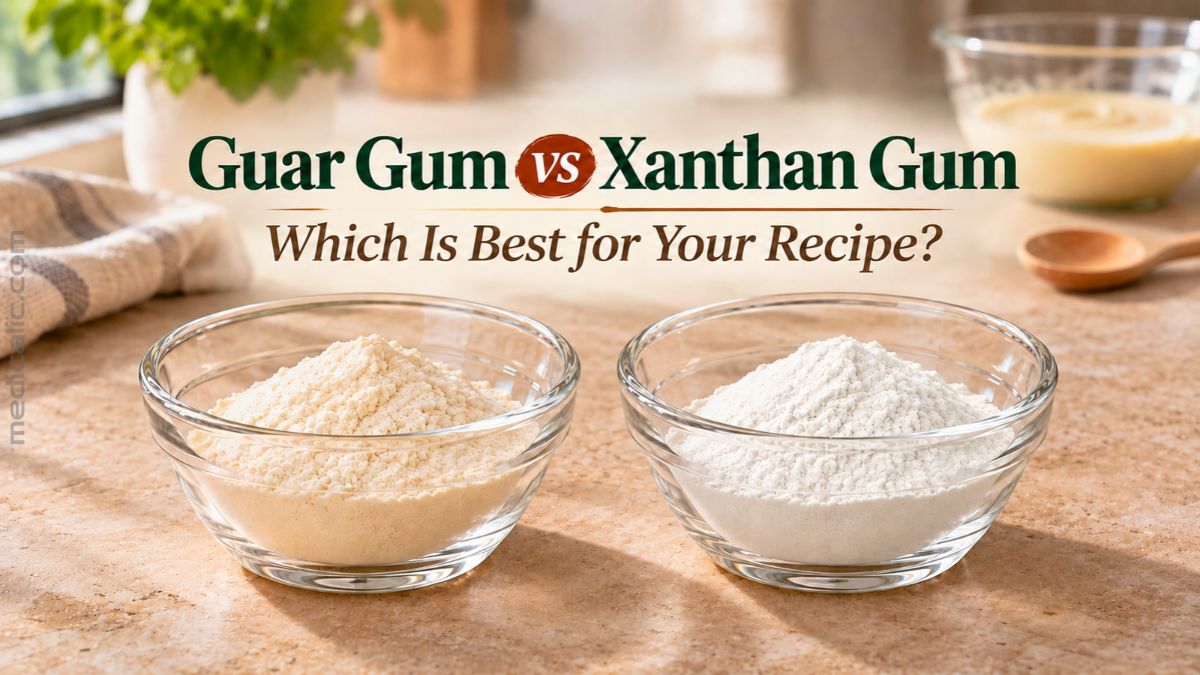
Guar gum and xanthan gum may look nearly identical in their jars, but the results they create can be surprisingly different.
The trick is to understand what your food needs before you reach for either one. Once you know what you’re trying to achieve, that tiny pinch stops feeling like a gamble, and the difference shows up where it matters: a loaf that holds its rise, a scoop that stays smooth, a dressing that pours just right.
Medical References
Update History
Existing medical references updated.
Originally written by Arooj Ahsan, RDN.
Your answer helps us improve the clarity and usefulness of our health content.