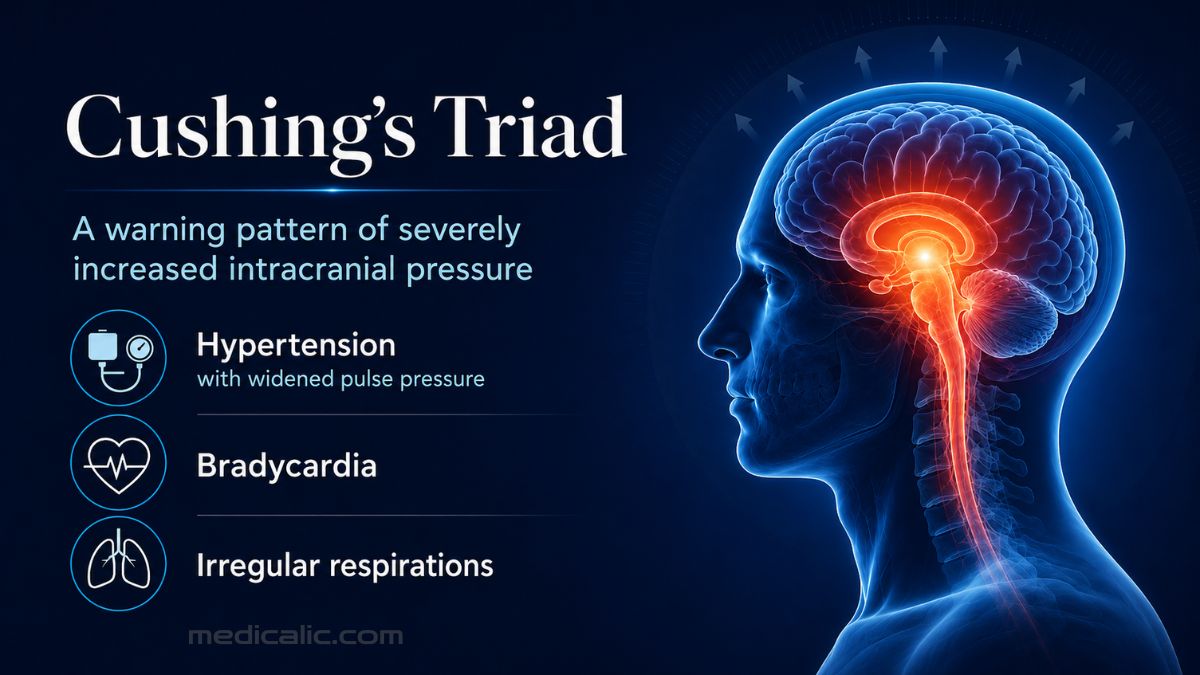
A rising blood pressure, a slowing heart rate, and abnormal breathing can form a dangerous pattern called Cushing’s triad. Together, these signs can indicate severely elevated pressure inside the skull, reduced blood flow to the brain, or brainstem compression.
What Is Cushing’s Triad?
Cushing’s triad is a group of three vital-sign changes linked to dangerously increased intracranial pressure (ICP):
- High blood pressure, often with widened pulse pressure
- Bradycardia, or an unusually slow heart rate
- Irregular or abnormal breathing
The physiological process behind these changes is called the Cushing reflex or Cushing response. The resulting three-sign pattern is known as Cushing’s triad. Clinicians use Cushing’s triad as a warning sign, not as a diagnosis by itself. It may signal severe intracranial hypertension with brainstem compromise or impending brain herniation, dangerous displacement of brain tissue. [1]
What Are the Three Signs of Cushing’s Triad?
1. High Blood Pressure With Widened Pulse Pressure
Blood pressure often rises as the body tries to preserve blood flow to the brain. The systolic pressure, or top number, may increase more than the diastolic pressure, widening the gap between them.
For example, 180/70 mmHg produces a pulse pressure of 110 mmHg. One reading does not diagnose Cushing’s triad. Clinicians consider the trend, heart rate, breathing, neurological examination, and the person’s overall condition.
2. Bradycardia
As blood pressure rises, the heart rate may slow. In adults, bradycardia generally means a resting pulse below 60 beats per minute, but that rate is not always abnormal. Fitness, medications, and underlying heart conditions can affect a person’s usual pulse.
A slow heart rate alone does not prove that ICP is elevated. The combination of new bradycardia, high blood pressure, and neurological decline is what makes the pattern especially concerning.
3. Irregular Breathing
Breathing may become slow, shallow, uneven, or interrupted by pauses when rising pressure affects brainstem centers that regulate respiration. No single pattern appears in every patient, so irregular or abnormal breathing is more accurate than expecting a specific rhythm such as Cheyne–Stokes breathing.
Why Does Cushing’s Triad Happen?
The skull is a rigid space containing brain tissue, blood, and cerebrospinal fluid. When bleeding, swelling, a mass, or excess fluid adds volume, the body initially compensates by displacing cerebrospinal fluid and venous blood. Once that reserve is exhausted, ICP may rise quickly.
Cerebral perfusion pressure, which helps drive blood flow through the brain, is commonly expressed as:
As ICP rises, cerebral perfusion may fall. The nervous system raises blood pressure in an effort to maintain brain blood flow. [2] pressure sensors may then contribute to a slower pulse. If the brainstem becomes compressed or poorly perfused, breathing can become irregular.
How the triad appears varies with age, medications, ventilation, the location of the injury, and how quickly ICP rises. Direct brain injury, medications, ventilation, age, and the speed or location of the pressure increase can change how the signs appear.
What Causes Cushing’s Triad?
Conditions that can produce severe intracranial hypertension include:
- Traumatic brain injury
- Epidural, subdural, or intracerebral bleeding
- A large stroke with brain swelling
- Brain tumor or abscess
- Hydrocephalus, or excess cerebrospinal fluid
- Severe brain infection
- Diffuse swelling after oxygen deprivation
- Blocked venous drainage from the brain
Cushing’s triad is the alarm, not the final diagnosis. Treatment depends on the cause.
Is Cushing’s Triad an Early or Late Sign?
The complete triad is generally a late and ominous sign. Other neurological warning signs may appear before or alongside the complete triad, including worsening headache, repeated vomiting, confusion, increasing sleepiness, unequal pupils, weakness, seizures, or declining consciousness.
Its absence does not rule out dangerously raised ICP. In a prehospital study of 249 adults with traumatic brain injury, a Cushing-type response was defined as systolic blood pressure above 160 mmHg together with a heart rate below 60 beats per minute.
This response had a specificity of 96.9% but a sensitivity of only 11.5% for raised ICP. When either a fixed dilated pupil or this Cushing-type response was considered a positive warning sign, sensitivity increased to 36.8%, while specificity remained high at 93.2%. These thresholds were specific to the study and should not be treated as universal diagnostic criteria. [3]
The pattern is highly concerning when present, but its absence cannot reliably exclude raised ICP.
When to Call Emergency
Get emergency help immediately for:
- Increasing drowsiness or difficulty waking
- Loss of consciousness or a seizure
- Unequal or poorly responsive pupils
- New weakness, numbness, slurred speech, or confusion
- Repeated vomiting after a head injury
- Abnormal posturing or unusual stiffening
- Slow, irregular, labored, or paused breathing
- Rapid decline after a fall, crash, sports injury, assault, stroke-like episode, or recent brain surgery
Follow the emergency dispatcher’s instructions. Avoid giving food, drink, or medication. Do not move the person unnecessarily when a neck injury is possible unless the area is unsafe or movement is needed to keep the airway open.
How Clinicians Evaluate Suspected Cushing’s Triad
Emergency teams first protect the airway, support breathing and circulation, and check mental status, pupils, movement, vital-sign trends, and the events leading to the decline.
A non-contrast head CT commonly helps identify bleeding, swelling, hydrocephalus, or a mass. Some critically ill patients also need invasive ICP monitoring.
For selected patients with severe traumatic brain injury, the Brain Trauma Foundation recommends using ICP-monitoring information to guide care. The Brain Trauma Foundation’s fourth-edition severe TBI guideline recommends treating ICP above 22 mmHg because values above this level are associated with increased mortality. [4]
This is a hospital threshold for severe TBI, not a home measurement or a universal definition of Cushing’s triad.
How Is the Increased Intracranial Pressure Behind Cushing’s Triad Treated?
Treatment focuses on stabilizing the patient, limiting further brain injury, and correcting the cause. Clinicians may support oxygenation and ventilation, position the head and neck to aid venous drainage, use hypertonic saline or mannitol, drain cerebrospinal fluid, control seizures or fever, remove a blood clot or mass, or perform decompressive surgery.
Neurocritical care guidance conditionally suggests hypertonic sodium solutions over mannitol for the initial management of elevated ICP or cerebral edema in traumatic brain injury, although the supporting evidence is low quality.[5] Neither therapy has been shown to reliably improve long-term neurological outcomes by itself.
Clinicians must monitor these treatments closely because they can affect blood pressure, sodium levels, fluid balance, and kidney function. They do not recommend corticosteroids to improve outcomes or reduce ICP after severe traumatic brain injury. Studies have linked high-dose methylprednisolone to increased mortality, so clinicians consider it contraindicated.[6]
Cushing’s Triad vs. Cushing’s Syndrome and Beck’s Triad
| Condition | Main Problem | Classic Features |
|---|---|---|
| Cushing’s Triad | Severe intracranial hypertension due to increased ICP | High blood pressure with widened pulse pressure, bradycardia, and irregular breathing |
| Cushing’s Syndrome | Hormonal disorder caused by prolonged excess cortisol | Weight gain, easy bruising, muscle weakness, hypertension, and metabolic changes |
| Beck’s Triad | Cardiac tamponade (fluid pressure around the heart) | Low blood pressure, distended neck veins, and muffled heart sounds |
Although they share similar names, these conditions involve different organ systems and require different clinical approaches. [7]
Key Takeaways
Cushing’s triad consists of high blood pressure with widened pulse pressure, a slow heart rate, and irregular breathing. It may signal severe intracranial hypertension, brainstem compromise, and impending brain herniation.
Because the full triad is a late sign and may never appear, any sudden neurological decline—especially after a head injury—requires immediate emergency assessment.
Medical References
Update History
Medically reviewed by Dr. Jubair Islam.
Originally written by Dr. Rahul Kushwaha.
Your answer helps us improve the clarity and usefulness of our health content.