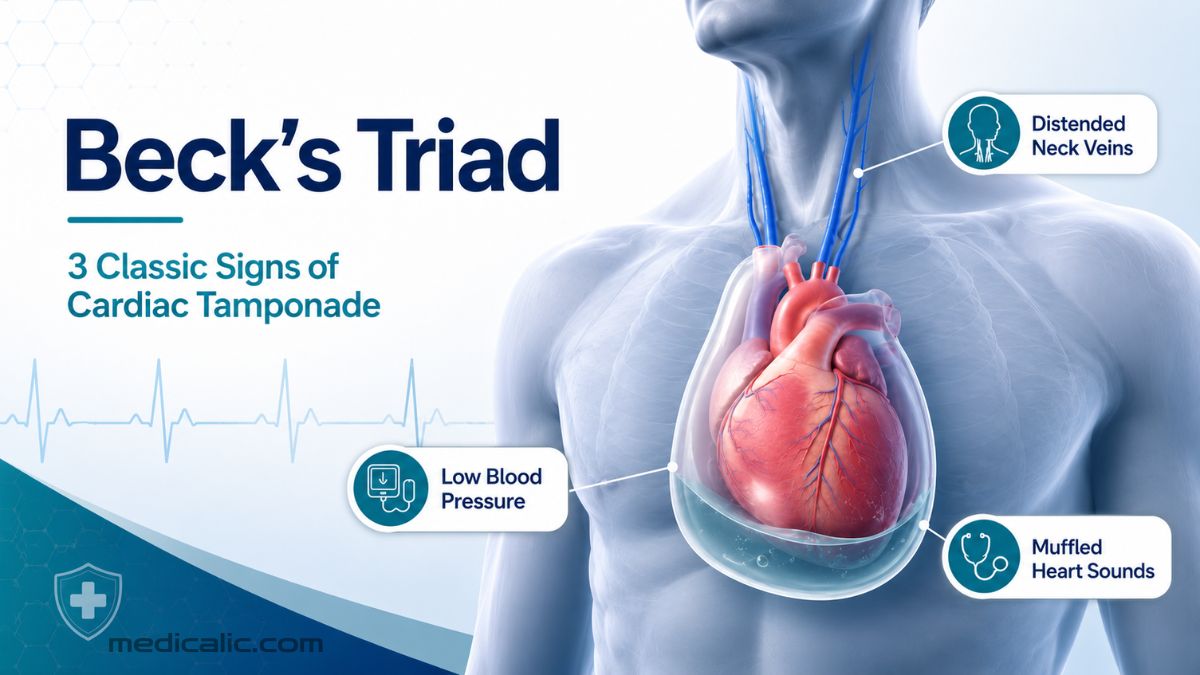
Low blood pressure, distended neck veins, and unusually quiet heart sounds form a classic clinical pattern known as Beck’s triad. The triad is most closely associated with cardiac tamponade, a medical emergency in which fluid or blood around the heart interferes with normal filling and circulation.
Beck’s triad can provide an important warning, particularly when tamponade develops rapidly after trauma, surgery, or a cardiac procedure. However, many patients never develop all three signs. Clinicians therefore treat the triad as a reason for urgent evaluation, not as a checklist that must be complete before cardiac tamponade is considered.
What Is Beck’s Triad?
Beck’s triad is a group of three physical examination signs classically associated with cardiac tamponade. The signs are hypotension, jugular venous distension, and muffled heart sounds.[1]
It is a bedside warning pattern rather than a stand-alone diagnostic test.
What Are the Three Elements of Beck’s Triad?
Beck’s triad consists of:
- Hypotension: abnormally low blood pressure
- Jugular venous distension: increased pressure in the jugular veins, sometimes visible as unusually prominent neck veins
- Muffled heart sounds: heart sounds that seem faint or distant through a stethoscope
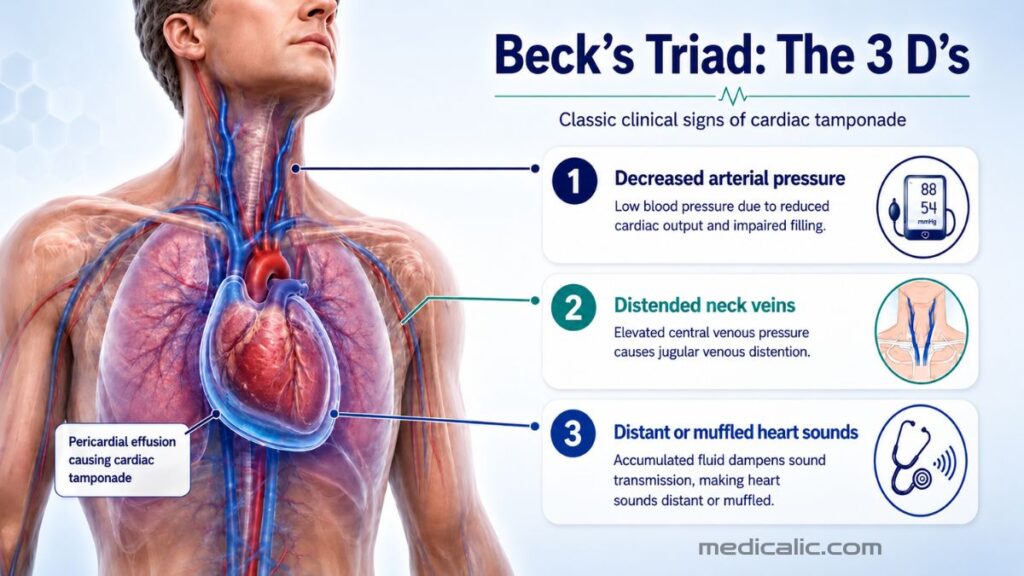
A common memory aid is the “three D’s”: distant heart sounds, distended neck veins, and decreased arterial pressure. This mnemonic is useful for learning, but it is not a diagnostic rule.
What Does Beck’s Triad Indicate?
Together, the three findings suggest that rising pressure around the heart may be restricting cardiac filling and reducing circulation. This pattern is most likely to appear when fluid or blood accumulates rapidly.
The triad should increase clinical suspicion, but it does not establish the diagnosis on its own. Many patients with cardiac tamponade have only one or two elements and may never develop the complete pattern.
Why Do These Three Signs Occur?
The heart is surrounded by the pericardium, a protective sac with a limited ability to stretch quickly. When fluid or blood builds up inside this space, the rising pressure can compress the heart and restrict how much blood enters its chambers between beats.[2]
Each part of Beck’s triad reflects this process:
- Blood pressure falls because reduced heart filling lowers the amount of blood pumped forward.
- Jugular veins become distended because blood backs up in the systemic venous circulation.
- Heart sounds may become faint because surrounding fluid or blood reduces sound transmission to the chest wall.
The speed of accumulation is especially important. A relatively small, rapidly developing hemopericardium—blood inside the pericardial sac—may cause sudden circulatory collapse. A larger effusion developing over weeks may initially cause fewer signs because the pericardium has more time to stretch.
Is Beck’s Triad Always Present?
No, and this is one of the most important limitations of the triad.
In one retrospective emergency-department study involving 153 adults with pericardial effusion, none of the patients with effusion or tamponade had all three elements of Beck’s triad.[3] In that cohort, the complete triad had a reported sensitivity of 0% (95% CI, 0%–19.4%). Because this was a retrospective study in a selected patient population, the result should not be interpreted as a universal estimate.
The complete pattern is more likely to appear when tamponade develops rapidly, such as after acute bleeding from chest trauma. It is often incomplete when fluid accumulates more gradually.
Blood pressure may remain normal early in the condition. Jugular venous distension may be difficult to detect in a dehydrated person, while muffled heart sounds can be subtle or obscured by body size, background noise, lung disease, or mechanical ventilation.
Clinicians should therefore not wait for all three findings before investigating suspected cardiac tamponade.
Because the complete triad is frequently absent, clinicians also look for other symptoms and signs of impaired circulation.
Other Cardiac Tamponade Warning Signs
The components of Beck’s triad are examination findings that most people cannot reliably assess at home. Someone with cardiac tamponade may experience:
- Sudden or worsening shortness of breath
- Chest pressure or discomfort
- A rapid heartbeat
- Weakness, dizziness, or fainting
- Confusion or reduced alertness
- Cold, pale, or clammy skin
Clinicians may also detect a narrow pulse pressure or pulsus paradoxus, a fall in systolic blood pressure of more than 10 mmHg during inspiration.[4] Pulsus paradoxus can support the diagnosis, but it is not specific to cardiac tamponade and may be absent in some patients.
How Clinicians Evaluate Suspected Tamponade
Clinicians evaluate the person’s symptoms, vital signs, circulation, medical history, jugular venous pressure, and heart sounds. Recent chest trauma, heart surgery, catheter procedures, pacemaker placement, or ablation may increase concern.
Bedside transthoracic echocardiography is usually the key imaging test. It can show fluid around the heart and help determine whether pressure is affecting cardiac filling.[5] Beck’s triad may strengthen suspicion, but diagnosis depends on the complete clinical and imaging picture.
Beck’s Triad vs. Cushing’s Triad
Although both are named triads, they describe different medical emergencies.[6]
| Feature | Beck’s Triad | Cushing’s Triad |
|---|---|---|
| Associated emergency | Cardiac tamponade | Dangerously increased intracranial pressure |
| Blood pressure | Hypotension | Hypertension with widened pulse pressure |
| Heart rate | Often rapid, although not part of the triad | Bradycardia |
| Other defining findings | Distended neck veins and muffled heart sounds | Irregular breathing |
What Is Beck’s Cognitive Triad?
Beck’s cognitive triad belongs to psychology rather than cardiology. It describes negative beliefs about the self, the world, and the future within cognitive theories of depression.[7]
Despite sharing the Beck name, the cognitive triad has no connection to cardiac tamponade, pericardial pressure, or the three cardiovascular signs discussed in this article.
When to Seek Emergency Help
Call emergency services immediately or the appropriate emergency number in your country if someone has severe breathing difficulty, faints, becomes confused or unusually drowsy, develops cold and clammy skin, or has chest symptoms accompanied by weakness and a rapid heartbeat.
Seek immediate help when these symptoms occur after chest trauma, heart surgery, or a cardiac procedure.
Key Takeaways
- Beck’s triad consists of hypotension, jugular venous distension, and muffled heart sounds.
- It is classically associated with cardiac tamponade, particularly when fluid or blood accumulates rapidly around the heart.
- Many patients with cardiac tamponade do not have the complete triad.
- Clinicians use Beck’s triad as a warning clue rather than a stand-alone diagnostic test.
- Suspected cardiac tamponade requires immediate medical assessment.
Medical References
Update History
Medically reviewed by Dr. Jubair Islam.
Originally written by Dr. Rahul Kushwaha.
Your answer helps us improve the clarity and usefulness of our health content.