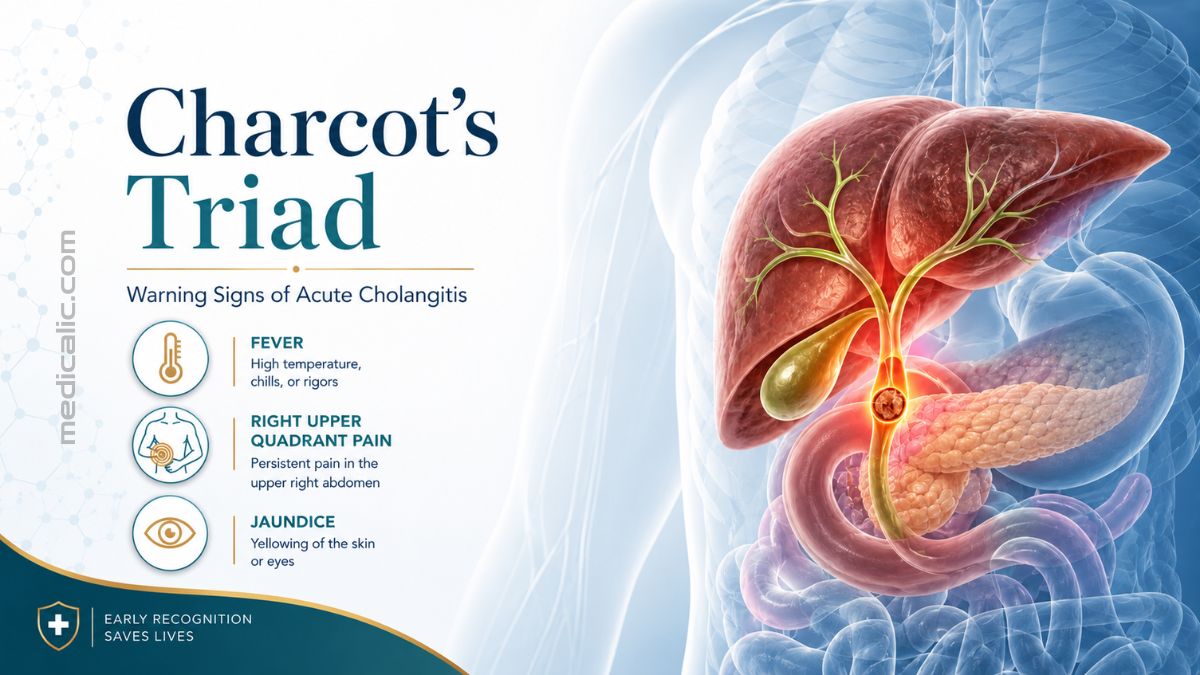
Fever, pain beneath the right ribs, and yellowing of the eyes or skin may seem like separate symptoms. When they occur together, they form Charcot’s triad, a classic clinical pattern that raises urgent concern for acute cholangitis, a potentially serious infection of the bile ducts.[1]
The complete triad strongly supports the diagnosis when present, but it is not a checklist that every patient will complete. Many people with acute cholangitis develop only one or two of these features.
Charcot’s triad should therefore be treated as a warning signal, not a requirement. Recognizing the pattern can speed up diagnosis, but waiting for all three symptoms may delay urgent medical care.
What Is Charcot’s Triad?
The biliary form of Charcot’s triad consists of:
- Fever, often with chills or shaking
- Right upper quadrant abdominal pain
- Jaundice, meaning yellowing of the skin or whites of the eyes
Charcot’s triad is classically associated with acute cholangitis, also called ascending cholangitis.
The Three Components of Charcot’s Triad
Fever or Chills
Fever reflects the body’s inflammatory response to infection. Shaking chills, or rigors, may occur when the infection is more intense or has spread into the bloodstream.
Some older adults and immunocompromised people may have a less obvious fever response, so a normal temperature does not eliminate concern.
Right Upper Quadrant Pain
The liver, gallbladder, and major bile ducts sit mainly in the upper-right abdomen. Obstruction and rising pressure in the bile ducts may cause pain or tenderness beneath the right ribs.
The pain can also be felt in the upper-middle abdomen and may occur with nausea or vomiting.
Jaundice
Jaundice develops when bilirubin cannot drain normally through the biliary system and accumulates in the blood. Yellowing may be easiest to notice in the whites of the eyes. Dark urine, pale stools, itching, and reduced appetite may appear as well.
How Reliable Is Charcot’s Triad for Diagnosis?
The complete triad is clinically meaningful, but its absence is not reassuring enough to stop an evaluation. A systematic review of 16 studies involving 4,288 patients estimated the sensitivity of Charcot’s triad at 36.3%. Among the three studies that reported specificity, the pooled estimate was 93.2%.[2] A later nationwide prospective cohort of 794 patients undergoing ERCP for suspected biliary obstruction reported a sensitivity of 46% and a specificity of 99%.[3] Together, these findings show that the complete triad strongly supports acute cholangitis when present but fails to identify more than half of affected patients.
This limitation is especially important in older adults. In a retrospective study of patients with ERCP-confirmed acute cholangitis due to common bile duct stones, 33.6% of those aged 80 or older presented with altered mental status, while 9.1% had no abdominal pain, fever, or jaundice.[4] Symptoms may also be subtle or atypical in people with biliary stents, malignant obstruction, or weakened immune systems.
How Acute Cholangitis Develops
Acute cholangitis usually begins when a stone, stricture, tumor, or blocked stent prevents normal bile drainage. The resulting bile stasis and increased duct pressure allow bacteria to multiply and may lead to bloodstream infection or sepsis.
Bile duct obstruction → bile stasis and rising pressure → bacterial infection → systemic inflammation or sepsis
Common causes include:
- Common bile duct stones
- Benign bile duct strictures
- Pancreatic, ampullary, or bile duct tumors
- A blocked biliary stent
- Incomplete drainage or another complication following ERCP or a biliary intervention
- Less commonly, parasitic obstruction
How Doctors Diagnose Acute Cholangitis
Modern diagnosis does not depend on Charcot’s triad alone. The Tokyo Guidelines 2018 organize the evidence into three broad groups:[5]
| Diagnostic area | What doctors look for |
|---|---|
| Systemic inflammation | Fever, chills, abnormal white blood cell count, or elevated inflammatory markers |
| Cholestasis | Jaundice or abnormal bilirubin and liver test results |
| Imaging | Bile duct dilation or evidence of a stone, stricture, mass, or stent obstruction |
A suspected diagnosis is based on evidence of systemic inflammation plus either cholestasis or supportive imaging. A definite diagnosis requires findings from all three categories.
Blood tests help support the diagnosis, identify cholestasis, and assess the severity of illness.
Tests That Support the Diagnosis
- Complete blood count
- CRP or other inflammatory markers
- Bilirubin
- Alkaline phosphatase and GGT
- AST and ALT
- Blood cultures
Tests That Help Assess Severity
- Creatinine and kidney function
- Platelet count
- PT/INR or other coagulation tests
- Serum albumin
- Lactate when sepsis or poor tissue perfusion is suspected
Abdominal ultrasound is usually the first imaging test and may show bile duct dilation or gallstones. If ultrasound is inconclusive and clinical suspicion remains high, CT can help identify obstruction, complications, tumors, or another cause of the symptoms. MRCP or endoscopic ultrasound may be used when more detailed evaluation of the bile ducts is needed.[6]
ERCP is primarily a therapeutic procedure rather than a routine diagnostic test. Its main role is to drain an obstructed bile duct and treat the underlying cause.
Severity Grading in Acute Cholangitis
The Tokyo Guidelines classify acute cholangitis into three severity levels. Severity grading guides the urgency of organ support and biliary drainage.
| Severity grade | General meaning | Typical management implication |
|---|---|---|
| Grade I: Mild | No features of moderate or severe disease | Initial treatment may include antibiotics, fluids, and close monitoring |
| Grade II: Moderate | Meets at least two moderate-severity criteria, such as an abnormal white blood cell count, fever of 39°C or higher, age 75 years or older, bilirubin of 5 mg/dL or higher, or low albumin | Early biliary drainage is generally recommended |
| Grade III: Severe | Dysfunction of one or more organs, such as the cardiovascular, neurological, respiratory, renal, hepatic, or blood-clotting systems | Immediate resuscitation and organ support are required, followed by biliary drainage as soon as the patient can safely undergo it |
Severity can change over time, so clinicians reassess patients rather than relying on the initial presentation alone.
Charcot’s Triad vs. Reynolds’ Pentad
Reynolds’ pentad is a historical bedside pattern associated with severe acute cholangitis. It adds two findings to Charcot’s triad:
- Low blood pressure
- Altered mental status, such as confusion or reduced alertness
| Finding | Charcot’s triad | Reynolds’ pentad |
|---|---|---|
| Fever | ✓ | ✓ |
| Right upper quadrant pain | ✓ | ✓ |
| Jaundice | ✓ | ✓ |
| Low blood pressure | ✓ | |
| Altered mental status | ✓ |
Reynolds’ pentad suggests severe illness with circulatory or neurological dysfunction. Yet it is even less sensitive than Charcot’s triad, so clinicians should never wait for all five findings before treating a patient who appears septic or unstable.
Charcot’s triad is one of several classic three-sign patterns used in clinical medicine. Another important example is Beck’s triad, which is associated with cardiac tamponade.
Cholangitis vs. Cholecystitis
- Acute cholangitis is an infection of the bile ducts, usually related to obstruction.
- Acute cholecystitis is inflammation of the gallbladder, most often caused by a stone blocking the cystic duct.
Both can cause fever and right-sided abdominal pain. Jaundice, however, raises greater concern for obstruction of the common bile duct or cholangitis.
Charcot’s triad is therefore classically linked to cholangitis—not uncomplicated cholecystitis.
The main differences between these conditions are summarized below:
| Condition | Typical clue |
|---|---|
| Biliary colic | Episodic pain without systemic inflammation |
| Acute cholecystitis | Persistent right upper quadrant pain with gallbladder inflammation |
| Choledocholithiasis | Common bile duct stone, sometimes causing jaundice |
| Acute cholangitis | Obstruction plus infection and systemic inflammation |
How Acute Cholangitis Is Treated
Treatment has two main goals: control the infection and drain the obstructed bile duct.
Initial hospital care may include:[7]
- Intravenous fluids
- Antibiotics
- Blood cultures and laboratory monitoring
- Pain and nausea control
- Support for low blood pressure or organ dysfunction
The blocked bile duct often needs drainage. ERCP is generally preferred when feasible because it can decompress the biliary system and treat the cause without open surgery.
Guidance from the American Society for Gastrointestinal Endoscopy favors endoscopic over percutaneous drainage and suggests biliary decompression within 48 hours for most appropriate patients.[9] Patients with septic shock or clinical deterioration may require earlier intervention after initial resuscitation and stabilization.
Depending on the cause, ERCP may involve removing a stone, replacing a blocked stent, opening a narrowed duct, or placing temporary drainage.
The exact antibiotic choice and timing of procedures depend on illness severity, local resistance patterns, allergies, organ function, and the source of obstruction.[8]
When to Seek Emergency Care
Do not wait for all three symptoms of Charcot’s triad. Seek urgent evaluation for:
- Fever with yellow skin or eyes
- Persistent or worsening pain beneath the right ribs
- Jaundice with chills, vomiting, or marked weakness
- New confusion, unusual drowsiness, or fainting
- Rapid breathing, very low blood pressure, or reduced urine output
- Fever or abdominal symptoms after ERCP or biliary stent placement
Suspected acute cholangitis requires prompt hospital assessment and treatment because the condition can deteriorate rapidly.
Frequently Asked Questions
Yes. Jaundice may be mild, absent, or appear later. Fever or pain may also be missing, particularly in atypical presentations.
The same name is also used for a historical neurological triad described in multiple sclerosis: nystagmus, intention tremor, and scanning speech. It is separate from the biliary triad and is not the modern basis for diagnosing MS.
Key Takeaway
Charcot’s triad is an important clue to acute cholangitis, but it is absent in many confirmed cases. Diagnosis depends on the overall clinical picture, laboratory evidence of inflammation and cholestasis, and imaging of the biliary system. Suspected cases require prompt assessment because early antibiotics, supportive care, and biliary drainage can reduce the risk of progression to sepsis and organ dysfunction.
Medical References
Update History
Medically reviewed by Dr. Jubair Islam.
Originally written by Dr. Rahul Kushwaha.
Your answer helps us improve the clarity and usefulness of our health content.