You finally settle into bed, hoping your heart will calm down with the rest of your body. Then you turn onto one side, lie flat, or adjust your pillow. Suddenly, your heartbeat feels louder, faster, or more irregular. For people with atrial fibrillation, nighttime can make every flutter feel more noticeable.
The best AFib sleep position is not the same for everyone. For many people, right-side sleeping or an elevated back position is the best place to start. Left-side sleeping can trigger or intensify palpitations in some people with paroxysmal AFib, while sleeping flat on the back can worsen snoring or obstructive sleep apnea. [1,3,4]
Sleep position will not cure atrial fibrillation. It should not replace medication, rhythm monitoring, CPAP therapy, cardiology care, or emergency evaluation when symptoms are serious. But the right position can make sleep feel calmer, reduce heartbeat awareness, and help you notice patterns worth discussing with your clinician.
Why Sleep Position Can Affect AFib Symptoms
Sleep position affects AFib symptoms because lying down changes how your body feels and functions at night. Your heart rate, breathing pattern, blood return to the chest, and nervous system activity all shift during sleep. At the same time, your bedroom is quieter and you are less distracted, so an irregular heartbeat can feel stronger than it did during the day.
Position also changes how pressure is distributed across the chest. Lying on the left side can make the heartbeat easier to feel because the heart sits closer to the chest wall. For some people, that creates stronger heartbeat awareness. For others, it seems to trigger palpitations more directly.
Back sleeping has a different concern. It can make snoring and obstructive sleep apnea worse because the tongue and jaw can fall backward and crowd the airway. For people with sleep apnea, back sleeping is often one of the least helpful positions because it can make airway crowding worse.[8] For people with AFib, that matters because sleep-disordered breathing is linked with AFib and other cardiovascular complications. [3]
This is why sleep position should be treated as a comfort and pattern-tracking tool. It is not the root cause for everyone, but it can influence symptoms, breathing comfort, reflux, and how strongly you notice your heartbeat.
What Research Says About AFib Sleep Position
Research on AFib sleep position is still limited, but it gives useful clues. A 2021 study published in Frontiers in Physiology included 94 people with symptomatic paroxysmal AFib. Twenty-two percent reported that a specific body position triggered their AFib symptoms. Among those who named a trigger position, 57% reported the left lateral position, 33% reported the back/supine position, 10% reported the right side, and 5% reported the stomach/prone position. [1]
A related 2021 study in Physiological Reports found that the left lateral body position increased markers of pulmonary vein stress in healthy volunteers. The pulmonary veins matter because they are a common source of AFib-triggering electrical activity. This does not prove that left-side sleeping triggers AFib in everyone, but it supports a plausible reason why some people notice symptoms in that position. [2]
Key Numbers Behind AFib Sleep Position
These numbers should be read carefully. They do not prove that one sleep position works for everyone. They show that sleep position can matter for a meaningful subgroup of people with symptomatic paroxysmal AFib. [1,2]
The practical takeaway is balanced: right-side sleeping is a reasonable first option if the left side triggers symptoms; elevated back sleeping is useful when breathing or reflux is part of the problem; and left-side sleeping should be guided by your symptom pattern rather than treated as universally good or bad.
Best AFib Sleep Position by Situation
| Sleep Position | Best Fit | What to Watch |
|---|---|---|
| Right side | A good first option if left-side sleeping triggers palpitations | Can worsen reflux for some people |
| Elevated back | Useful for reflux, snoring, breathing discomfort, or suspected sleep apnea | Not a replacement for sleep apnea treatment |
| Left side | Comfortable for some people and often used for reflux | Can trigger or intensify palpitations in some people |
| Flat back | Comfortable for some people without snoring or apnea | Can worsen snoring and obstructive sleep apnea |
| Stomach | Works for a small number of people | Can strain the neck, chest, and upper back |
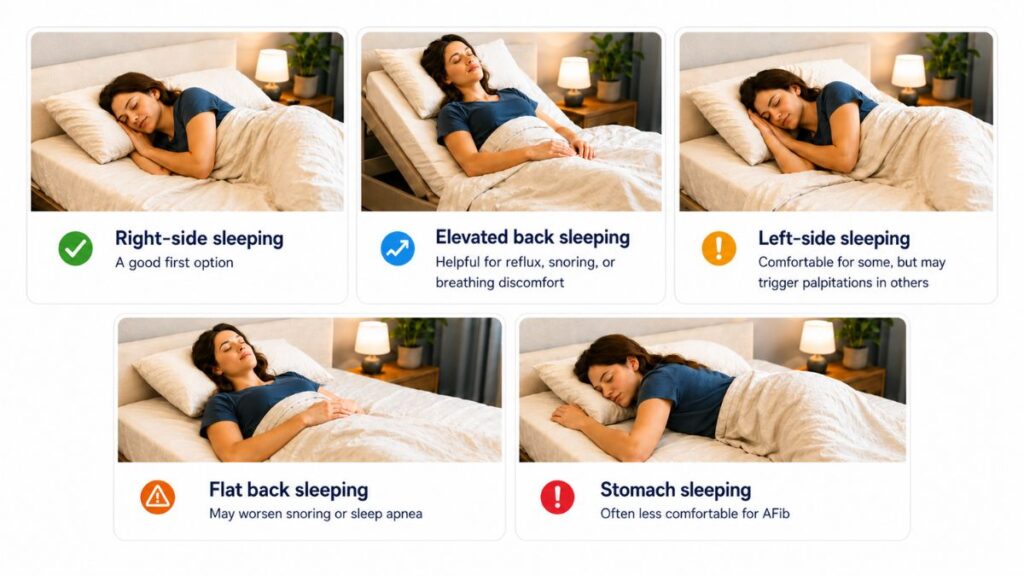
Right-side sleeping
Right-side sleeping is a practical first position to try if you feel worse on your left side. Many people find that the heartbeat feels less forceful in this position. It also avoids the left-sided chest pressure that some people associate with stronger palpitations.
If right-side sleeping worsens reflux, shoulder pain, or hip discomfort, adjust the setup or try an elevated position instead.
Elevated back sleeping
An elevated back position works well when AFib symptoms overlap with reflux, snoring, or breathing discomfort. The goal is to raise the upper body, not just bend the neck with extra pillows. A wedge pillow or adjustable bed supports the chest, shoulders, and upper back more evenly.
This is especially relevant if snoring or possible sleep apnea is part of the picture. Sleep-disordered breathing, including sleep apnea, is closely linked with AFib and other cardiovascular problems. [3]
If you snore loudly, wake up gasping, feel excessively sleepy during the day, or wake with morning headaches, ask your clinician about sleep apnea testing. The American Heart Association lists loud snoring or gasping, irregular breathing during sleep, daytime sleepiness, and morning headaches among common sleep apnea symptoms. [4]
Left-side sleeping
Left-side sleeping is the most complicated AFib sleep position. It can feel comfortable and can be useful for some people with reflux. But for others, it makes the heartbeat feel stronger or brings on palpitations soon after lying down.
If left-side sleeping repeatedly triggers symptoms, choose another position and track the pattern. If you sleep well on the left side and it does not trigger symptoms, current evidence does not support labeling it automatically unsafe.
Flat back sleeping
Sleeping flat on the back is not automatically bad for AFib. The concern is stronger when it worsens snoring, oxygen drops, or obstructive sleep apnea. If you wake up choking, gasping, or with a racing heart after sleeping on your back, that pattern deserves medical attention.
Stomach sleeping
Stomach sleeping is not well studied as an AFib trigger. The main concern is comfort and body strain. It can twist the neck, compress the chest, and make relaxed breathing harder. Although this position can help keep the airway open for some people, it can also strain the spine and neck. [8]
How to Test Your Best AFib Sleep Position
Instead of switching positions randomly, treat this like a simple two-week experiment.
Start with right-side sleeping for three or four nights. Use a pillow behind your back if you tend to roll over. Note whether you wake with palpitations, what time symptoms happen, and whether you had alcohol, caffeine, a heavy meal, dehydration, or unusual stress that evening.
Next, try an elevated back position for three or four nights. Use a wedge pillow or adjustable bed if possible. Avoid stacking pillows under the neck because that can bend the airway and create strain.
Then test left-side sleeping only if it does not clearly trigger symptoms. If palpitations start soon after turning left, change position and record the pattern.
For the final nights, use the position that gave you the calmest sleep. Bring your notes to your cardiologist or electrophysiologist, especially if you use a smartwatch rhythm alert, wearable ECG, or a device such as KardiaMobile.
Track the sleep position you started in, the position you woke in, palpitations, chest discomfort, shortness of breath, dizziness, snoring, gasping, morning headache, alcohol, caffeine, late meals, stress, and any rhythm recording. This turns “I sleep badly with AFib” into information your clinician can actually use.
Nighttime Triggers Beyond Sleep Position
Sleep position is only one part of the AFib sleep puzzle. Palpitations can become more noticeable after alcohol, caffeine, nicotine, dehydration, stress, heavy meals, and poor sleep. Cleveland Clinic lists caffeine, alcohol, nicotine, stress, dehydration, and certain foods among common contributors to heart palpitations. [6]
A calmer bedtime routine can make symptoms less chaotic. Avoid alcohol close to bedtime if it is a known trigger. Keep caffeine earlier in the day. Avoid very large meals within a couple of hours of bed. Caffeine and nicotine can take hours to wear off and that alcohol can disrupt sleep later in the night. [7]
The goal is not to become afraid of sleep. The goal is to make the night more predictable for your heart, breathing, digestion, and nervous system.
When to Get Medical Help
AFib is a serious heart rhythm condition that needs proper medical care. AFib can lead to blood clots in the heart and increases the risk of stroke, heart failure, and other heart-related complications. [5]
Make an appointment with your healthcare provider if you have new palpitations, worsening nighttime symptoms, longer episodes than usual, frequent awakenings with a racing heart, or symptoms that interfere with sleep.
Get urgent or emergency care if palpitations come with chest pain, severe shortness of breath, fainting, severe dizziness, confusion, new weakness, or stroke-like symptoms.
Mayo Clinic advises emergency help for chest pain in the setting of possible AFib because chest pain can signal a heart attack. [5]
Cleveland Clinic also recommends immediate help for palpitations with chest pain, breathing difficulty, dizziness, confusion, fainting, severe swelling, or sudden unusual fatigue. [6]
Sleep position can improve comfort, but it should never delay medical care when symptoms are severe, unusual, or worsening.
Key Takeaways
The best AFib sleep position depends on your symptoms. Right-side sleeping is a good first option when left-side sleeping triggers palpitations. Elevated back sleeping is useful when reflux, snoring, or breathing discomfort is part of the problem. Left-side sleeping is fine for some people but clearly triggering for others.
The bigger issue is not just which side you sleep on. Sleep apnea, alcohol, caffeine, dehydration, stress, reflux, medication timing, and overall heart health can all affect nighttime symptoms.
Use sleep position as a comfort tool, not a treatment replacement. Track your pattern, make small changes, and share what you notice with your clinician.
AFib Sleep Position FAQs
For many people, the best starting position is the right side or an elevated back position. Right-side sleeping is useful when left-side sleeping triggers palpitations. Elevated back sleeping is helpful when reflux, snoring, or breathing discomfort is involved.
Sleep position can affect AFib symptoms by changing chest pressure, breathing comfort, reflux, and how strongly you notice your heartbeat. Back sleeping can also worsen snoring or sleep apnea in some people.
Sleep apnea is strongly connected with AFib and other cardiovascular problems. If you snore loudly, gasp during sleep, wake with morning headaches, or feel sleepy during the day, ask about sleep apnea testing.
Get urgent help if palpitations come with chest pain, severe shortness of breath, fainting, confusion, severe dizziness, new weakness, or stroke-like symptoms. Do not try to solve those symptoms by changing sleep position.
Medical References
Update History
Originally written by Medicalic.
Your answer helps us improve the clarity and usefulness of our health content.