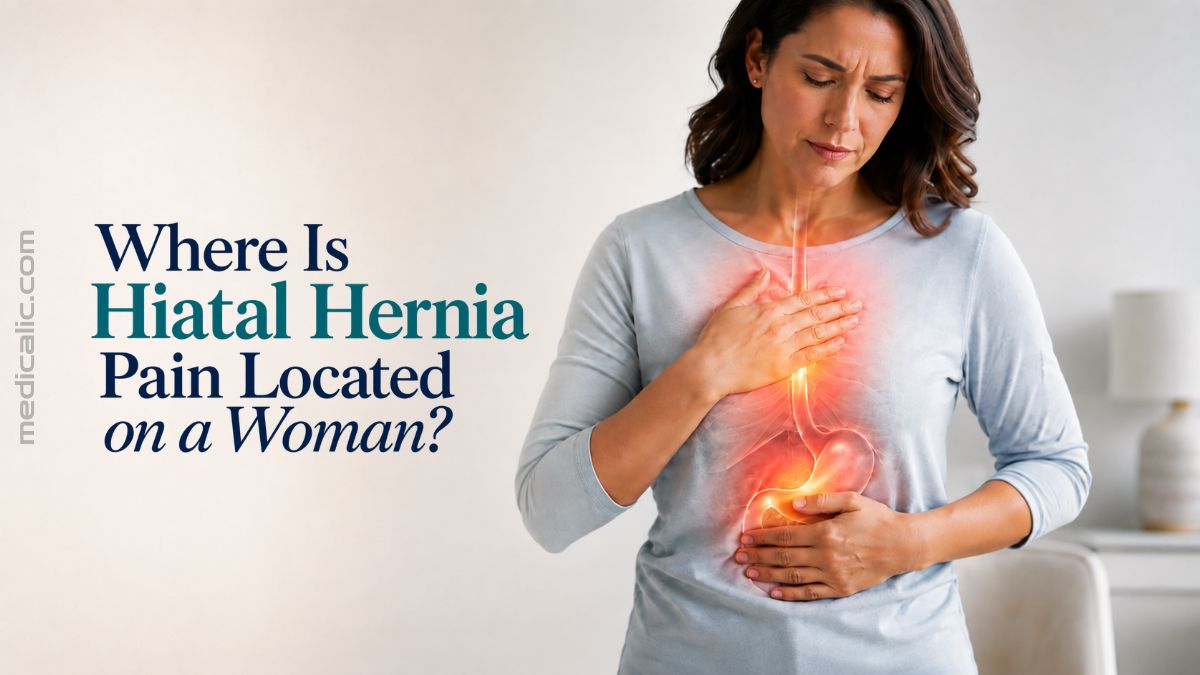
A burning, pressure-like, or aching feeling around your chest or upper abdomen can be unsettling, especially when it is difficult to tell whether it is coming from your stomach, esophagus, chest wall, or heart. So, where is hiatal hernia pain located on a woman?
Hiatal hernia discomfort is most often felt in the center of the chest behind the breastbone or in the upper-middle abdomen just below the ribs. If acid reflux is involved, a burning sensation may rise from the chest toward the throat.
Larger hernias may cause more pressure or fullness than classic heartburn. Many small hiatal hernias, however, cause no symptoms at all.
There is no established female-specific location for hiatal hernia pain. The basic anatomy involved is the same, so symptoms in women generally occur in the same chest and upper-abdominal areas seen in other adults.
Pain location alone cannot tell you whether a hiatal hernia is responsible. Heart, lung, esophageal, stomach, gallbladder, breast, rib, and muscle problems can produce discomfort in overlapping areas.
Where Is Hiatal Hernia Pain Usually Located?
A hiatal hernia develops at the diaphragm, the large muscle separating your chest from your abdomen. Your esophagus passes through a small opening in this muscle called the hiatus before connecting with your stomach. With a hiatal hernia, part of the stomach moves upward through that opening into the chest.[1]
Because the hernia is internal, you usually cannot see or feel a lump from the outside. And the place where the hernia sits is not always the same place where you feel symptoms, especially when acid reflux is involved.
Center of the chest or behind the breastbone
Hiatal-hernia-related discomfort is commonly felt in the middle of the chest, especially behind the breastbone. It may feel like burning, pressure, aching, tightness, or indigestion. When reflux is involved, the burn may rise toward the throat and occur with regurgitation, a sour taste, cough, or hoarseness.[2] That rising burn comes from irritation of the esophagus, not from the hernia physically moving upward.
Reflux discomfort can feel surprisingly similar to heart-related pain. For that reason, new or unexplained chest pain should never be assumed to come from a known hiatal hernia.
Upper-middle abdomen
Discomfort can also settle in the upper-central abdomen beneath the breastbone and ribs, an area doctors call the epigastrium.
A larger hiatal hernia may cause chest or upper-abdominal pain or pressure, make you feel full unusually quickly, and sometimes lead to trouble swallowing or shortness of breath.
Under the left breast or ribs
Some women describe deep chest or upper-abdominal discomfort as being “under the breast.” A hiatal hernia or reflux could potentially be perceived in that area because the lower chest and upper stomach are nearby.
However, pain under the left breast is not a specific sign of a hiatal hernia. Breast tissue, chest-wall muscles, ribs, lungs, esophagus, stomach, and heart can all cause pain in or near this region.
Pain that is clearly within the breast—especially if accompanied by a new lump, nipple changes, discharge, or skin changes—deserves evaluation as a breast symptom rather than being assumed to come from a hiatal hernia.
Back or shoulder pain
Back or shoulder pain is not a typical or specific sign of a hiatal hernia. If pain in either area is persistent or severe, it deserves evaluation rather than being attributed to a hernia based on location alone.
What Does Hiatal Hernia Pain Feel Like?
Hiatal hernia discomfort does not feel the same for everyone. When symptoms occur, the sensation often depends on what is causing them.
Reflux-related discomfort is more likely to feel burning, especially behind the breastbone. A larger hernia may feel more like pressure, fullness, or a dull ache in the chest or upper abdomen.
Finding a hiatal hernia on an imaging test does not automatically mean it explains every episode of chest or abdominal pain.
Is Hiatal Hernia Pain Different in Women?
Women do not appear to have a separate pattern of hiatal hernia pain locations.
The relevant anatomy is essentially the same, so the usual symptom areas remain the central chest, behind the breastbone, and upper-middle abdomen. Some studies suggest that women experience or report reflux symptoms more intensely or frequently than men.[3] However, those studies looked at GERD, not hiatal-hernia pain specifically, and they do not show that women feel the pain in a different place.
Pregnancy deserves separate consideration because hormonal changes and increased abdominal pressure can make gastroesophageal reflux more likely.[4]
That does not mean heartburn during pregnancy proves a hiatal hernia is present. Persistent chest pain, severe upper-abdominal pain, difficulty breathing, repeated vomiting, or other concerning symptoms during pregnancy should be assessed by a healthcare professional.
When Does Hiatal Hernia Pain Tend to Get Worse?
Timing can offer another useful clue.
Reflux-related symptoms may become more noticeable after eating or when lying down. People with hiatal-hernia-related reflux may benefit from smaller meals and avoiding lying down soon after eating. Elevating the upper body during sleep may also help some people with nighttime reflux.
Bending or activities that increase pressure within the abdomen can sometimes make symptoms more noticeable, although this pattern cannot confirm the diagnosis by itself.
If you are trying to understand recurring discomfort, keeping a short symptom record can be useful. Note where the discomfort occurs, what it feels like, what you had recently eaten, your body position, how long it lasts, and whether symptoms such as breathlessness, sweating, nausea, or trouble swallowing occur with it.
Hiatal Hernia Pain vs. Heart-Related Chest Pain
Reflux and heart-related pain can overlap enough that symptoms alone are not always easy to separate.
Reflux becomes more plausible when the sensation is a burning discomfort behind the breastbone that occurs along with regurgitation or a sour taste and is related to meals or lying down.
But these clues cannot safely rule out a heart problem.
For women as well as men, chest pain or discomfort remains the most common heart attack symptom. Women can also experience shortness of breath, nausea, lightheadedness, cold sweating, unusual tiredness, or discomfort involving the back, shoulder, arm, jaw, or stomach.[5]
If you develop new or severe chest pressure or pain, particularly with trouble breathing, sweating, faintness, nausea, or discomfort spreading into your arm, jaw, neck, shoulder, or back, call 911 in the United States or your local emergency number elsewhere.
Do not assume the pain is harmless because you already have reflux or a diagnosed hiatal hernia.
When to Seek Medical Care
Occasional heartburn is common, but persistent symptoms or certain warning signs should be checked by a healthcare professional.
You should also get medical advice if symptoms do not improve with appropriate over-the-counter treatment and lifestyle changes. NIDDK also recommends evaluation for digestive-tract bleeding, such as vomiting blood, coffee-ground-like material, or passing black, tarry stools.
How Doctors Diagnose a Hiatal Hernia
Doctors may use tests to confirm a hiatal hernia and investigate other possible causes of your symptoms.
The condition is often discovered while a doctor is investigating heartburn or chest or upper-abdominal pain. Depending on the situation, testing may include an upper gastrointestinal X-ray after drinking contrast material, upper endoscopy to examine the esophagus and stomach, or esophageal manometry to measure how the muscles of the esophagus work during swallowing.[6]
How Hiatal Hernia Symptoms Are Treated
Small, symptom-free hiatal hernias usually do not need treatment. When heartburn or reflux is the main problem, management may involve smaller meals, avoiding lying down after eating, losing weight if you are overweight or have obesity and your healthcare professional recommends it, stopping smoking, and raising the head and upper body during sleep.
Medicines used for reflux can include antacids for occasional mild symptoms, H2 blockers, and proton pump inhibitors.[7] Persistent symptoms or frequent medication use should be discussed with a healthcare professional rather than managed indefinitely without assessment.
Surgery is not required simply because a hiatal hernia has been found. It may be considered when symptoms are not adequately controlled, complications are present, or the characteristics of the hernia make repair appropriate.
Current SAGES guidance for type II–IV hiatal hernias emphasizes individualized surgical decisions and shared decision-making because management depends on factors such as symptoms, hernia type, clinical findings, benefits, and risks.[8]
Frequently Asked Questions
A hiatal hernia is generally not described as being on the right or left side in the way some abdominal-wall hernias are. It develops where the esophagus passes through the diaphragm near the central lower chest and upper abdomen.
Hiatal-hernia-related chest or upper-abdominal discomfort may sometimes feel as though it is beneath the breast. However, pain under the left breast is nonspecific and can also originate from the heart, lungs, ribs, muscles, breast tissue, stomach, or esophagus.
Yes. Larger hiatal hernias can cause chest or abdominal pain, early fullness, swallowing difficulty, or shortness of breath even when heartburn is not the main complaint.
It can. Reflux-related symptoms may fluctuate according to meals and body position. But ongoing, worsening, severe, or unexplained pain needs medical evaluation rather than being assumed to come from a hernia.
It can. Reflux-related symptoms may worsen after meals, while a larger hernia can cause upper-abdominal pressure or make you feel full unusually quickly. Pain after eating is not specific to a hiatal hernia, however.
The Bottom Line
So, where is hiatal hernia pain located on a woman? It most often appears behind the breastbone or in the upper-middle abdomen beneath the ribs. Reflux may cause burning that rises toward the throat. Larger hernias may cause pressure, early fullness, swallowing trouble, or shortness of breath.
Pay attention to when the discomfort appears and what symptoms come with it. Notice whether it follows meals or lying down. Persistent or unusual pain deserves medical evaluation. Severe or unexplained chest pain needs urgent care.
Medical References
Update History
Originally written by Dr. Rahul Kushwaha.
Your answer helps us improve the clarity and usefulness of our health content.