A new pain in early pregnancy can be hard to ignore and even harder not to overthink. Is it normal cramping? A sign of miscarriage? Or could it be an ectopic pregnancy?
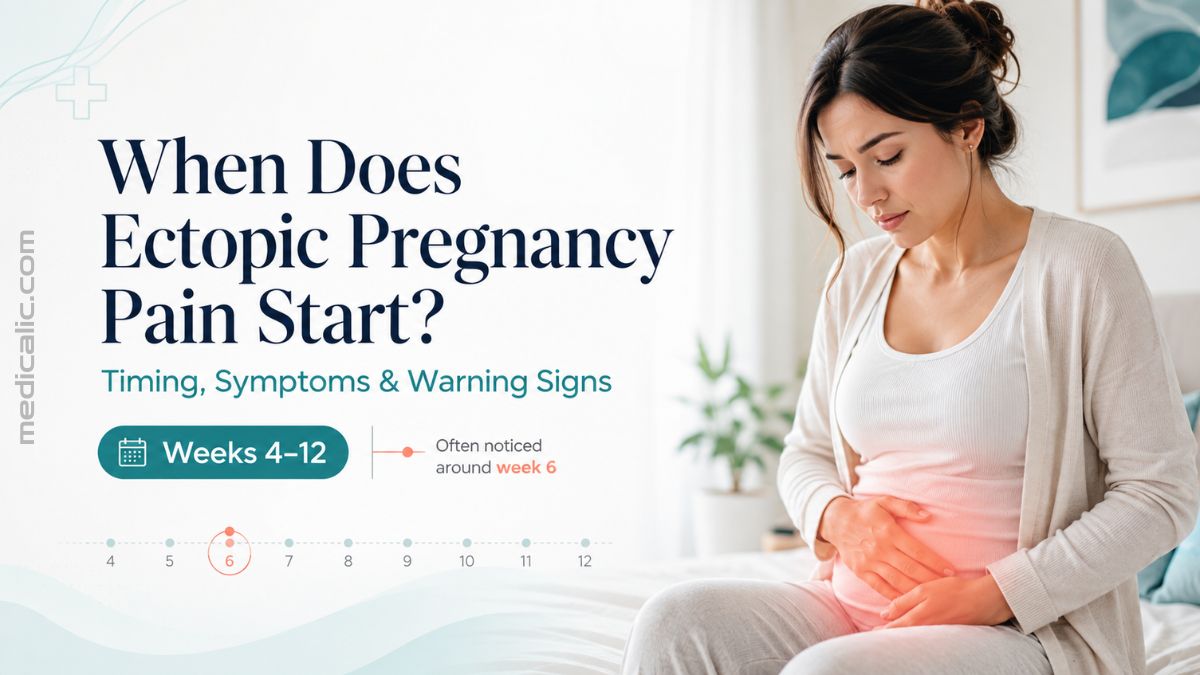
Ectopic pregnancy pain can start between about 4 and 12 weeks of pregnancy. Symptoms often become noticeable around week 6, and 6 to 8 weeks after the last menstrual period is a common time for them to appear. But there is no exact week when ectopic pregnancy pain must begin. Some people develop symptoms earlier or later, while others have little or no pain at first.[1]
That variability can make early symptoms difficult to interpret. Pregnancy week alone cannot tell you whether a new symptom is safe to ignore. An ectopic pregnancy can cause serious internal bleeding if it ruptures, so pay attention to the pattern of symptoms, not just the pregnancy week.
When Does Ectopic Pregnancy Pain Usually Start?
An ectopic pregnancy happens when a fertilized egg implants outside the main cavity of the uterus, most commonly in a fallopian tube. Less commonly, implantation can occur in places such as the cervix, ovary, abdomen, or a cesarean scar. An ectopic pregnancy cannot progress as a normal intrauterine pregnancy and can become dangerous if growing tissue causes bleeding.[2]
The timing varies, but the following timeline shows when symptoms are most often reported:
| Pregnancy stage | What may happen |
|---|---|
| Weeks 4–5 | You may have no unusual symptoms. Pain or spotting can occur, but these symptoms can also happen for other reasons in early pregnancy. |
| Around week 6 | This is a common time for ectopic pregnancy symptoms to become noticeable. |
| Weeks 6–8 | Pelvic or abdominal pain and irregular bleeding commonly appear during this period. |
| Weeks 9–12 | Symptoms can still begin later; a late start does not rule out an ectopic pregnancy. |
| At any stage | Sudden severe pain, fainting, extreme dizziness, or symptoms of internal bleeding require emergency assessment. |
The NHS reports that symptoms usually develop between weeks 4 and 12, while RCOG notes that many people develop physical symptoms around the sixth week. Johns Hopkins describes 6 to 8 weeks after the last normal menstrual period as a common presentation window. Pregnancy weeks are counted from the first day of the last menstrual period, not from the day of conception, so “6 weeks pregnant” is typically about four weeks after conception.
There is also no reliable “rupture week.” Waiting until a certain gestational age—or until pain becomes unbearable—is not a safe way to judge whether an ectopic pregnancy is becoming dangerous.
What Does Ectopic Pregnancy Pain Feel Like?
Ectopic pregnancy pain does not follow one fixed pattern. Its location, intensity, and timing can vary from person to person.
Where is ectopic pregnancy pain located?
It is commonly felt in the lower abdomen or pelvis, often more strongly on one side. However, one-sided pain is not required.[3]
Pain may feel:
- Low on the right or left side
- Central in the lower abdomen
- More widespread across the pelvis
- Difficult to pinpoint
The NHS describes ectopic pregnancy pain as typically low on one side and notes that it may develop suddenly or gradually.
Is ectopic pregnancy pain sharp or dull?
Either is possible.
Some people describe a dull ache or period-like cramping. Others experience sharper, stabbing, or increasingly intense pain. A mild beginning does not necessarily mean the condition is harmless.
In other words, how much it hurts does not reliably tell you whether a pregnancy is ectopic.
Can ectopic pregnancy pain come and go?
Yes. Ectopic pregnancy pain can come and go.
It may:
- Ease and return later
- Remain fairly constant
- Gradually worsen
- Begin suddenly
- Change from mild discomfort to more intense pain
Both NHS and RCOG guidance emphasize that ectopic pain can vary considerably in pattern.[2]
So, if pain disappears for a few hours, that does not reliably rule out an ectopic pregnancy.
Ectopic Pregnancy Pain vs. Normal Early-Pregnancy Cramps
The difficult part is that normal early-pregnancy discomfort and ectopic pregnancy pain can overlap.
Mild cramping and even some bleeding can occur in early pregnancy without indicating an ectopic pregnancy. On the other hand, ectopic symptoms may initially seem mild.
Certain patterns may raise more concern:
| Feature | Common early-pregnancy discomfort | Possible ectopic pregnancy |
|---|---|---|
| Location | Often mild or generalized | Often lower abdominal or one-sided |
| Pattern | May be brief and settle | May persist, recur, or worsen |
| Bleeding | Light spotting can have several causes | Bleeding may be different from your usual period |
| Shoulder pain | Not typical | Can occur, particularly with internal bleeding |
| Dizziness or fainting | Not expected from ordinary cramping | May signal significant internal bleeding |
A symptom checklist cannot tell you the cause with certainty. Miscarriage, ovarian problems, urinary conditions, gastrointestinal problems, and normal pregnancy changes can all cause abdominal or pelvic discomfort.
If pregnancy is possible and pain is new, persistent, one-sided, worsening, or accompanied by unusual bleeding, getting medical advice is safer than trying to identify the cause based on pain alone.
Other Ectopic Pregnancy Symptoms to Watch For
Pain is only one possible sign of an ectopic pregnancy.
Possible symptoms include:
- Vaginal spotting or bleeding
- Bleeding that looks different from your usual period
- One-sided or lower abdominal pain
- Shoulder-tip pain
- Dizziness or faintness
- Discomfort with bowel movements or urination
Some people have no noticeable symptoms at first and only discover the ectopic pregnancy during an ultrasound or further testing.
Bleeding can vary, too. It may be lighter, heavier, darker, or more intermittent than a usual period, but its appearance alone cannot tell you whether an ectopic pregnancy is the cause.
What is shoulder-tip pain?
Shoulder-tip pain is an unusual discomfort where the shoulder ends and the arm begins. Unlike ordinary muscle soreness, it may occur without an obvious shoulder injury and may not improve with movement or changing position.
In someone with a possible ectopic pregnancy, it can occur when internal bleeding irritates structures near the diaphragm. NHS guidance considers it a symptom that needs prompt medical attention.
It is particularly concerning when it occurs together with abdominal pain, dizziness, weakness, or fainting.
When Ectopic Pregnancy Symptoms Are an Emergency
You do not need to wait for “textbook” symptoms before seeking help.
Arrange prompt medical assessment if pregnancy is possible and you develop new pelvic or lower abdominal pain—especially if it is one-sided, keeps returning, worsens, or occurs with vaginal bleeding. Symptoms can appear even before you realize you are pregnant.
Seek emergency medical care immediately for:
- Sudden or severe abdominal or pelvic pain
- Severe pain with vaginal bleeding
- Shoulder-tip pain, especially with abdominal pain, dizziness, or weakness
- Fainting or collapse
- Extreme lightheadedness
- Signs that you may be becoming seriously unwell
These symptoms can occur when an ectopic pregnancy causes significant internal bleeding. A ruptured ectopic pregnancy is a medical emergency.[4]
How Doctors Check for an Ectopic Pregnancy
Symptoms can raise suspicion, but they cannot confirm where a pregnancy is located.
Evaluation commonly involves a combination of pregnancy testing, blood tests, and ultrasound.
Transvaginal ultrasound
A transvaginal ultrasound provides images of the uterus, ovaries, fallopian-tube areas, and pelvis. It can help determine whether a pregnancy is visible inside the uterus and may show findings that suggest an ectopic pregnancy.
If the pregnancy is extremely early, however, the location may not yet be clear. Repeat testing may then be needed.
hCG blood tests
Human chorionic gonadotropin, or hCG, is a hormone produced during pregnancy. When the pregnancy location is uncertain, clinicians may repeat hCG testing, often about 48 hours apart, along with ultrasound and clinical assessment.
But an hCG result should not be used by itself to determine where the pregnancy is located or how serious an ectopic pregnancy may be. NICE advises giving greater weight to changing symptoms than to hCG results when the pregnancy location remains unknown.[5]
Serious ectopic pregnancies can still occur at relatively low hCG levels. In a 2024 retrospective study of 519 ectopic pregnancies, 50.4% had hCG levels below 1,500 mIU/mL at presentation, including 44% of those with ultrasound evidence of rupture.[6]
Pregnancy of unknown location
Sometimes a pregnancy test is positive but ultrasound does not yet show a definite pregnancy inside or outside the uterus. Clinicians call this a pregnancy of unknown location, or PUL.
That does not automatically mean the pregnancy is ectopic. It may be an early intrauterine pregnancy that is still too small to see, a pregnancy that is not continuing, or an ectopic pregnancy.
Follow-up is important until the pregnancy location or outcome becomes clear.
Who Is at Higher Risk of an Ectopic Pregnancy?
Some people have known risk factors for ectopic pregnancy, while others do not. Risk is higher with:[7]
- A previous ectopic pregnancy
- Previous fallopian-tube surgery or pelvic surgery that may have affected the fallopian tubes
- Pelvic inflammatory disease
- Certain previous sexually transmitted infections
- Endometriosis
- Infertility treatment
- Smoking
- Age over 35
- Becoming pregnant with an IUD in place
- Becoming pregnant after tubal sterilization
Having one or more of these risk factors does not mean a pregnancy is ectopic, and having none of them does not rule it out.
What Happens If an Ectopic Pregnancy Is Diagnosed?
Management depends on factors such as your symptoms, whether there is bleeding, ultrasound findings, and the stage and behavior of the pregnancy.
Depending on the situation, doctors may use careful monitoring in selected stable cases, medication such as methotrexate, or surgery. Surgery is necessary when there is significant bleeding or rupture and may also be appropriate in other clinical situations.
Treatment is individualized; pregnancy week or a single hCG value does not determine the approach on its own.[8]
An ectopic pregnancy is a pregnancy loss, but it does not necessarily determine what happens in a future pregnancy. Many people who have had an ectopic pregnancy later have healthy pregnancies.
The Bottom Line
So, when does ectopic pregnancy pain start?
It can begin between roughly 4 and 12 weeks of pregnancy, with symptoms commonly becoming noticeable around week 6 or during the 6-to-8-week period after the last menstrual period. But there is no fixed timeline.
Pain can vary widely in location, intensity, and pattern, and some ectopic pregnancies cause no obvious pain at first.
Instead of asking only “Am I far enough along for ectopic pain?”, ask “Do my symptoms need medical assessment?”
If pregnancy is possible and something feels concerning—particularly new pelvic pain or unusual bleeding—contact a healthcare professional. If the pain becomes severe or you develop fainting, extreme dizziness, or other signs of serious internal bleeding, seek emergency care immediately.
Frequently Asked Questions
Symptoms can develop at around 4 weeks of pregnancy, although many people do not notice them until around week 6 or later.
Yes. Some people initially have no symptoms and are diagnosed during ultrasound or follow-up testing.
Symptoms can occur before you realize you are pregnant. A negative home pregnancy test makes an ectopic pregnancy less likely, but very early testing can be less reliable. If pregnancy is still possible and you have significant or worsening pain, bleeding, dizziness, or other concerning symptoms, seek medical advice rather than relying on one home test alone.
There is no dependable gestational week at which rupture occurs. Seek care based on symptoms rather than waiting for a particular pregnancy stage.
Medical References
Update History
Originally written by Medicalic.
Your answer helps us improve the clarity and usefulness of our health content.