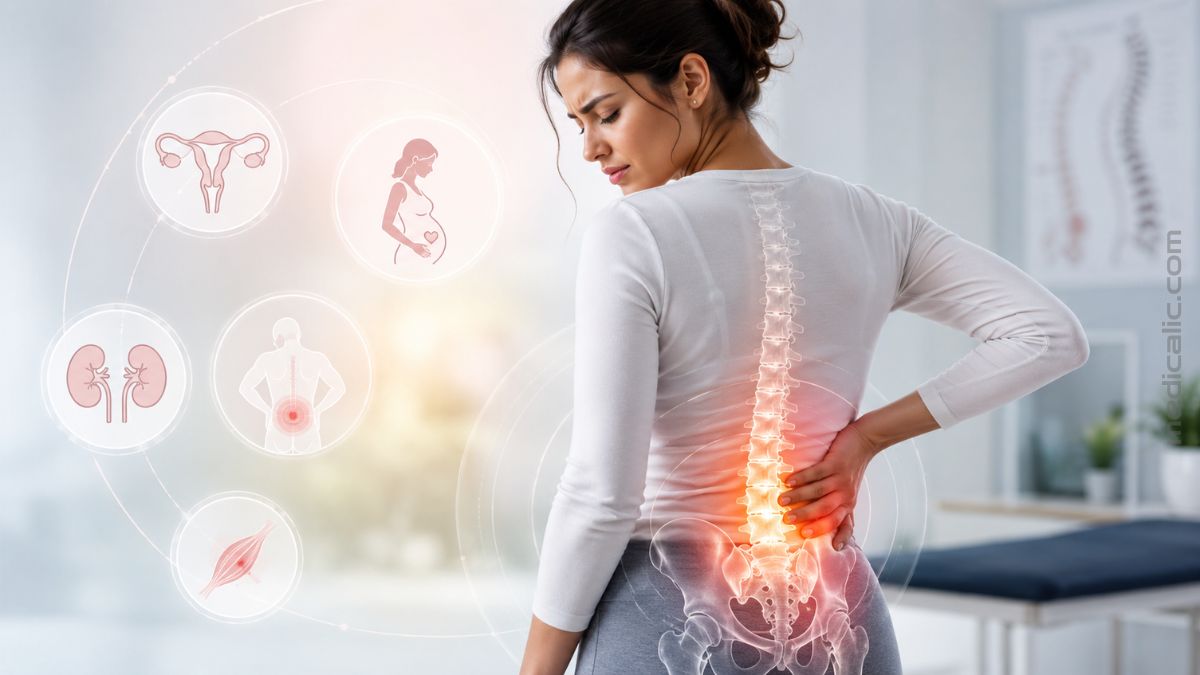
Lower back pain can be difficult to interpret. It might appear after lifting something heavy, develop after hours at a desk, flare around your period, or seem to arrive for no obvious reason. If you are dealing with it now, you may be wondering: What causes lower back pain in females, and when should I be concerned?
The reassuring part is that most lower back pain is not caused by a dangerous disease. In fact, about 90% of cases are considered nonspecific, meaning no single disease or damaged structure clearly explains the pain. Low back pain is also extremely common, affecting an estimated 619 million people worldwide in 2020, with women affected more often than men.[1,2]
However, women can also experience back pain related to menstruation, endometriosis, fibroids, pregnancy, urinary problems, kidney conditions, and osteoporosis.
The location of the pain is only one clue. When it started, what triggers it, whether it travels into a leg, and whether you have pelvic, menstrual, urinary, neurologic, or pregnancy-related symptoms usually tell you much more.
What Usually Causes Lower Back Pain in Females?
Most lower back pain is nonspecific or musculoskeletal rather than being caused by a gynecologic condition. Muscles, joints, nerves, physical loading, and several interacting factors can all contribute. Acute or subacute uncomplicated low back pain often improves over time without invasive treatment.
Depending on the pattern of pain and the symptoms that come with it, possibilities range from:
- Muscle or ligament strain
- Nonspecific lower back pain
- Sciatica or another irritated spinal nerve
- Arthritis or spinal stenosis
- Menstrual cramps
- Endometriosis
- Uterine fibroids
- Ovarian cysts
- Pelvic inflammatory disease
- Pregnancy-related changes
- Kidney stones
- Kidney infection
- Osteoporosis-related spinal fractures
More than one factor can also be involved at the same time. Period cramps, for example, do not rule out a separate muscle strain from exercise, lifting, or long periods of sitting.
What Your Lower Back Pain Pattern May Suggest
No single pain pattern can confirm the cause, but certain combinations of symptoms are more suggestive than others.
Pain that started after lifting, twisting, exercise, or repetitive work is more consistent with a muscle, ligament, or mechanical problem.
Pain that shoots from the back or buttock down one leg, especially with tingling or numbness, may suggest nerve irritation or sciatica.
Back pain that predictably appears before or during your period may be related to menstrual cramping.
Very painful periods together with painful sex, bowel or bladder pain during menstruation, or difficulty becoming pregnant can make endometriosis more likely to enter the picture.
Back or side pain plus fever, chills, painful urination, or nausea is less typical of a simple back strain and can point to a kidney infection.
Sudden one-sided pelvic pain with nausea or vomiting can occur with ovarian torsion or a complicated ovarian cyst and needs urgent medical assessment.
The accompanying symptoms matter more than whether the back hurts on the left or right.
Since most lower back pain comes from the back itself, muscles, joints, and nerves are the logical place to start.
Muscles, Joints, and Nerves: The Most Common Causes
Muscle or Ligament Strain
A strain can develop after heavy lifting, an awkward twist, repetitive work, a new workout, carrying a child, or simply doing more physical activity than your body is accustomed to.
The discomfort is often achy, tight, tender, or worse with certain movements. Muscle spasms may also occur.
Nonspecific Lower Back Pain
Sometimes no single muscle, disc, or joint explains the pain. Several things may be contributing at once, including physical load, strength, activity levels, previous pain episodes, sleep, stress, and pain sensitivity.
Calling the condition “nonspecific” does not mean the pain is imaginary. It simply means there is no single identifiable structural disease that adequately explains it.
Sciatica and Nerve Irritation
Sciatica describes a pattern of nerve-related pain, usually affecting one side.
It may feel:
- Shooting or electric
- Burning
- Sharp
- Tingly or numb
- Like pain traveling through the buttock and down the leg
A herniated disc or narrowing around a spinal nerve can contribute. If weakness is developing or worsening, medical assessment becomes more important.
Arthritis and Spinal Stenosis
Changes in spinal joints and discs become increasingly common with age. In some people, these changes contribute to osteoarthritis or spinal stenosis, in which space around the spinal nerves becomes narrower.
Spinal stenosis may produce back discomfort along with leg aching, heaviness, tingling, or numbness that becomes more noticeable while standing or walking and may ease when sitting or leaning forward.
One caution: age-related changes are common on scans, even in people without pain. An X-ray or MRI finding therefore has to make sense alongside your symptoms and examination.
But the spine is not the whole story. When back pain tracks with the menstrual cycle or appears alongside pelvic symptoms, gynecologic causes become more relevant.
Periods and Gynecologic Causes of Lower Back Pain
Menstrual Cramps
Yes, your period can cause lower back pain.
Menstrual pain, known medically as dysmenorrhea, results partly from uterine contractions and can be experienced in the lower abdomen, pelvis, back, hips, or thighs.[3] More than half of women who menstruate report some pain around their periods.
Menstrual back pain often begins shortly before or during a period and eases as the period ends.
Consider discussing it with a healthcare professional if your pain is becoming progressively more severe, repeatedly prevents normal activities, or occurs with unusually heavy or irregular bleeding.
Endometriosis
Endometriosis occurs when tissue similar to the lining of the uterus grows elsewhere in the body.
Endometriosis often shows up as more than ordinary period pain. Severe cramps, ongoing pelvic or lower-back pain, pain during or after sex, painful bowel movements, urinary pain during periods, or difficulty becoming pregnant can all be clues.[4] Some people, however, have few or no symptoms.
Lower back pain by itself is not enough to diagnose endometriosis.
Uterine Fibroids
Fibroids are noncancerous growths that develop in or around the uterus. Many produce no symptoms.
When symptoms do occur, they may include:[5]
- Heavy or painful periods
- Bleeding between periods
- Pelvic fullness or pressure
- Frequent urination
- Pain during sex
- Lower back pain
Fibroids become a more plausible explanation when dull back discomfort appears alongside heavy bleeding or persistent pressure in the lower abdomen.
Ovarian Cysts
Most ovarian cysts cause no symptoms and go away without treatment. When they do cause trouble, the pain is usually felt in the pelvis rather than the back. Sudden severe one-sided pelvic pain with nausea or vomiting needs urgent assessment because torsion or a ruptured cyst may be responsible.[6]
Pelvic Inflammatory Disease
Pelvic inflammatory disease, or PID, is an infection involving the female reproductive organs. It can be associated with sexually transmitted infections such as chlamydia and gonorrhea, although other bacteria can also be involved.
PID usually causes lower abdominal or pelvic pain, although the discomfort may extend toward the lower back. Fever, unusual vaginal discharge, pain or bleeding during sex, burning with urination, or bleeding between periods may occur as well. Some infections cause only mild symptoms.
Prompt diagnosis matters because untreated PID can damage the reproductive tract.
Life stage can change the picture too, particularly during pregnancy, after childbirth, and as bone health changes after menopause.
Pregnancy, Postpartum, and Menopause-Related Back Pain
Pregnancy
Back pain is common during pregnancy as the body’s posture and physical loading change. Pelvic girdle pain may become more noticeable when walking, climbing stairs, standing on one leg, or turning in bed.
The important part is knowing when pregnancy-related back pain comes with symptoms that need attention. Contact your maternity healthcare team promptly if pain occurs with vaginal bleeding, fluid leakage, fever, significant abdominal or pelvic pain, painful urination, dizziness, fainting, or other concerning symptoms.
An ectopic pregnancy is an important exception because it can initially resemble less serious pelvic or back pain. Early symptoms can include abnormal bleeding, low back pain, mild abdominal or pelvic pain, or one-sided cramping. Severe pain, weakness, dizziness, fainting, or shoulder pain can signal internal bleeding and requires emergency care.[7]
After Pregnancy
Musculoskeletal back discomfort may also continue or develop after childbirth as the body recovers and everyday demands such as lifting, carrying, feeding, and disrupted sleep place new stresses on the back.
New severe symptoms, fever, heavy bleeding, significant weakness, or feeling seriously unwell after childbirth should not simply be assumed to be routine back pain.
Menopause, Osteoporosis, and Spinal Fractures
Around and after menopause, a new backache is not automatically caused by hormonal change, but bone health becomes more important.
Lower estrogen levels after menopause contribute to loss of bone density, which can eventually lead to osteoporosis.
Osteoporosis often causes no symptoms until a fracture occurs. A vertebral compression fracture may produce sudden back pain after a relatively minor fall, bend, lift, or other everyday stress. Repeated vertebral fractures can also contribute to loss of height or a more stooped posture.
In the United States, the USPSTF recommends osteoporosis screening for women age 65 and older. It also recommends screening postmenopausal women younger than 65 when clinical risk assessment shows increased fracture risk.[8]
Not every pain felt near the lower back starts in the spine or pelvis. Kidney and urinary problems can cause pain in the same general area, usually with other clues.
Kidney and Urinary Causes
Kidney Stones
Kidney stone pain is usually felt more toward the side or flank than the center of the lower back. It can be sharp, come in waves, and move toward the lower abdomen or groin. Blood in the urine, urinary urgency, painful urination, nausea, or vomiting may occur as well.
Severe pain or visible blood in the urine deserves medical evaluation.
Kidney Infection
A kidney infection can develop when bacteria travel upward through the urinary tract.
Typical symptoms may include:[9]
- Fever or chills
- Back, side, or groin pain
- Frequent or painful urination
- Cloudy, dark, bloody, or foul-smelling urine
- Nausea or vomiting
These symptoms require prompt medical care rather than routine home treatment for back strain.
When Should You Worry About Lower Back Pain?
Most back pain is not an emergency, but some combinations of symptoms should be taken seriously.
Seek emergency care for:
- New inability to control or empty your bladder
- New loss of bowel control
- Numbness around the genitals, buttocks, or inner thighs
- Rapidly worsening leg weakness
- Severe back pain after major trauma
- Sudden severe pelvic pain with vomiting
- Possible pregnancy with severe pain, heavy bleeding, fainting, or significant dizziness
Back pain combined with bladder or bowel dysfunction, leg weakness, and numbness in the “saddle” region can signal cauda equina syndrome, a rare spinal nerve emergency.[10]
Arrange prompt medical evaluation for:
Fever, chills, urinary symptoms, unexplained vaginal bleeding or discharge, severe or progressively worsening pain at night, unexplained weight loss, a history of cancer, pain after a minor injury when osteoporosis is possible, or symptoms that are steadily worsening rather than improving.
How Doctors Find the Cause
Finding the cause usually starts with the story of the pain, not a scan. A clinician will want to know when it began, what makes it better or worse, whether it travels into a leg, and whether symptoms such as weakness, numbness, menstrual changes, possible pregnancy, urinary problems, fever, bleeding, or a recent injury change the picture.
Depending on those findings, testing might include a urine test, pregnancy test, blood work, pelvic examination, ultrasound, X-ray, or MRI.
For uncomplicated acute low back pain without red flags, immediate imaging is generally not considered necessary.[11] Imaging becomes more useful when clinicians suspect fracture, infection, cancer, cauda equina syndrome, or another specific condition.
What Can Help Mild Lower Back Pain?
If there are no warning signs, complete bed rest is usually not the answer.
Gentle movement within your comfort level can help you stay mobile, while temporarily reducing activities that clearly aggravate the pain. Superficial heat is one evidence-supported non-drug option for acute or subacute non-radicular low back pain.[12]
Pay attention to what changes the pain. Did it begin after lifting? Does it flare after hours of sitting, return around your period, or ease when you change position?
Persistent or frequently recurring pain may benefit from a clinical assessment and an individualized exercise or physical therapy program.
Before taking over-the-counter pain medicine, check with a healthcare professional or pharmacist if you are pregnant, have kidney disease, stomach ulcers, heart disease, take blood-thinning medicines, or use other medications that could interact with pain relievers.
Frequently Asked Questions
The most common category is nonspecific low back pain, meaning no single disease or structural problem can confidently account for the symptoms.
Yes. Backache can occur around menstruation, and menstrual pain is one of the most commonly reported period problems. Pain that becomes severe, progressively worsens, or occurs with unusually heavy bleeding should be assessed for conditions such as endometriosis or fibroids.
Back discomfort can occur during pregnancy, but it is not a reliable early pregnancy sign. If your period is late and pregnancy is possible, a home pregnancy test is a much better way to find out. Pain with abnormal bleeding, dizziness, or fainting needs prompt medical attention.
A bladder infection more commonly causes burning during urination, urinary frequency, urgency, or lower abdominal pressure. Fever, chills, nausea, or back or side pain can indicate a kidney infection and should be evaluated promptly.
Yes. Fibroids can cause dull lower back discomfort, especially when it occurs with heavy bleeding or pelvic pressure.
The Bottom Line
Most lower back pain in females comes from nonspecific or musculoskeletal causes, not the reproductive organs. But periods, pregnancy, pelvic conditions, urinary symptoms, and bone health can all change what a particular episode of pain means.
Instead of focusing only on whether the pain is on the left or right, look at the whole pattern: when it began, what makes it better or worse, where it travels, and what other symptoms occur with it.
What matters most is recognizing when back pain comes with neurologic, pregnancy-related, urinary, or pelvic warning signs that need faster medical attention.
For most people, uncomplicated lower back pain improves. The key is knowing which accompanying symptoms make it worth getting checked sooner.
Medical References
Update History
Originally written by Dr. Jubair Islam.
Your answer helps us improve the clarity and usefulness of our health content.