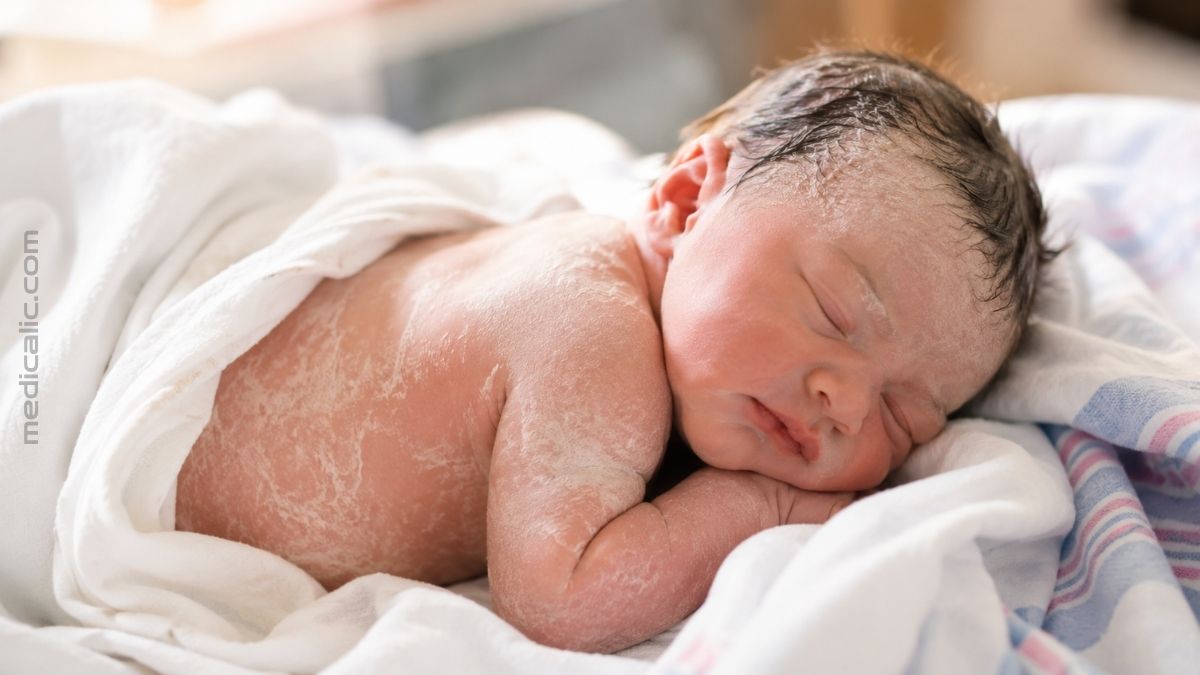
The moment your newborn is placed on your chest, you may expect soft, pink baby skin. Instead, you might be surprised to see a creamy white coating on the skin and wonder whether it needs to be washed away.
That coating is vernix caseosa. It is not dirt, an infection, or a sign of poor hygiene. It is a normal protective substance that develops before birth and helps shield your baby’s skin in the womb.
Vernix also helps retain moisture and contains components involved in the skin’s natural defenses. So for a healthy term newborn, there is usually no need to scrub it away immediately.
In fact, the World Health Organization (WHO) recommends delaying the first bath for at least 24 hours after birth.
What Is Vernix Caseosa?
Vernix caseosa is the soft, creamy or waxy white material that develops on fetal skin during pregnancy and may still be visible after birth.
Its name reflects its appearance: vernix refers to a varnish-like coating, while caseosa refers to its cheese-like texture.
Vernix forms as fetal skin matures, with contributions from shed skin cells and lipid-rich secretions associated with the developing skin and sebaceous glands. It begins developing around the middle of pregnancy and becomes more prominent as gestation advances, particularly during the third trimester.[1]
Although it may look like a substance that should be washed away, vernix is part of normal fetal development. Its structure is well suited to one of pregnancy’s unusual challenges: protecting delicate skin that spends months surrounded by fluid.
What Is Vernix Caseosa Made Of?
Vernix is unusual because it combines a very high water content with fats and proteins.
Research reviews describe it as approximately:[2]
- 80% water
- 10% protein
- 10% lipids
The lipid portion contains substances such as ceramides, cholesterol, free fatty acids and phospholipids—components that are also important to normal skin-barrier function.
This combination creates a hydrated but relatively water-resistant coating. In simple terms, vernix can hold moisture while also helping shield developing skin from constant exposure to amniotic fluid.
Why Do Babies Have Vernix Caseosa?
The main purpose of vernix caseosa is to provide temporary protection while fetal skin develops and then adapts to the outside world.
Before birth, the baby’s skin is surrounded by amniotic fluid. After birth, that environment changes within seconds to comparatively dry air.
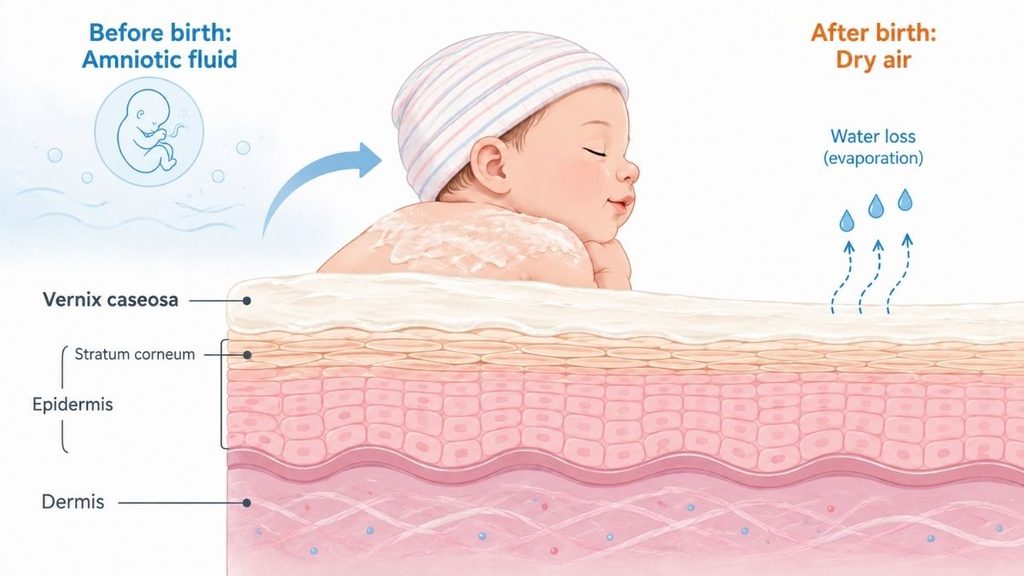
The outermost layer of skin, called the stratum corneum, forms much of the body’s protective barrier. Vernix helps support this developing barrier before birth and may continue to support hydration and skin adaptation during the first hours after delivery.
That transition happens quickly: vernix that protected fetal skin in a fluid-filled environment may continue to help retain moisture as the newborn adjusts to dry air.
What Are the Benefits of Vernix Caseosa?
Some benefits of vernix are better established than others, and biological activity does not always translate into proven clinical benefit.
It supports the newborn skin barrier
Vernix provides a physical interface between developing fetal skin and amniotic fluid. Its water-and-lipid structure may also help limit excessive moisture loss once the baby is born.
This does not mean newborn skin depends entirely on vernix. Healthy full-term infants already have a functioning skin barrier at birth. Vernix is better understood as an additional protective and conditioning layer rather than the baby’s only defense.
It acts like a natural moisturizer
Because vernix contains both water and skin-related lipids, it has moisturizing properties. Leaving normal vernix in place for a period after birth may help support skin hydration rather than immediately removing the coating through washing or vigorous wiping.
The American Academy of Pediatrics’ HealthyChildren guidance also notes that leaving vernix on the skin for a while may help protect newborn skin from drying.[3]
It contains antimicrobial components
Researchers have identified antimicrobial peptides and proteins in vernix, including substances involved in the body’s innate—or built-in—immune defense.
Laboratory studies have shown antibacterial activity in vernix-derived material.[4]
However, finding antimicrobial substances in vernix does not prove that leaving it on a baby’s skin prevents sepsis or other serious infections. The biological evidence for antimicrobial activity is stronger than the evidence for specific clinical infection-prevention benefits.
It may reduce friction during birth
The slippery, lipid-rich texture of vernix may also provide lubrication and reduce friction as a baby passes through the birth canal. Reviews of vernix biology include lubrication among its proposed physiological functions.
When Should Vernix Caseosa Be Washed Off?
For a healthy term newborn, there is usually no need to wash vernix off immediately after birth.
WHO guidance recommends delaying the first bath for at least 24 hours. When waiting 24 hours is not possible for cultural reasons, WHO guidance has advised waiting at least six hours rather than bathing immediately.[5]
Visible blood, meconium, or other body fluids can still be gently cleaned when necessary. Normal vernix underneath does not need aggressive scrubbing.
Babies who are premature, medically unstable or receiving neonatal intensive care may have different skin-care needs, so bathing and skin care should follow the neonatal team’s recommendations.
What does the research on delayed bathing show?
A 2022 systematic review included 16 studies involving 39,020 healthy term or near-term newborns. Compared with bathing within the first six hours, later bathing was associated with lower rates of hypothermia and hypoglycemia in several studies and with higher exclusive breastfeeding rates at hospital discharge.[6] However, much of the evidence was observational and certainty varied by outcome.
Delayed bathing does more than preserve vernix. It may also allow more uninterrupted skin-to-skin contact, reduce handling and separation, support temperature regulation, and give feeding more time to become established.
These findings should not be interpreted to mean that vernix itself prevents hypoglycemia or hypothermia, or directly improves breastfeeding outcomes. The research mainly evaluates the timing of the first bath as a whole.
Is leaving vernix on for several days better?
Not necessarily.
Current evidence supports avoiding an unnecessarily early bath in healthy term newborns, but research has not established that leaving vernix untouched for many days or weeks provides additional medical benefits.
Vernix does not need to remain completely untouched for days. The practical goal is simply to avoid rushing to remove a normal, potentially useful part of newborn skin.
Why Do Some Babies Have More Vernix Than Others?
There is no “correct” amount of vernix for a newborn to have.
One baby may be covered in thick white patches, while another may have only traces around the neck, back, armpits or groin. Some babies have very little visible vernix at birth.
Gestational age is one factor. Vernix develops and changes as fetal skin matures, so very premature babies may be born before the coating is fully developed, while post-term newborns often have relatively little remaining. This helps explain why the amount visible at birth varies so widely.
Individual biology and how much vernix was shed before or during delivery also influence what parents see.
The amount of vernix alone should not be used as a measure of whether a newborn is healthy.
Vernix Caseosa vs. Lanugo
Vernix and lanugo are sometimes confused because both are associated with fetal skin development.
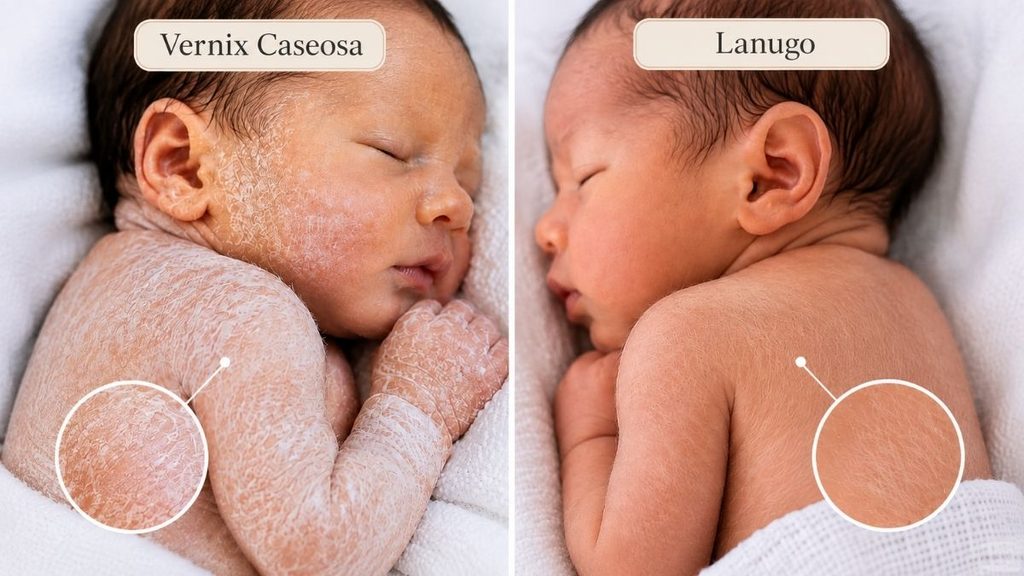
The creamy white coating seen on newborn skin is vernix caseosa, while lanugo is the very fine, soft hair that grows over much of the fetus during pregnancy.
This fine fetal hair can help hold vernix against the developing skin. After birth, the white coating gradually disappears through normal absorption, movement, and routine newborn skin care, while lanugo typically sheds on its own.[7]
What Does Normal Vernix Look and Smell Like?
Normal vernix caseosa is typically:
- white to creamy white
- occasionally slightly yellowish
- thick and paste-like in some areas
- thin or patchy in others
It is often most noticeable in skin folds, including the neck, armpits and groin.
Vernix itself should not generally have a strongly offensive smell. A newborn may temporarily smell of amniotic fluid, blood or other substances associated with delivery, however.
If a persistent foul odor occurs with redness, swelling, drainage, fever, poor feeding, or other signs that your newborn is unwell, contact the baby’s healthcare team promptly rather than assuming the odor is simply from vernix.
What Scientists Are Still Learning About Vernix
Vernix research is moving beyond its traditional role as a protective skin coating.
Scientists are studying its relationship with the newborn skin microbiome, immune signaling, skin-barrier development and inflammatory conditions such as atopic dermatitis, or eczema.
For example, the registered PROTEGO randomized trial is designed to investigate whether retaining vernix after birth affects skin-barrier measures, the microbiome, and the development of atopic dermatitis during a baby’s first year.[8] Until randomized trial results are available, it would be premature to claim that retaining vernix prevents eczema.
Frequently Asked Questions
Most babies develop vernix during pregnancy, but not every newborn has a large amount visible at birth. Some babies are heavily coated, while others have only small patches or almost none.
There is usually no need to scrub vernix off or deliberately rub it in. It can simply remain on the skin and gradually disappear with routine newborn care.
Visible vernix commonly decreases during the first day or two as it dries, is absorbed, transfers onto clothing or bedding, or is removed during routine cleaning.
Vernix contains antimicrobial proteins and peptides, but this has not been shown to mean that keeping vernix on the skin prevents serious newborn infections. Its antimicrobial activity is a biological property, not a proven infection-prevention treatment.
Usually not. The amount visible at birth varies widely. Having little or no visible vernix does not, by itself, mean there is anything wrong with your baby.
The Bottom Line
Vernix caseosa is a normal, protective coating—not something that needs to be urgently washed away.
It helps protect developing skin and support hydration, while also containing components involved in the skin’s natural defenses. Still, claims that vernix prevents infection or eczema go beyond what current evidence can prove.
For a healthy term newborn, the practical approach is simple: avoid aggressive removal, keep the baby warm and close to their parent, and do not rush the first bath. WHO recommends waiting at least 24 hours after birth when possible.
Newborn care comes with plenty of unfamiliar sights and decisions, but vernix is usually not something parents need to “fix.” In most cases, it is simply a normal part of fetal skin development and the transition to life after birth.
Medical References
Update History
Medically reviewed by Dr. Jubair Islam.
Originally written by Dr. Rahul Kushwaha.
Your answer helps us improve the clarity and usefulness of our health content.