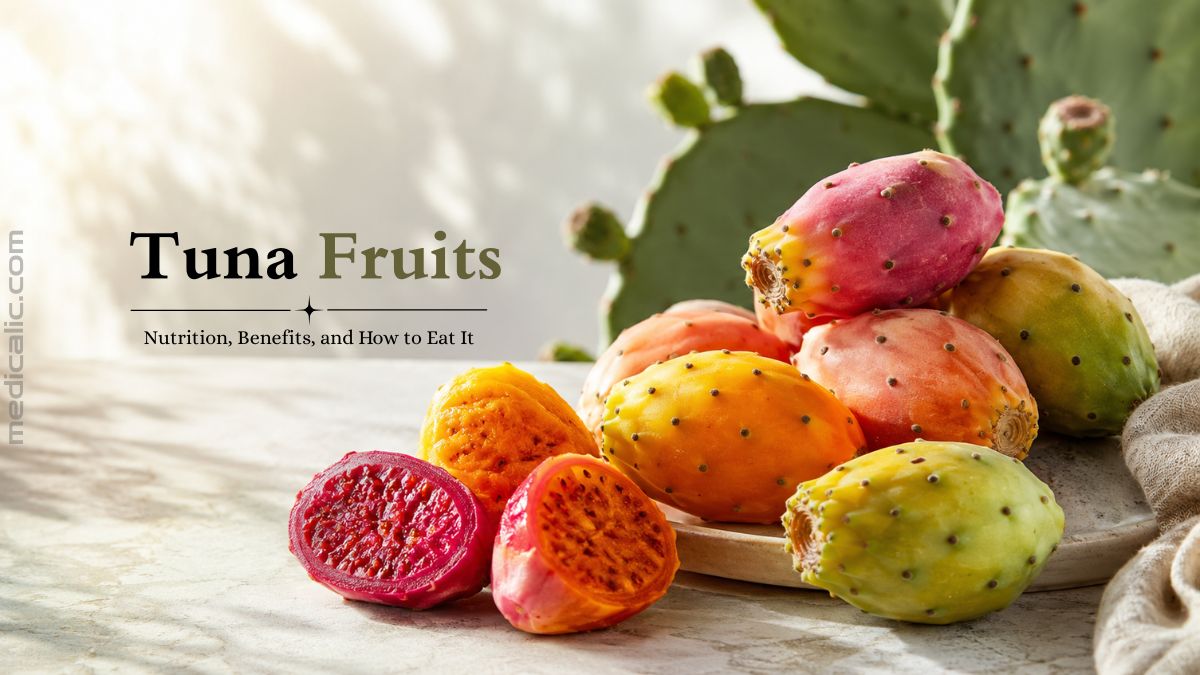
If you are looking for foods that may support digestion or fit into a balanced blood-sugar-conscious diet, the name tuna fruit may make you pause. Fish—in a fruit?
Despite the name, tuna fruit has nothing to do with the sea. It is the colorful, mildly sweet fruit of the prickly pear cactus, providing fiber, magnesium, vitamin C, and naturally occurring plant pigments.
However, it is not a cure for diabetes, inflammation, obesity, or any other health condition. The most useful way to view tuna fruit is as a refreshing, nutritious whole fruit, not a medical treatment.
What Is Tuna Fruit?
Tuna fruit, also called prickly pear or cactus pear, grows on cacti in the Opuntia genus. Tuna is the Spanish name commonly used for the fruit, particularly in Mexico and other Spanish-speaking regions.[1]
The fruit is usually oval and may have green, yellow, orange, red, or purple skin. Inside, it contains juicy flesh and many small, firm seeds.
Its flavor varies by variety and ripeness. Most tuna fruit tastes gently sweet and refreshing, with notes people often compare to watermelon, pear, melon, berries, or citrus.
Tuna Fruit vs. Nopal
Tuna fruit and nopal come from the same type of cactus, but they are different foods:
| Feature | Tuna fruit | Nopal |
|---|---|---|
| Plant part | Cactus fruit | Flat cactus pad or stem |
| Other names | Prickly pear, cactus pear | Nopales, cactus pads |
| Flavor | Mildly sweet and fruity | Tart, vegetal, slightly earthy |
| Texture | Juicy with firm seeds | Crisp or tender, sometimes slippery |
| Common uses | Fresh fruit, drinks, sauces, preserves | Salads, tacos, eggs, soups |
This distinction is important when evaluating health claims. Research involving nopal pads, concentrated cactus extracts, or supplements does not automatically prove that fresh tuna fruit produces the same effects.
Tuna Fruit Nutrition
Tuna fruit is relatively low in calories and provides a notable amount of fiber and magnesium.
Approximately one cup, or 149 grams, of raw prickly pear contains:[2]
| Nutrient | Approximate amount |
|---|---|
| Calories | 61 |
| Carbohydrates | 14.3 g |
| Fiber | 5.4 g |
| Protein | 1.1 g |
| Fat | 0.8 g |
| Vitamin C | 20.9 mg |
| Magnesium | 126.7 mg |
| Potassium | 327.8 mg |
| Calcium | 83.4 mg |
These figures are based on USDA food-composition data. Actual values can vary by species, growing conditions, ripeness, and serving size.
Tuna fruit also contains betalains, the pigments responsible for many of its vivid colors. Red and purple fruits generally contain more betacyanins, while yellow and orange varieties contain more betaxanthins.
These compounds have antioxidant activity in laboratory testing. That does not mean eating tuna fruit prevents cancer, reverses aging, or neutralizes every harmful process in the body. It simply makes the fruit one more useful source of plant compounds within a varied diet.
Potential Health Benefits of Tuna Fruit
Research on prickly pear products is promising but inconsistent. Studies have tested fresh fruit, juice, pulp, cactus pads, powders, extracts, and supplements. These forms differ substantially in fiber, concentration, and chemical composition.
Supports Digestive Health
A cup of tuna fruit provides about 5.4 grams of fiber. Fiber supports normal bowel function, adds bulk to stool, and may help you feel satisfied after eating.
Whole tuna fruit generally provides more fiber than strained juice. However, suddenly eating a large amount may cause gas, bloating, abdominal discomfort, or changes in bowel movements.
Provides Magnesium and Vitamin C
Tuna fruit is especially notable for its magnesium content. Magnesium contributes to normal muscle, nerve, and energy-related functions.
Its vitamin C supports collagen production, wound healing, antioxidant defenses, and normal immune function. Potassium also contributes to fluid balance and normal cellular activity.
These are valuable nutritional qualities, but they should not be presented as proof that tuna fruit treats a specific illness.
Adds Antioxidant Plant Compounds
Prickly pear fruit contains betalains, phenolic compounds, flavonoids, and vitamin C. Reviews of Opuntia ficus-indica fruit have identified potential antioxidant and anti-inflammatory properties, although much of the evidence comes from laboratory, animal, or small human studies.[3]
An open-label, single-arm 2025 study found improvements in several salivary antioxidant and oxidative-stress markers after 50 healthy adults took 1,500 milligrams of Opuntia ficus-indica powder daily for three months. However, the study had no control group and tested a commercial powder supplement—not ordinary servings of fresh fruit.[4] The findings therefore cannot show that fresh tuna fruit prevents or treats disease.
May Fit a Heart-Healthy Diet
Tuna fruit can be included in a heart-supportive eating pattern because it provides fiber, potassium, magnesium, and plant compounds.
Some research involving various Opuntia products has reported changes in cholesterol or cardiovascular risk markers.[5] However, products, doses, participant groups, and study designs have varied considerably.
Tuna fruit should not replace cholesterol medication, blood pressure treatment, physical activity, or dietary changes recommended by a qualified healthcare professional.
Can Tuna Fruit Help With Diabetes or Weight Loss?
This is where realistic expectations matter most.
A systematic review of controlled human trials found that studies involving prickly pear fruit predominantly reported no significant improvement in glucose or insulin.[6] More encouraging blood-sugar findings generally involved cactus pads, combined Opuntia products, or preparations other than the fresh fruit. The review also identified important weaknesses in the quality of the available evidence.
Tuna fruit is therefore not a proven diabetes treatment.
A person with diabetes may still be able to include it in a balanced eating plan. One cup contains roughly 14 grams of carbohydrate, so portion size, medications, glucose response, and the rest of the meal should be considered.
There is also insufficient evidence that fresh tuna fruit directly causes meaningful weight loss. Its fiber and water may make it satisfying, but no single fruit can compensate for an eating pattern that regularly provides more energy than the body needs.
Do not reduce or stop diabetes, cholesterol, or weight-management medication based on claims about tuna fruit or cactus supplements.
Tuna Fruit Seeds, Side Effects, and Safety
Most healthy adults can eat a moderate portion of properly peeled tuna fruit. Still, several precautions are worth knowing.
The Seeds Are Edible but Very Firm
Many people swallow the seeds with the pulp. Others remove them by pressing the fruit through a fine-mesh strainer.
Rare reports have linked excessive consumption of prickly pear seeds with hard masses called phytobezoars, which can cause severe fecal impaction or bowel obstruction. In one published case, a 76-year-old woman developed a large rectal phytobezoar after eating almost 40 prickly pears.[7]
Consider limiting or straining the seeds if you have:
- Severe or chronic constipation
- A previous bowel obstruction
- Intestinal narrowing
- A serious bowel-motility disorder
- Previous stomach or intestinal surgery
Seek prompt medical care for severe abdominal pain, repeated vomiting, substantial abdominal swelling, or an inability to pass stool or gas.
Tiny Spines Can Irritate the Skin
The outer skin may carry clusters of nearly invisible barbed bristles called glochids. These can detach easily and penetrate the skin with light contact.
Handle unpeeled fruit with kitchen tongs or thick gloves. Do not bite through the peel, even when the fruit appears smooth.
Digestive Effects
Eating a large portion may cause:
- Gas or bloating
- Nausea
- Abdominal discomfort
- Diarrhea
- Constipation or difficult stool passage from excessive seeds
If you are trying tuna fruit for the first time, start with a small portion and see how your digestive system responds.
Allergic Reactions
Allergy to tuna fruit appears uncommon, but reactions to any food are possible.
Stop eating it and seek emergency help for difficulty breathing, throat tightness, faintness, widespread hives, or rapidly increasing swelling of the lips, face, or tongue.
How to Choose, Peel, and Eat Tuna Fruit
Choosing a Ripe Fruit
Look for tuna fruit that is:
- Plump and heavy for its size
- Slightly soft when gently pressed
- Free from mold, slime, or leaking liquid
- Not severely bruised or shriveled
Do not judge ripeness by color alone. Depending on the variety, ripe fruit may remain green or develop yellow, orange, red, or purple skin.
Peeling It Safely
- Hold the fruit with kitchen tongs or thick gloves.
- Place it on a stable cutting board.
- Slice off both ends with a sharp knife.
- Make one shallow lengthwise cut through the skin.
- Lift the edge of the thick peel with the knife.
- Pull the peel away from the flesh.
- Slice the fruit or scoop out the pulp.
Even store-bought fruit that has been commercially cleaned may retain some glochids. Careful handling is still worthwhile.
Simple Ways to Eat It
Once peeled, tuna fruit can be:
- Eaten chilled on its own
- Added to yogurt or oatmeal
- Mixed into fruit salad
- Blended into a smoothie
- Strained for an unsweetened drink
- Made into salsa, sauce, sorbet, jam, or jelly
Jam, syrup, candy, and sweetened drinks may contain substantial added sugar. They should not be treated as nutritional equivalents of fresh fruit.
Refrigerate peeled or cut tuna fruit promptly in a covered container. For longer storage, the fruit pulp or strained juice can be frozen in sealed containers.
Fresh Tuna Fruit vs. Juice and Supplements
| Form | Main advantage | Main limitation |
|---|---|---|
| Fresh fruit | Retains fiber and pulp | Contains hard seeds and requires careful peeling |
| Pureed fruit | Easy to add to food | Portions can become large |
| Strained juice | Smooth and seed-free | Much of the fiber may be removed |
| Jam or syrup | Convenient and flavorful | Often contains added sugar |
| Powder or supplement | Concentrated and portable | Not equivalent to fresh fruit; dose and quality vary |
For most people, fresh tuna fruit offers the best balance of fiber, nutrients, and portion awareness.
A supplement may contain fruit, seeds, pads, extracts, or combinations of cactus components. Because concentrated products can differ in composition and dose, check the label carefully and discuss them with a healthcare professional if you take medication, have a medical condition, or are pregnant or breastfeeding.[8]
Is Tuna Fruit Worth Trying?
Yes, when you approach it as food rather than medicine.
Tuna fruit offers fiber, magnesium, vitamin C, potassium, water, and colorful plant compounds. It can add variety to your diet and may be especially enjoyable when chilled.
Its health benefits should remain in perspective. Evidence does not establish fresh tuna fruit as a treatment for diabetes, obesity, chronic inflammation, cancer, or cardiovascular disease.
A new fruit will not solve a chronic health problem by itself. Still, small, realistic food choices can contribute to a healthier overall pattern, and tuna fruit can be one of them.
Frequently Asked Questions
Yes. Tuna is a Spanish name for the fruit commonly called prickly pear or cactus pear in English.
No. The fruit and fish share a name but are entirely unrelated.
It is usually mild, juicy, and lightly sweet. Depending on the variety, its flavor may resemble watermelon, pear, melon, berries, or citrus.
Its fiber may support regular bowel movements. However, consuming excessive quantities of its hard seeds has rarely caused severe fecal impaction. People with significant constipation or a history of bowel obstruction should be cautious.
No. Both grow on cacti, but they come from different plants and have different appearances, flavors, and textures.
Medical References
Update History
Medically reviewed by Arooj Ahsan, RDN.
Originally written by Haikal Rayyan.
Your answer helps us improve the clarity and usefulness of our health content.