
A headache that strikes without warning and becomes extremely painful within seconds can feel frightening. This sudden pattern is known as a thunderclap headache.
Unlike many migraines, which often build gradually, a thunderclap headache reaches its highest intensity in less than one minute. Although the pain may improve quickly, it can still signal a life-threatening brain emergency, such as bleeding or a blood clot. [2]
The reassuring part is that rapid medical evaluation can help doctors identify the cause and begin the right treatment as early as possible.
What Is a Thunderclap Headache?
A thunderclap headache reaches maximum intensity in less than one minute. ICHD-3 criteria for primary thunderclap headache include pain lasting at least five minutes, but any new explosive headache warrants urgent evaluation even if it improves quickly. [3]
The term describes a headache pattern, not a final diagnosis. If a thorough evaluation reveals no underlying condition, doctors may classify it as a primary thunderclap headache. This is a diagnosis of last resort made only after serious causes have been excluded.
What Does a Thunderclap Headache Feel Like?
People often describe the pain as an explosion, a sudden blow to the head, or a switch being flipped. It may occur anywhere in the head and can spread toward the neck or upper back.
Depending on the cause, additional symptoms may include:
- Nausea or vomiting
- Neck pain or stiffness
- Confusion or unusual drowsiness
- Fainting
- A seizure
- Blurred, double, or lost vision
- Difficulty speaking
- Weakness or numbness on one side
- Problems with balance or walking
Even if the headache is your only symptom, the explosive onset itself is a critical warning sign that requires immediate attention.
What Causes a Thunderclap Headache?
Several conditions can produce the same sudden pain pattern. Some causes are immediately life-threatening. Others may be reversible, but they still require urgent evaluation to prevent complications. The symptoms alone usually cannot reveal which cause is responsible.
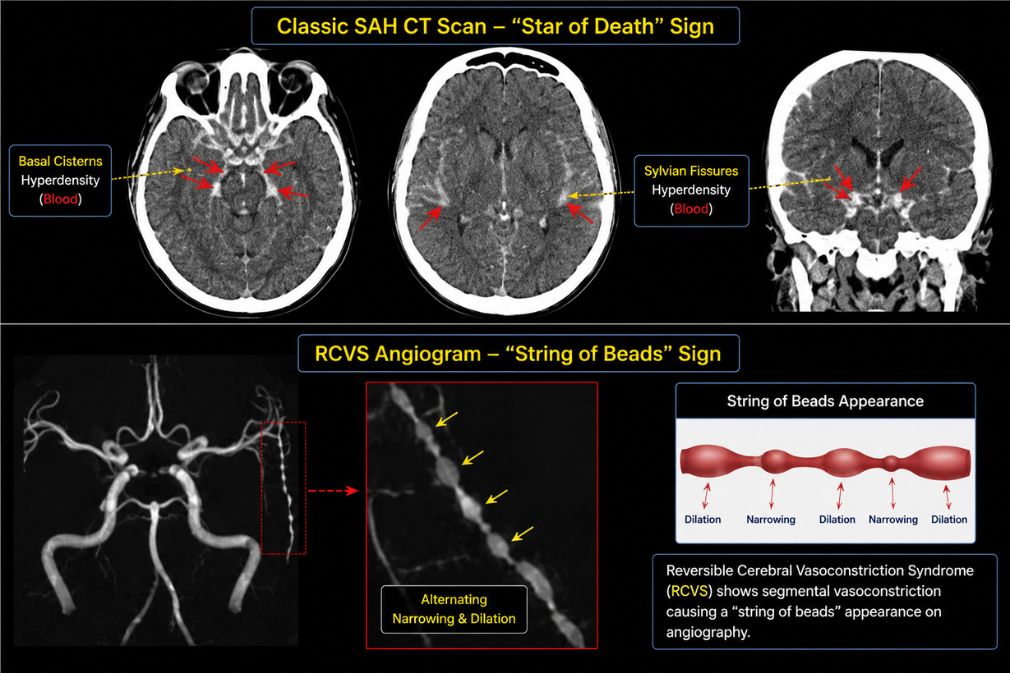
Diagnostic imaging for thunderclap headaches: A CT scan showing bleeding around the brain (Subarachnoid Hemorrhage) and an angiogram revealing temporarily narrowed blood vessels (RCVS).Subarachnoid Hemorrhage
One of the most urgent causes is a subarachnoid hemorrhage, or bleeding in the space surrounding the brain. This can occur when a brain aneurysm (a weakened area in an artery) ruptures. [4]
A thunderclap headache is a classic warning sign of this type of bleeding. Fast diagnosis is essential because aneurysmal subarachnoid hemorrhage can cause severe complications and requires specialist treatment.
Reversible Cerebral Vasoconstriction Syndrome
Reversible cerebral vasoconstriction syndrome (RCVS) occurs when arteries in the brain temporarily narrow and often causes repeated thunderclap headaches over several days or weeks. [5]
Crucially, early brain or blood-vessel imaging can appear normal because vascular narrowing may become more visible over the following days to weeks. This is why recurrent attacks require careful medical follow-up, even after a reassuring initial scan.
Common Triggers and High-Risk Situations
These headaches may occur during heavy exercise, sexual activity, coughing, sneezing, lifting, or straining. They may also occur during pregnancy or in the weeks following childbirth. Although these situations can trigger benign primary headaches, they are also associated with serious conditions such as RCVS and subarachnoid hemorrhage. An identifiable trigger therefore does not prove that the headache is harmless. [1]
Other Possible Causes
Doctors may also investigate for:
- Bleeding within the brain
- A blood clot in the brain’s venous system
- A tear in an artery of the head or neck
- Ischemic stroke
- Pituitary gland bleeding
- Meningitis or another infection
- A sudden change in pressure around the brain
- A hypertensive emergency or posterior reversible encephalopathy syndrome (PRES)
- Complications following a head or neck injury
Because these conditions require different treatments, attempting to diagnose the cause from symptoms or online information is unsafe.
How Is a Thunderclap Headache Diagnosed?
Evaluation usually begins with a detailed history and neurological examination. Doctors will want to know:
- The exact time the pain started
- How quickly it reached maximum intensity
- What you were doing at the time
- Whether similar attacks have occurred
- Whether you lost consciousness or developed neurological symptoms
- Which prescription medicines, supplements, or recreational substances you use
- Whether you are pregnant or recently gave birth
CT Scan
A noncontrast CT scan of the head is commonly used to look for bleeding. Timing matters because fresh blood is generally easier to detect soon after symptoms begin.
A 2024 multicenter study found that the estimated probability of subarachnoid hemorrhage after a negative CT performed within six hours was about 0.5%. CT within 24 hours detected most cases, but it was not perfectly sensitive for all forms of subarachnoid hemorrhage. Doctors therefore interpret the result alongside the neurological examination, scan timing and quality, and the patient’s overall risk. [6]
Additional Testing
A normal early scan is encouraging, but it may not provide the full picture. Depending on the timing of the scan, examination findings, and suspected cause, doctors may recommend additional testing, such as:
- CT angiography to examine arteries
- MRI or magnetic resonance angiography
- MR venography to assess veins
- A lumbar puncture to analyze spinal fluid
- Repeat blood-vessel imaging when RCVS remains possible
Thunderclap Headache vs. Migraine
A migraine can be intense, disabling, and associated with nausea, light sensitivity, visual changes, or other neurological symptoms. However, a typical migraine often develops over several minutes or longer.
A thunderclap headache is defined by its explosive onset.
| Feature | Thunderclap headache | Typical migraine |
|---|---|---|
| Time to maximum pain | Less than one minute | Usually builds more gradually |
| Emergency evaluation | Required for a new or suspected attack | Not always required for a familiar, diagnosed pattern |
| Possible causes | May include bleeding or vascular disorders | Usually a primary headache disorder |
| Duration | May last minutes or hours; primary criteria specify at least five minutes | Commonly lasts hours or longer |
Having a history of migraines does not rule out a medical emergency. A headache that peaks far faster than your usual migraine should be treated as a new symptom.
How Is a Thunderclap Headache Treated?
There is no single treatment for thunderclap headache because treatment depends entirely on the underlying cause.
A ruptured aneurysm may require emergency endovascular or neurosurgical treatment. A blood clot, infection, artery tear, pressure disorder, or stroke will require its own targeted care. RCVS management may involve removing a suspected trigger, controlling symptoms, monitoring the brain and blood vessels, and treating complications under specialist supervision.
Do not delay emergency evaluation while trying to treat a suspected thunderclap headache with painkillers. Pain relief does not treat the underlying cause.
Once serious causes have been excluded, your clinician can explain the diagnosis, expected recovery, follow-up plan, and whether any medicines or activities should be avoided.
Can a Thunderclap Headache Be Harmless?
Sometimes testing does not reveal bleeding, a clot, infection, RCVS, or another identifiable disease. In that situation, doctors may eventually diagnose a primary thunderclap headache.
However, you can never assume the pain is harmless without a complete medical evaluation. International headache criteria emphasize that a primary thunderclap headache is strictly a diagnosis of exclusion. It is made only after serious, life-threatening causes are confidently ruled out.
Frequently Asked Questions
No. RCVS, blood clots, artery tears, and infections can produce identical pain, requiring testing to differentiate.
Yes, but improvement does not rule out a vascular emergency like bleeding. Immediate evaluation remains crucial.
It lasts at least five minutes. Some attacks continue for hours, while repeated RCVS-related attacks may occur over days or weeks.
Early CTs can occasionally miss certain conditions. Depending on clinical suspicion, doctors may proceed with MRI, angiography, or a lumbar puncture.
Absolutely. Repeated attacks strongly suggest RCVS. Always inform your clinician about multiple episodes, as initial imaging might not capture the vascular changes.
The Bottom Line
An explosive headache peaking within seconds demands immediate attention. Seeking emergency care ensures you safely rule out or rapidly treat serious conditions like hemorrhages or clots while interventions are most effective.
Medical References
Update History
Medically reviewed by Dr. Jubair Islam.
Originally written by Dr. Rahul Kushwaha.
Your answer helps us improve the clarity and usefulness of our health content.