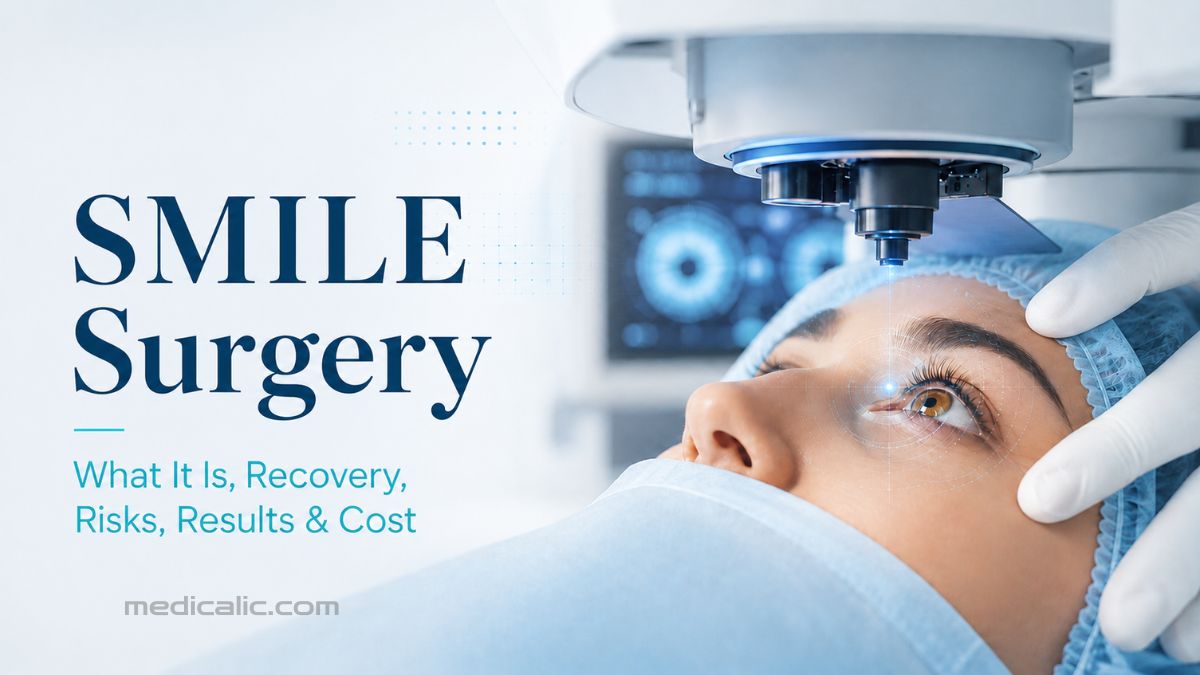
If glasses or contact lenses have become a daily frustration, SMILE surgery may sound like an appealing solution. It can reduce dependence on corrective lenses without creating the larger corneal flap used in LASIK, and many appropriately selected patients recover functional vision quickly.
But “small incision” does not mean “small decision”.
SMILE eye surgery, or small incision lenticule extraction, permanently changes the shape of the cornea. It has a strong record for correcting nearsightedness and myopic astigmatism in suitable patients, but it can also cause dry eye, glare, halos, residual prescription and other complications.
So the most useful question is not simply, “Is SMILE surgery good?” It is: “Are my eyes a good fit for SMILE?”
What Is SMILE Surgery?
SMILE is a form of refractive eye surgery designed to change how light focuses on the retina.
Instead of creating a LASIK-style flap, a femtosecond laser forms a thin, lens-shaped piece of tissue, called a lenticule, inside the cornea. The surgeon separates and removes this lenticule through a small opening. Removing it changes the curvature and focusing power of the cornea.
SMILE is often described as flapless because it avoids the larger corneal flap created in LASIK. But it still involves a small incision, removal of corneal tissue and permanent reshaping of the cornea.
What Can SMILE Surgery Correct?
SMILE is primarily used to treat myopia, commonly called nearsightedness, with or without astigmatism.
In the United States, current FDA labeling for the VisuMax SMILE procedure includes spherical refractive errors from −1.00 to −10.00 diopters, cylinder from −0.75 to −3.00 D, and a spherical equivalent no greater than 10.00 D in magnitude. Patients must be at least 22 years old, with no more than a 0.50-D change in sphere or cylinder during the previous year.[1]
These are regulatory treatment ranges, not guarantees that every person within them is suitable.
Availability also differs internationally. Devices, treatment ranges and approved indications vary by country, so information from an overseas clinic should not automatically be assumed to match U.S. FDA labeling. ZEISS likewise notes that available uses and treatment options differ between markets.
SMILE also does not stop normal aging of the eye. Even after successful distance correction, presbyopia can eventually make reading glasses necessary, and other age-related changes can affect vision later.
Who Is a Good Candidate for SMILE Surgery?
Your prescription is only one part of the decision.
Before recommending refractive surgery, an eye surgeon needs to evaluate factors such as your prescription stability, corneal shape and thickness, ocular-surface health and overall eye health. Conditions that make the cornea structurally abnormal or vulnerable to progressive thinning may make corneal refractive surgery inappropriate.
Dry-eye symptoms also deserve attention before surgery. Pre-existing ocular-surface problems can affect measurements, comfort and postoperative visual quality. Refractive-surgery experts therefore place considerable emphasis on identifying and treating significant dry-eye disease before surgery.
A proper SMILE consultation therefore involves much more than reading letters from an eye chart.
Corneal mapping and other measurements help determine whether SMILE can be performed safely and predictably in your eyes.
Who May Not Be a Good Candidate for SMILE?
Under current U.S. FDA labeling, SMILE is contraindicated when too little corneal tissue would remain after treatment, when corneal mapping is abnormal—including keratoconus or suspected keratoconus—or when myopia is unstable. Severe dry eye, active eye infection or inflammation, certain herpes-related eye histories, active autoimmune or connective-tissue disease, uncontrolled diabetes and uncontrolled glaucoma can also make the procedure inappropriate.
These are reasons for careful medical screening, not something that can be determined from prescription strength alone.
How Does SMILE Eye Surgery Work?
The procedure is usually performed with numbing eye drops.
After the eye is positioned under the laser, the femtosecond laser creates the lenticule inside the corneal stroma and makes a small access incision. The surgeon then separates the lenticule from surrounding tissue and removes it manually through that opening. Stitches are generally not required.
This manual stage is worth understanding. SMILE is highly technology-driven, but the laser does not perform the entire operation by itself.
The surgeon still has to identify, separate and remove the correct tissue cleanly. A surgeon’s experience with SMILE—including the management of lenticule-related complications—therefore matters when comparing clinics.
Does SMILE surgery hurt?
Significant pain during treatment is not generally expected because topical anesthetic drops numb the eye. Pressure, suction or unusual sensations may still be noticeable.
After surgery, some people experience watering, light sensitivity, blurry vision, irritation or a gritty feeling while the eye settles.
Calling the procedure universally “painless” is therefore too absolute. Comfortable or only mildly uncomfortable for many patients is a more realistic expectation.
What Is Recovery Like After SMILE Surgery?
One of the attractions of SMILE surgery is relatively fast functional recovery.
Vision can begin improving quickly, sometimes immediately, but it may remain hazy or fluctuate during the early healing period. Cleveland Clinic notes that many patients can resume their normal routine within a few days while vision continues improving over days or weeks.
A practical recovery timeline may look like this:
- First 24 hours: Blurry or hazy vision, watering, irritation and light sensitivity can occur. Arrange transportation home rather than planning to drive yourself.
- First several days: Everyday vision often improves substantially, although it may not yet feel perfectly crisp or stable.
- First few weeks: Dryness, glare, halos or fluctuations can continue while healing progresses.
- Later recovery: Visual quality and ocular-surface symptoms may keep improving even after you feel able to work, drive or perform most normal activities.
Your own surgeon’s instructions should take priority over generic timelines. Restrictions involving swimming, makeup, exercise, eye rubbing, water exposure and driving can vary according to your recovery.
You may feel ready for normal activities before your visual clarity and ocular-surface symptoms have completely stabilized.
How Successful Is SMILE Surgery?
SMILE can produce excellent results in appropriately screened patients, but “success” deserves a careful definition.
In the FDA clinical study supporting approval for myopia with astigmatism, 84.2% of treated eyes achieved uncorrected 20/20 vision or better at the stability time point, while 93.7% were within ±0.50 D of the intended refractive target. These numbers describe visual and refractive outcomes—not whether every patient felt completely symptom-free or glasses-free.
An FDA-required U.S. post-approval study followed 171 treated patients, of whom 159 completed the six-month assessment. At six months, 98.7% reported being completely, very or somewhat satisfied with their vision, while 96.2% fell into those satisfaction categories for the SMILE procedure itself.[2]
Those numbers are encouraging, but 98.7% satisfaction does not mean 98.7% achieved perfect vision or were completely satisfied.
The study grouped somewhat, very and completely satisfied patients together. It also found that 11.3% developed new very or extremely bothersome visual symptoms compared with their preoperative status. About 1.3% developed very or extreme difficulty with daily activities related to visual symptoms. No serious adverse events were reported in that particular study.
That distinction matters: refractive accuracy, patient satisfaction and freedom from visual symptoms are related outcomes, but they are not the same outcome.
What Are the Risks and Side Effects?
SMILE surgery has a strong clinical evidence base, but it is not risk-free.
Possible problems include dry eye, blurry or fluctuating vision, glare, halos and a remaining prescription that may still require glasses or further treatment. SMILE-specific surgical difficulties can also occur during lenticule separation or removal.
Rare but potentially serious complications can include corneal infection or inflammation, scarring, ectasia and loss of best-corrected visual acuity. Sudden vision loss, severe or worsening eye pain, marked redness, discharge or other concerning symptoms require urgent advice from your surgeon or urgent ophthalmic care.
For night driving, visual acuity is only part of the story. A 20/20 eye-chart result does not fully capture glare, halos, starbursts, contrast sensitivity or how comfortable vision feels in darkness. The FDA post-approval study evaluated several of these symptoms separately for that reason.
Can SMILE Surgery Cause Dry Eye?
Yes, although the risk profile differs somewhat from LASIK.
Because SMILE does not create a LASIK-style flap, it affects the cornea differently. Some studies suggest this may translate into better postoperative tear-film or corneal-sensitivity measures than femtosecond LASIK. A 2025 systematic review and meta-analysis reported advantages for keratorefractive lenticule extraction in several dry-eye-related outcomes.[3]
Dry eye can still occur after SMILE, and pre-existing dry-eye disease remains an important consideration before refractive surgery.
If you already experience burning, fluctuating vision, frequent artificial-tear use or contact-lens intolerance, make sure those symptoms are discussed during your evaluation rather than assuming SMILE will automatically solve them.
How Long Do SMILE Surgery Results Last?
The corneal tissue removed during SMILE does not simply grow back into its original shape, so the refractive correction is intended to be long-lasting.
But your eyes continue to change with age.
Ten-year studies are reassuring. In one larger long-term case series involving 208 eyes, 84.6% had uncorrected 20/20 or better vision at 10 years, and overall efficacy remained stable despite some refractive change over time. Another 10-year study following 32 eyes found an average myopic regression of about −0.32 D, with 81% of eyes within ±0.50 D and 94% within ±1.00 D of the intended target at the final visit.[4]
The tissue removed during SMILE is permanently removed, but the refractive result can still change as the eye ages. Myopia may progress, some refractive regression can occur, and presbyopia or cataracts may later change your need for glasses.
What Is SMILE Pro?
SMILE Pro refers to the newer SMILE treatment workflow performed with the ZEISS VISUMAX 800 femtosecond laser platform.
The system operates at a maximum laser repetition frequency of 2 MHz and includes technologies such as CentraLign for centration assistance and OcuLign for cyclotorsion adjustment. Under applicable settings, ZEISS states that the laser can create a lenticule in less than 10 seconds.
These features can shorten laser time and support surgical alignment, although it is less clear whether they translate into better final vision for an individual patient.
In a 2025 contralateral-eye comparison, the VISUMAX 800 reduced docking and overall surgical time compared with the VISUMAX 500, while the measured visual, refractive and optical-quality outcomes at three months were not significantly different between platforms.
A larger 2026 multicenter study involving 605 eyes treated with VISUMAX 800 also reported strong refractive predictability at six months, while noting increases in some higher-order aberrations.[5] The finding reinforces an important point: accurate refractive correction does not necessarily capture every aspect of subjective visual quality.
If a clinic emphasizes the word Pro, ask what the newer platform is expected to improve for your particular eyes.
SMILE Surgery vs. LASIK
LASIK creates a corneal flap before reshaping deeper tissue, whereas SMILE removes a lenticule through a smaller access incision without creating a LASIK-style flap.
SMILE may be attractive when avoiding a flap is important or when its ocular-surface profile is considered advantageous. LASIK may suit other prescriptions, treatment goals or corneal characteristics better. Which option makes more sense ultimately depends on your examination, expected visual outcome and individual risk profile.
How Much Does SMILE Surgery Cost?
There is no single reliable global price for SMILE surgery.
Fees vary by surgeon, location, technology, preoperative testing, postoperative care and whether future enhancement treatment is included.
As one current U.S. example, UCLA Health lists SMILE at $3,500 per eye.[6] That is an example from one medical center, not a U.S. national average.
When comparing prices, ask what the quote actually includes. A lower advertised fee may be less attractive if important diagnostic testing, medications, follow-up visits or enhancement care require separate payment.
For elective eye surgery, the quality of screening and follow-up deserves at least as much attention as the headline price.
Questions to Ask Before Choosing SMILE Surgery
Before committing, consider asking your surgeon:
- Why do you recommend SMILE rather than LASIK, PRK or another option for my eyes?
- What do my corneal topography or tomography results show?
- Is my corneal thickness appropriate for the planned treatment?
- Do I have dry-eye or ocular-surface problems that should be treated first?
- What visual result is realistic for my prescription?
- What is my individual risk of glare, halos or night-vision problems?
- Which SMILE platform will you use, and why?
- How do you manage residual prescription if I need an enhancement later?
- What postoperative visits and medications are included?
- Which symptoms after surgery should make me contact you urgently?
You do not need to become an expert in laser physics before deciding. You do need a clear explanation of why the procedure makes sense for your specific eyes.
Frequently Asked Questions
Yes, SMILE has a strong safety and effectiveness record in appropriately selected patients, but complications such as dry eye, visual symptoms or residual refractive error can still occur.
Yes. Current U.S. FDA labeling includes myopic astigmatism with cylinder from −0.75 through −3.00 D when the other eligibility requirements are met.
Vision often improves quickly, but clarity can continue settling over days or weeks.
Possibly. Some patients retain a small prescription, while others may need glasses for specific situations. Aging can also lead to reading-glasses needs or other changes years after otherwise successful surgery.
SMILE Pro uses the newer VISUMAX 800 system, which offers faster laser delivery and additional alignment assistance. Current comparative evidence suggests workflow advantages, but it does not establish universally superior final vision for every patient.
The corneal tissue removed during SMILE is permanently removed, but your prescription and eye health can still change with age. That means the procedure cannot guarantee lifelong freedom from glasses.
Bottom Line
SMILE can be an effective way to reduce dependence on glasses or contact lenses, but the small incision does not remove the need for careful screening or realistic expectations.
Whether it is right for you depends on your prescription, corneal structure, ocular surface and the visual outcome you realistically hope to achieve.
Medical References
Update History
Originally written by Dr. Rahul Kushwaha.
Your answer helps us improve the clarity and usefulness of our health content.