
Red Man Syndrome—the name itself gives a clue about this reaction. When the antibiotic vancomycin is given too quickly through a vein (intravenously), it can cause a sudden feeling of warmth, itching, discomfort, and skin redness.
This visible skin flushing is the reason behind the historical name Red Man Syndrome.
In this complete clinical overview, we will explore the mechanism, symptoms, risk factors, diagnosis, treatment, and prevention of this reaction.
So, take a deep breath and continue reading to understand this condition in a clear and comprehensive way.
What Is Red Man Syndrome (Vancomycin Infusion Reaction)?
The term Red Man Syndrome has been replaced by Vancomycin Infusion Reaction (VIR) to improve scientific accuracy and better reflect the mechanism behind this reaction.
Throughout this article, we will use the term Vancomycin Infusion Reaction (VIR) when referring to this condition.
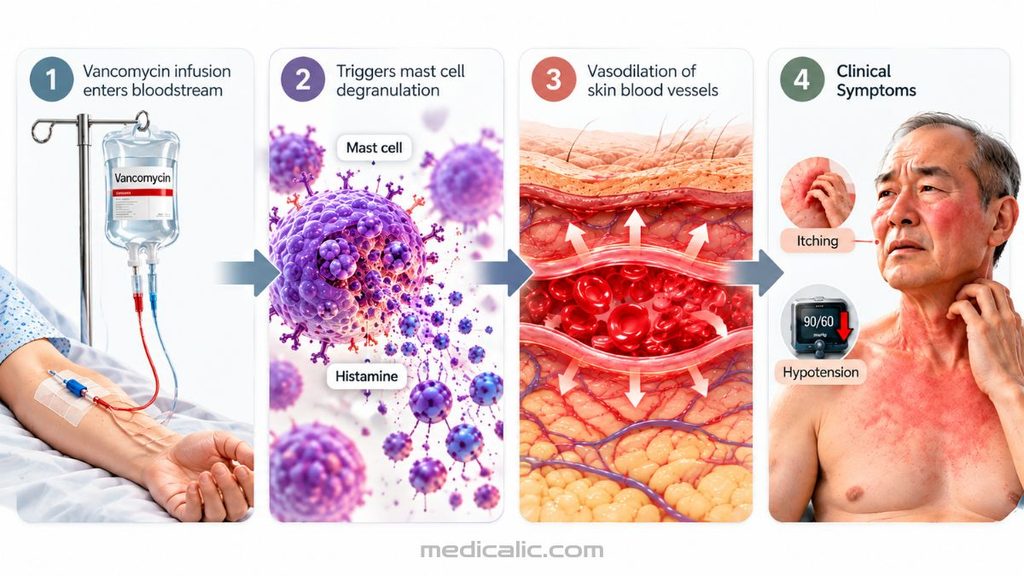
VIR is a non-IgE-mediated hypersensitivity reaction. Unlike a true IgE-mediated allergy, it does not require prior sensitization. Vancomycin can directly activate mast cells and basophils, leading to the release of histamine and other inflammatory mediators.[1]
This distinction is clinically important because VIR does not always prevent future vancomycin use. With appropriate precautions, such as slower infusion and careful monitoring, many patients can receive vancomycin again.
Causes and Pathophysiology
Vancomycin infusion reaction occurs when vancomycin directly activates mast cells and basophils, causing the release of histamine and other inflammatory mediators. Unlike a true IgE-mediated allergy, this process does not require prior sensitization or a drug-specific IgE response.
Histamine causes blood vessels in the skin to widen, leading to warmth, flushing, and itching. In more severe reactions, widespread mediator release can contribute to a drop in blood pressure. Research has also identified the mast-cell receptor MRGPRX2 as a possible pathway involved in this direct activation.[2]
Three key aspects of vancomycin administration help explain why one infusion may trigger a reaction while another is tolerated:
- Infusion rate: Faster administration increases the risk. A commonly used preventive limit is 10 mg/min, although institutional protocols may vary.[3]
- Dose and infusion duration: Larger doses require longer infusion times. A high dose given too quickly increases the risk; dose alone does not determine whether a reaction will occur.
- Solution concentration: More concentrated solutions may increase infusion-related adverse effects, especially when combined with a faster delivery rate.
Clinical studies support the importance of infusion rate. In a small crossover study, healthy volunteers receiving 1 g of vancomycin over two hours experienced fewer and milder reactions compared with the same dose given over one hour.
Risk Factors and Incidence
The risk of developing a Vancomycin Infusion Reaction is influenced by several factors related to drug administration and a history of previous reactions.
Rapid infusion, a higher dose given over a shorter infusion time, a more concentrated solution, and a history of previous reactions are important risk factors. Children and young adults can also be affected, and pediatric studies have associated age, dose, concentration, and previous reactions with increased risk.[4] Other mast-cell-activating agents, including some opioids, radiocontrast media, and neuromuscular blockers, may further increase susceptibility when administered around the same time.
The reported frequency of this reaction varies substantially depending on the population studied, infusion practices, and how the reaction is defined or recorded. The commonly cited range of approximately 5%–50% reflects older and heterogeneous reports and should not be interpreted as a single expected risk with current infusion practices. A World Allergy Organization statement reports rates ranging from 3.7%–47% among infected patients, highlighting the variability of available data. In a multicenter study of 546 patients aged six months to 21 years, 14% developed the reaction.
A first dose can trigger the reaction because prior sensitization is not required. Conversely, symptoms may recur even after previous doses were tolerated. Although slowing the infusion reduces the risk, the reaction can still occur despite appropriate administration; therefore, its occurrence alone does not prove an infusion error.
Symptoms and Onset of Vancomycin Infusion Reaction
Symptoms usually appear during the infusion, often within the first few minutes, but may also occur later or shortly after completion. Patients may report itching or burning before visible skin changes appear.
- Skin symptoms: Flushing, erythema (redness), warmth, itching, burning, and sometimes urticaria (hives).[5]
- Systemic and cardiovascular symptoms: Dizziness, rapid heartbeat, low blood pressure, chest or back pain, muscle spasms, fever, or chills. Severe reactions may involve fainting or cardiovascular instability.
Some patients may develop features requiring closer assessment. Angioedema—swelling beneath the skin, particularly around the lips or face—has been reported. Breathing difficulty, wheezing, throat swelling, or collapse require immediate assessment as they may indicate anaphylaxis.
Mild symptoms may begin to improve within 20–30 minutes after stopping the infusion and providing appropriate treatment. Many reactions resolve within an hour, although symptoms may persist for several hours. The time taken for symptoms to resolve alone does not confirm the diagnosis or determine when restarting vancomycin is safe.
Diagnosis: Vancomycin Infusion Reaction vs. Anaphylaxis
Vancomycin Infusion Reaction is primarily a clinical diagnosis. Assessment should consider the timing of symptom onset relative to the infusion, as well as the dose, concentration, infusion rate, concurrent medications, previous reactions, and overall clinical findings.
A reaction that occurs during or shortly after vancomycin administration supports the diagnosis; however, timing alone cannot reliably distinguish Vancomycin Infusion Reaction from anaphylaxis.
Anaphylaxis must be considered when symptoms are severe or involve features beyond a typical infusion reaction. Airway symptoms, respiratory distress, or circulatory instability require urgent evaluation and management. Anaphylaxis can occur without a documented previous exposure, and severe infusion reactions may sometimes be difficult to distinguish from it at the bedside.
Other conditions that may resemble this reaction include:
- Delayed drug reactions, including drug reaction with eosinophilia and systemic symptoms (DRESS): These usually follow a different time course and may involve fever, eosinophilia, and internal-organ involvement. Eosinophilia is not a defining feature of every drug-related rash.
- Infection or sepsis-related changes: Fever, rigors, skin changes, and hypotension may be caused by the underlying illness rather than the infusion itself. Both the infection and the possibility of an infusion reaction should be assessed.
Serum tryptase may support the evaluation of a suspected severe hypersensitivity reaction, especially when compared with a baseline value. However, it is not a standalone test for distinguishing Vancomycin Infusion Reaction from anaphylaxis.[6] Severe infusion reactions may occasionally show elevated tryptase, and a normal result does not exclude anaphylaxis. Testing should not delay emergency treatment.
Treatment and Management of Vancomycin Infusion Reaction
The first step in managing a suspected Vancomycin Infusion Reaction is to stop the infusion and promptly assess the patient.[7] Management depends on the severity of symptoms and whether the clinical features suggest a severe hypersensitivity reaction or anaphylaxis.
Clinically, patients can be broadly divided into those with skin symptoms and stable vital signs, and those who develop systemic features such as chest or back pain, muscle spasms, significant hypotension, or collapse.
| Severity | Typical presentation | Management approach |
|---|---|---|
| Mild to moderate | Flushing, itching, or erythema with stable vital signs and no concerning systemic features. | Stop or pause the infusion, assess the patient, treat symptoms with an appropriate antihistamine, and consider restarting at a slower rate after symptoms resolve. |
| Severe | Significant hypotension, chest or back pain, muscle spasms, collapse, or features suggestive of anaphylaxis. | Stop the infusion, perform urgent clinical assessment, provide supportive treatment such as IV fluids when indicated, and treat suspected anaphylaxis promptly with intramuscular epinephrine. |
Initial Management of an Acute Reaction
Management should begin with assessment of airway, breathing, and circulation.
- Stop vancomycin and notify the treating team.
- Assess the severity of the reaction. Check blood pressure, heart rate, oxygen saturation, and the extent of symptoms.
- Treat histamine-mediated symptoms when appropriate. A prescribed H1 antihistamine may be used for flushing, itching, and other histamine-related symptoms. The choice, route, and dose depend on patient factors. For example, UCSF’s adult protocol uses diphenhydramine 50 mg orally or intravenously, or cetirizine 10 mg orally. Pediatric dosing requires age- and weight-based guidance.
- Provide supportive care when needed. IV fluids may be required for hypotension, and oxygen should be given when clinically indicated. If anaphylaxis is suspected, intramuscular epinephrine is the first-line treatment; antihistamines should not delay or replace it.
Restarting Vancomycin After a Reaction
After symptoms resolve and the patient becomes clinically stable, the decision to restart vancomycin should be based on the severity of the reaction, the likelihood that the event represents an infusion reaction, and the ongoing need for treatment.
Restarting is not appropriate after every vancomycin-associated reaction. Patients with more severe or recurrent reactions may require closer monitoring, additional precautions, or specialist input.
When treatment is continued, a modified administration plan may include a slower infusion rate and careful monitoring. Decisions regarding further adjustments should be individualized according to the patient’s risk and clinical situation.
Recurrent Reactions, Premedication, and Alternative Antibiotics
Some patients with recurrent reactions may tolerate further doses with a carefully planned approach. Antihistamine premedication may be considered in selected patients according to the treatment plan. For persistent histamine-mediated symptoms, an H2 blocker such as famotidine or cimetidine may be considered as an adjunct under a local or specialist plan.
Corticosteroids are not routine premedication for vancomycin infusion reactions. Hydrocortisone has been described in specialist desensitization protocols, but this does not establish a universal recommendation for routine use before every infusion. Desensitization is a supervised procedure reserved for selected patients whose need for vancomycin outweighs the risks and is different from simply restarting a slower infusion.
If vancomycin cannot be tolerated despite appropriate management, alternative agents such as daptomycin or teicoplanin may be considered depending on the infection, organism, availability, and reaction history. These agents are not interchangeable in every situation; for example, daptomycin is not indicated for pneumonia, and teicoplanin requires caution in patients with confirmed vancomycin hypersensitivity because cross-reactions may occur.
Prevention: Safe Vancomycin Infusion Rates and Dilution
Prevention begins with an appropriate dose-specific administration plan. A fixed instruction such as “give vancomycin over at least one hour” may be insufficient if the maximum infusion rate is not considered.
Current prescribing recommendations generally use a maximum infusion rate of 10 mg/min and a minimum infusion time of 60 minutes, whichever requires longer. Based on this approach, a 1 g dose requires at least 100 minutes, a 1.5 g dose requires at least 150 minutes, and a 2 g dose requires at least 200 minutes.
Patients with previous infusion reactions may require a slower administration schedule and additional precautions based on the severity of the previous event.
| Preventive measure | Practical application |
|---|---|
| Infusion time and rate | Use a dose-specific infusion schedule. When applying a 10 mg/min limit, calculate the required duration rather than relying on a fixed infusion time. |
| Dilution | A concentration of 5 mg/mL or less is commonly used. Higher concentrations may be appropriate in selected patients but should be planned with the clinical and pharmacy team. |
| Premedication | Consider a prescribed antihistamine for patients with previous infusion reactions. Routine premedication is not required simply because a patient is receiving the first dose. |
| Other triggers | When feasible, avoid administering vancomycin at the same time as other mast-cell-activating medications, including certain opioids, contrast media, and neuromuscular blockers. |
| Documentation | Record the dose, concentration, infusion rate, administration time, symptoms, treatment provided, and any subsequently tolerated regimen. |
A clear record of the tolerated infusion plan helps nurses, pharmacists, and prescribers maintain a consistent approach. Premedication should support appropriate administration practices rather than replace appropriate infusion rate control.
Complications, Recovery, and Future Vancomycin Use
Most patients recover completely once the reaction is recognized and appropriately managed. Severe complications such as significant hypotension, syncope, arrhythmia, or cardiovascular collapse are uncommon but require prompt recognition and treatment.
A stress-induced cardiomyopathy associated with a vancomycin infusion reaction has been described in a conference case report. This represents an exceptional report and does not indicate that cardiomyopathy is a typical consequence of vancomycin infusion reactions.
A previous vancomycin infusion reaction does not automatically prevent future use of vancomycin. Many patients can continue treatment with an individualized administration plan and appropriate monitoring.[8] However, suspected anaphylaxis or severe delayed reactions such as DRESS require a different management approach and specialist assessment rather than simply restarting vancomycin.
Oral Vancomycin Reactions and Pediatric Cases
Vancomycin infusion reaction is most commonly associated with intravenous administration, but rare flushing-type reactions have also been reported with oral vancomycin. Although oral vancomycin is usually poorly absorbed, absorption may increase when the intestinal lining is inflamed. In patients with reduced renal clearance, absorbed drug may accumulate.
A rash or flushing during oral vancomycin treatment still requires clinical assessment. Not every reaction has the same mechanism as an intravenous infusion reaction, and the overall clinical situation should be considered.
The following two scenarios are illustrative examples, not verified published case histories.
Oral Vancomycin in Kidney Disease: An Illustrative Example
A patient with chronic kidney disease develops flushing and hypotension while receiving oral vancomycin. The medication is stopped, the patient’s circulation is assessed, and other possible causes are considered, including the possibility of systemic exposure.
Symptoms improve after withdrawal and appropriate treatment, including an antihistamine when indicated. This example highlights why oral administration should not automatically exclude vancomycin from consideration. However, it does not prove systemic absorption without supporting evidence.
Pediatric Infusion Reaction: An Illustrative Example
A 10-year-old child receives a prescribed 15 mg/kg dose of intravenous vancomycin over 30 minutes and develops erythema and itching. The infusion is stopped, and the child is assessed.
In this example, a later dose is tolerated after administration over a longer period. The key point is that pediatric management should consider the actual dose, infusion rate, previous reaction, and clinical response. A specific duration, such as two hours, is not a universal rule for all children and should be determined by clinical assessment and local pediatric protocols.[9]
Clinical Guidelines and Hospital Protocols
Vancomycin administration practices can vary between institutions, particularly for pediatric patients, infusion schedules, and management after a previous reaction. Local protocols help translate general recommendations into practical instructions for prescribing, monitoring, and escalation.
Examples of institutional guidance include:
- UCSF adult vancomycin infusion reaction (VIR) guidance recommends stopping the infusion, assessing the severity of the reaction, and considering measures such as antihistamines, dilution adjustments, and a slower infusion rate when appropriate. Severe reactions require closer monitoring and supportive care, while suspected anaphylaxis requires prompt treatment.
- NHS Grampian provides a vancomycin prescribing pathway with specific administration requirements for clinicians working within that system.
- Stanford Medicine Children’s Health describes modified administration after mild reactions, including antihistamine treatment and restarting at a reduced rate (30%–50% of the original rate). Its standard pediatric infusion schedule is institution-specific and should not be interpreted as a universal rule for every patient or dose.
When applying any guideline, clinicians should consider the relevant product information, institutional protocol, and the patient’s prior reaction history. A standard infusion schedule may be appropriate for routine administration but may not be sufficient for a patient who has previously experienced a vancomycin infusion reaction.
Research and Future Directions
Research is continuing to explore why some patients are more susceptible to vancomycin infusion reactions. Recent studies have investigated mast-cell activation pathways, including the role of the MRGPRX2 receptor, which may help explain why certain individuals develop stronger reactions.
However, these findings remain part of ongoing research. No validated genetic or laboratory test currently predicts an individual’s risk before vancomycin treatment.[10] At present, prevention and management still rely on appropriate infusion practices, careful clinical assessment, and accurate documentation of previous reactions.
As understanding of these mechanisms improves, future research may help identify patients at higher risk and develop more personalized approaches to vancomycin administration. Until then, a well-documented reaction history and a clear treatment plan remain essential for safely preserving the use of this important antibiotic when it is needed.
Medical References
Update History
Reference accuracy and source links verified.
Medical review completed for clinical accuracy.
Redundant content removed.
New information added to improve completeness.
Originally written by Dr. Rahul Kushwaha.
Your answer helps us improve the clarity and usefulness of our health content.