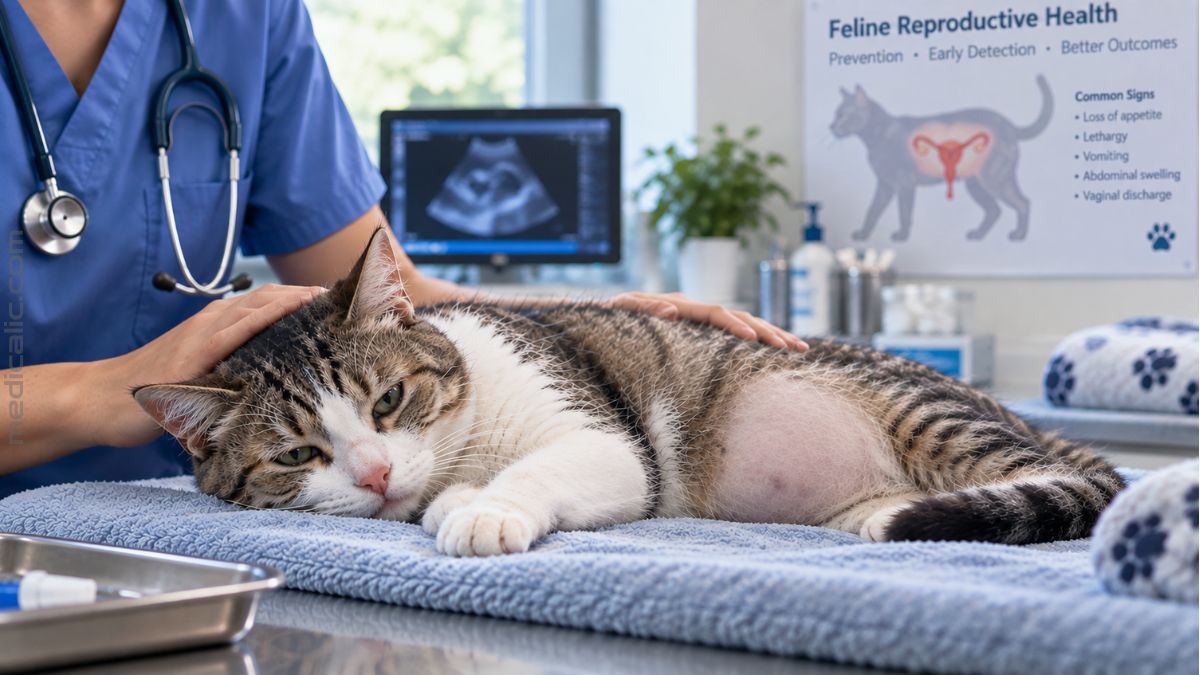
An unspayed female cat who suddenly stops eating, hides more than usual, or starts drinking far more water may be showing the first signs of something serious. You might notice abnormal fluid under her tail—or no discharge at all.
Pyometra is one condition you do not want to miss. It can worsen quickly and lead to uterine rupture, sepsis, shock, and death. The good news is that cats treated before major complications develop often do very well.[1]
If your intact cat suddenly seems unwell, especially in the weeks after estrus, contact a veterinarian rather than waiting for more obvious symptoms to appear.
What Is Pyometra in Cats?
Pyometra is an infection in which the uterus becomes filled with pus and inflammatory fluid. It mainly occurs in sexually intact female cats and is associated with hormonal changes around the reproductive cycle.
Cats typically enter a progesterone-dominated phase after ovulation, which may be triggered by mating or occur spontaneously. During this phase, progesterone increases uterine secretions and reduces uterine contractions, creating conditions that can favor ascending bacterial infection. Pyometra is most often seen during this post-ovulation phase and commonly develops within weeks of estrus.[2]
Although pyometra is less common in cats than in dogs, it can still be easy to miss—especially because cats are so good at hiding illness.
Signs and Symptoms of Pyometra in Cats
Pyometra has no single unmistakable symptom. Some cats may simply seem “off,” while others can become visibly sick very quickly.
Watch for:
- reduced appetite or refusing food
- lethargy or unusual hiding
- increased thirst and urination
- vomiting or diarrhea
- fever or dehydration
- abdominal discomfort or enlargement
- vaginal discharge
- frequent licking around the vulva
- weakness or collapse in advanced illness
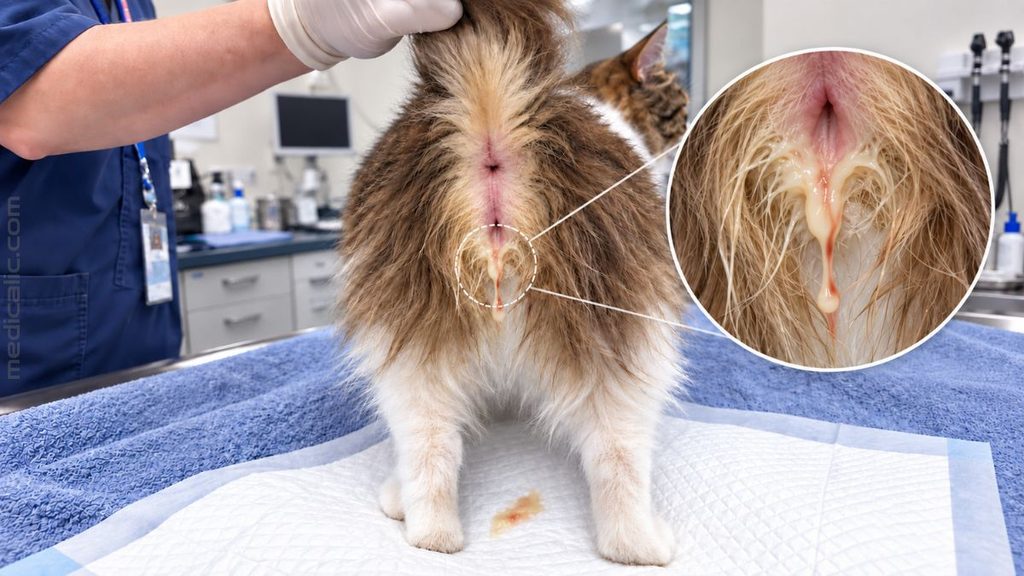
When discharge is present, it may look creamy, bloody, pus-like, or simply different from normal. However, the absence of discharge does not rule out pyometra. Cats often groom discharge away, and cats with a closed cervix may have no external discharge at all.[3]
Open vs. Closed Pyometra
With open pyometra, the cervix allows infected material to drain from the uterus. Discharge may therefore be noticeable around the vulva, under the tail, or on bedding.
With closed pyometra, the cervix is closed and infected fluid remains trapped inside the uterus. As the uterus enlarges, the abdomen may become distended and the cat may become increasingly ill.
Closed pyometra is especially dangerous because nothing drains externally, even as infected fluid accumulates inside the uterus. Whether open or closed, pyometra is always a veterinary emergency that requires prompt treatment.
When Is Pyometra an Emergency?
Pyometra is not a “watch and wait” condition. Once suspected, seek urgent veterinary care.
Without treatment, an infected uterus can rupture and release contaminated material into the abdomen, leading to peritonitis, severe systemic illness, and shock.[4]
If your cat is rapidly declining, take her to an emergency veterinary hospital.
What Causes Pyometra in Cats?
Pyometra usually develops when reproductive-hormone changes leave the uterus vulnerable to bacteria ascending from the lower reproductive tract.
Risk generally increases with age, particularly after about seven years, although younger cats can still develop pyometra. Some breeds also appear to be more susceptible than others.[5]
Certain reproductive hormone medications can increase risk, so heat-suppression treatment should always be managed by a veterinarian.
How Veterinarians Diagnose Pyometra
Diagnosis begins with the cat’s symptoms, reproductive history, spay status, recent estrus, and findings on physical examination.
Blood tests can help assess inflammation, dehydration, kidney-related changes, and the cat’s overall condition. Urinalysis may provide additional information.
Imaging is often what brings the diagnosis into focus. Ultrasound can reveal an enlarged, fluid-filled uterus and help distinguish pyometra from pregnancy and other abdominal conditions. X-rays may also show an enlarged uterus, particularly in some closed-cervix cases.[6]
Because several reproductive and abdominal conditions can look similar from the outside, diagnosis cannot be made from discharge or appearance alone. Once pyometra is confirmed or strongly suspected, treatment usually needs to begin quickly.
Pyometra in Cats Treatment
For most cats, treatment ultimately means surgery: an ovariohysterectomy to remove the ovaries and infected uterus.[7]
Although the procedure resembles a spay, operating on a cat with pyometra is a very different clinical situation. The uterus may be enlarged and fragile, and the cat may already be dehydrated or systemically ill.
A sick or dehydrated cat may need IV fluids, antibiotics, pain control, and other supportive care before surgery.
Can Antibiotics or Home Remedies Treat Pyometra?
Antibiotics can help control infection, but on their own they usually do not solve the core problem: the infected uterus is still there.
The main exception is a breeding cat in which preserving fertility is an important goal. In selected cases, a medical approach may be considered instead of immediate surgery. Uterus-preserving treatment is much less predictable than surgery and requires close veterinary supervision. Treatment can fail, and recurrence or later reproductive problems remain possible.[8][9]
This is also not a condition that can be safely treated at home. Herbal products, supplements, or leftover antibiotics can delay effective veterinary treatment.
Survival and Prognosis
In uncomplicated cases treated early, the outlook is often very good.
The prognosis becomes more guarded when a cat arrives critically ill, the uterus has ruptured, or sepsis and organ complications are already present.
No single survival figure can predict an individual outcome, because prognosis varies with disease severity and the complications already present when treatment begins. The same factors also influence how quickly a cat recovers after surgery.
Recovery After Pyometra Surgery
What recovery looks like depends heavily on how sick the cat was before surgery. Stable cats may improve quickly, while complicated cases may need longer hospitalization and supportive care.
At home, focus on giving medications as directed, protecting the incision, limiting activity, and keeping follow-up appointments. Prevent licking or chewing of the incision if your veterinary team recommends a recovery suit or protective collar.
Contact the clinic promptly if your cat becomes increasingly weak, repeatedly vomits, refuses food, appears painful, or develops redness, swelling, opening, or discharge around the surgical incision.
Can Pyometra Be Prevented?
For a cat who will not be used for breeding, spaying is the most reliable way to prevent pyometra.
One rare exception is stump pyometra, which can occur when uterine tissue remains after surgery, particularly if functional ovarian tissue is also present.[10]
For breeding cats, reproductive health should be managed with a veterinarian, and unexplained changes in appetite, behavior, thirst, abdominal size, or vaginal discharge deserve attention.
Key Takeaway
Pyometra can become life-threatening quickly, but cats treated before serious complications develop often recover well.
The tricky part is that early pyometra may look like nothing more than a cat who suddenly seems “off.”
If an unspayed female cat suddenly seems unwell, particularly in the weeks after estrus, it is safer to call your veterinarian before the classic signs appear.
Medical References
Update History
Originally written by Dr. Neelam Mehta.
Your answer helps us improve the clarity and usefulness of our health content.