If you are comparing PRK vs LASIK, you are probably trying to make a decision that feels bigger than choosing between two laser procedures. You want clear vision, but you also want to know what recovery will feel like, what risks matter for your eyes, and whether one option truly fits you better than the other.
For appropriately selected patients, both PRK and LASIK can provide excellent vision. The biggest practical difference is how the surgeon reaches the corneal tissue being reshaped. LASIK creates a thin corneal flap; PRK removes the outer epithelial layer and treats the surface underneath without creating a flap.[1]
The short answer is:
LASIK generally offers faster recovery and less discomfort during the first few days. PRK is flap-free and may be preferable for some people with certain corneal measurements or lifestyles where avoiding a flap matters. Neither is automatically the safer or better choice for everyone.
PRK vs LASIK at a Glance
| Factor | LASIK | PRK |
|---|---|---|
| Corneal flap | Yes | No |
| Where laser treatment occurs | Beneath the flap | At the corneal surface |
| Early discomfort | Usually less | Usually greater |
| Visual recovery | Usually faster | Slower |
| Thin or borderline corneas | May be unsuitable | May be considered in selected cases |
| Flap-related complications | Possible | None |
| Dry eye symptoms | Can occur | Can occur |
| Corneal haze | Not a typical surface-healing issue | Possible |
| Long-term visual potential | Excellent in suitable candidates | Excellent in suitable candidates |
| Main practical advantage | Speed and early comfort | Flap-free treatment |
The biggest difference patients notice is usually the recovery, not the eventual visual result.
How PRK and LASIK Work
Both procedures are forms of refractive surgery. They reshape the cornea so light focuses more accurately on the retina, reducing refractive errors such as nearsightedness, farsightedness, and astigmatism.
How LASIK works
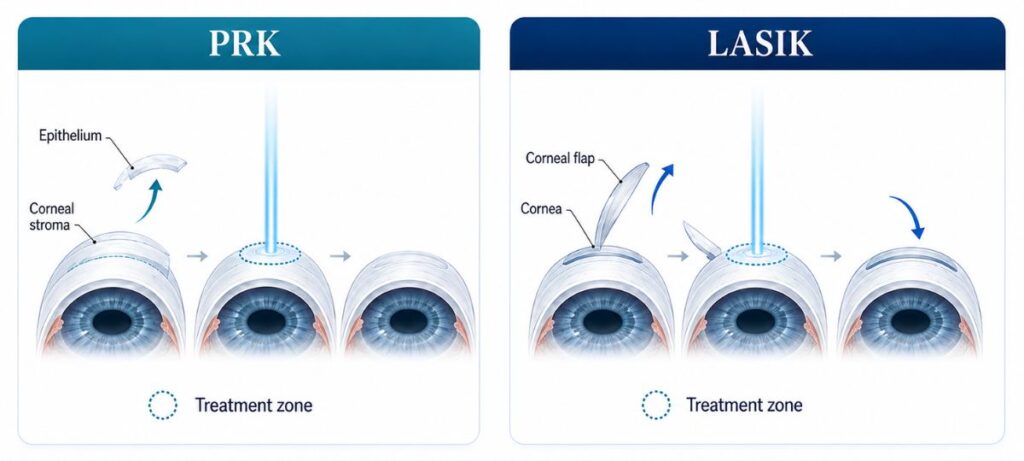
During LASIK, the surgeon creates a thin flap in the cornea, usually with a femtosecond laser in modern treatment. The flap is lifted, an excimer laser reshapes the underlying corneal tissue, and the flap is repositioned.
Because most of the surface epithelium remains intact, recovery is typically fast. UCLA notes that many patients see reasonably well by the next day, although vision may still fluctuate while the eye heals.
How PRK works
With photorefractive keratectomy (PRK), no corneal flap is created. The surgeon removes the central epithelium, applies the excimer laser to the exposed tissue, and generally places a bandage contact lens over the eye while the epithelium regenerates.
The epithelial layer usually heals within several days, but clear, stable vision develops more gradually than it typically does after LASIK.
PRK vs LASIK Results: Which Gives Better Vision?
PRK may take longer to heal, but that does not mean the final vision is necessarily worse.
A 2026 meta-analysis examining TransPRK, a laser-based variation of surface ablation, included 17 studies and 5,686 treated eyes. Researchers found no statistically significant difference between TransPRK and LASIK in pooled efficacy or predictability, although the pooled safety measure favored LASIK. Because the analysis specifically examined TransPRK rather than every form of conventional PRK, it should not be interpreted as proof that every PRK and LASIK technique has identical outcomes.[2]
But 20/20 vision tells only part of the story. After refractive surgery, some patients can experience glare, halos, double vision, difficulty in low-contrast conditions, undercorrection, overcorrection, or a continued need for glasses or contact lenses.[3]
What matters is how well you actually see in daily life—not just the number you reach on an eye chart.
PRK vs LASIK Recovery and Pain
This is where LASIK and PRK feel most different to patients.
LASIK recovery
LASIK usually provides useful vision quickly. Temporary redness, tearing, stinging, gritty sensations, dryness, blur, or light sensitivity can still occur, but early discomfort is generally limited compared with PRK. UCLA reports that many LASIK patients see fairly well the next day.
If getting back to computer work, driving, or everyday activities quickly is a major priority, LASIK often has the practical advantage—provided your surgeon considers you a suitable candidate.
PRK recovery
PRK requires the corneal surface to heal. During the first several days, patients commonly experience symptoms such as:
- burning, stinging, or a gritty sensation
- tearing and redness
- light sensitivity
- blurry or fluctuating vision
- greater discomfort than is typical after LASIK
UCLA reports that PRK-related stinging and grittiness commonly last about three to four days, while visual recovery may take several weeks.[4]
A slow first week after PRK can be completely expected; the corneal surface is still healing.
PRK vs LASIK Risks and Side Effects
Neither procedure is risk-free. PRK and LASIK simply trade different risks, so safety depends on your cornea, ocular surface, prescription, and lifestyle.
Dry eye
LASIK can worsen pre-existing dry eye, which is why careful assessment of the ocular surface is important before surgery. The FDA specifically identifies dry eye as a condition that LASIK can aggravate.
PRK should not be presented as a guarantee against dry eye, however. A 2026 IRIS Registry study involving 48,892 eyes found documented dry-eye disease in 16.1% of LASIK eyes and 15.6% of PRK eyes across follow-up. During the one-to-three-month interval, documented dry eye was actually more frequent after PRK. Because this was a registry study based on clinical coding, it describes real-world documented diagnoses rather than proving that one procedure biologically causes more dry eye in every patient.[5]
If dry eye is already an issue, the condition of your tear film and ocular surface before surgery may matter more than whether you choose PRK or LASIK.
Glare, halos, and night vision
Glare, halos, starbursts, double vision, and poorer vision under low-contrast conditions can occur after refractive surgery. The FDA also notes that pupil size and other preoperative characteristics may influence visual symptoms.
Ask specifically about night driving, glare, and contrast—not just your chances of reaching 20/20.
LASIK flap complications
Because LASIK creates a flap, it introduces complications that PRK cannot have, including flap displacement, flap-interface problems, and certain forms of postoperative inflammation. The FDA notes that flap migration and related complications can sometimes require additional treatment.
Avoiding a flap can therefore be attractive for people who regularly participate in activities where direct blows to the eye are possible. The FDA specifically lists sports such as boxing, wrestling, and martial arts as considerations when evaluating LASIK candidacy.
PRK corneal haze
PRK’s surface-healing process introduces a different concern: corneal haze, an opacity that can affect vision. Modern treatment strategies have reduced its impact, but the possibility has not disappeared. So PRK is not simply LASIK without a flap; its healing process creates a different set of trade-offs.
Rare but potentially serious complications of refractive surgery can also include infection, corneal weakening or ectasia, and loss of best-corrected vision. Careful preoperative screening is a major part of reducing these risks.
Who May Be Better Suited to PRK or LASIK?
The right procedure depends on your measurements—not only your preference.
LASIK may make more sense when:
- your corneal anatomy provides enough suitable tissue
- your prescription is stable
- rapid visual recovery matters to you
- you prefer less discomfort during early healing
- you do not have significant concerns about trauma to a corneal flap
- your ocular surface is healthy enough for surgery
PRK may deserve stronger consideration when:
- avoiding a corneal flap is important
- your corneal thickness or other measurements make LASIK less desirable
- your activities create greater concern about eye trauma
- preserving more available stromal tissue is valuable
- you are comfortable accepting a slower and more uncomfortable recovery
PRK can be considered for some people with thinner corneas because it does not require creation of a LASIK flap. But “thin cornea = PRK” is too simplistic. Corneal thickness, shape, topography or tomography, prescription, planned tissue removal, and ectasia risk all need to be evaluated together. Some abnormal or structurally unstable corneas may not be appropriate for either operation.
Who may need to delay or avoid surgery?
Laser refractive surgery may be inappropriate or need to be postponed in people with refractive instability, keratoconus or other corneal disease, significant uncontrolled dry eye, certain ocular conditions, or medical problems and medications that can interfere with healing. Pregnancy and breastfeeding can also be associated with refractive instability.
In the United States, the FDA states that no LASIK lasers are approved for people younger than 18. Requirements and approved treatment ranges can differ internationally.[6]
PRK vs LASIK Cost and Long-Term Results
The cost of PRK vs LASIK can vary substantially by country, city, surgeon, laser technology, follow-up care, and what is included in the surgical package.
In the United States, refractive surgery is generally considered elective, and the FDA notes that most medical insurance does not pay for it.
Rather than choosing the lowest advertised price, ask whether your quote includes:
- preoperative testing
- surgeon and facility fees
- postoperative appointments
- prescribed postoperative care
- management of complications
- possible enhancement procedures
Price should not be the deciding factor; compare the full package rather than the advertised fee alone.
Do PRK and LASIK last forever?
The corneal reshaping from PRK or LASIK is intended to be lasting, but your eyes can continue to change throughout life.
Refractive error may change or regress, and presbyopia—the normal age-related loss of near focusing ability—can eventually make reading glasses necessary even after successful distance-vision surgery. Refractive surgery also cannot guarantee lifelong freedom from glasses or contact lenses.[7]
Questions to Ask Before Choosing PRK or LASIK
A high-quality consultation should feel like medical decision-making rather than a sales presentation. Useful questions include:
- Why do you recommend PRK or LASIK for my specific eyes?
- What do my corneal topography or tomography scans show?
- Is my corneal thickness and shape suitable for treatment?
- Do I have dry-eye disease or another ocular-surface problem that should be treated first?
- How much corneal tissue will the procedure affect?
- What recovery timeline should I realistically expect?
- Which laser and treatment profile will you use, and why?
- What side effects are most relevant to my prescription and anatomy?
- What happens if I still need glasses or an enhancement afterward?
- What outcomes should I consider besides 20/20 vision?
The FDA recommends comparing surgeons and procedures, understanding complications, and being cautious about anyone who promises guaranteed results.
Frequently Asked Questions
Not universally. PRK eliminates LASIK flap-related risks but requires surface healing and carries risks such as haze and slower visual recovery. LASIK has different concerns, including flap complications and potential worsening of dry eye. The safer procedure is the one that best fits your corneal anatomy, prescription, ocular surface, and lifestyle.
For many suitable patients, LASIK is better for fast recovery and early comfort, while PRK can be preferable when avoiding a flap or preserving more available corneal tissue is important. Both can provide excellent visual outcomes in appropriately selected patients.
Generally, yes during the first few postoperative days, because PRK requires the corneal epithelium to regenerate.
Yes. Both PRK and LASIK can correct astigmatism in appropriately selected patients. The expected result depends on the amount and type of astigmatism, your corneal anatomy, and the laser and treatment profile being used.[8]
SMILE is another refractive option that reshapes the cornea by removing a small lenticule through an incision rather than using a LASIK-style flap or PRK surface ablation. Its suitability depends on the refractive error, available technology, regulatory approvals, and individual anatomy. SMILE can be a strong option for some patients, but newer does not automatically mean better for your eyes.
The Bottom Line
Choosing between PRK and LASIK is less about finding a universal “winner” and more about finding the procedure that best fits your eyes.
LASIK’s biggest advantage is speed: visual recovery is usually faster and the first few days tend to be more comfortable.
PRK’s defining advantage is being flap-free: that can matter when corneal measurements, available tissue, occupation, or lifestyle make a LASIK flap less desirable.
The deciding factors are your corneal scans, tear-film health, prescription, visual goals, and risk profile—not marketing or recovery speed alone.
For the right candidate, either procedure can bring you closer to the freedom of relying less on glasses or contact lenses. The best choice is the one your eyes can safely support—not simply the one that sounds better on paper.
Medical References
Update History
Medically reviewed by Dr. Jubair Islam.
Originally written by Dr. Rahul Kushwaha.
Your answer helps us improve the clarity and usefulness of our health content.