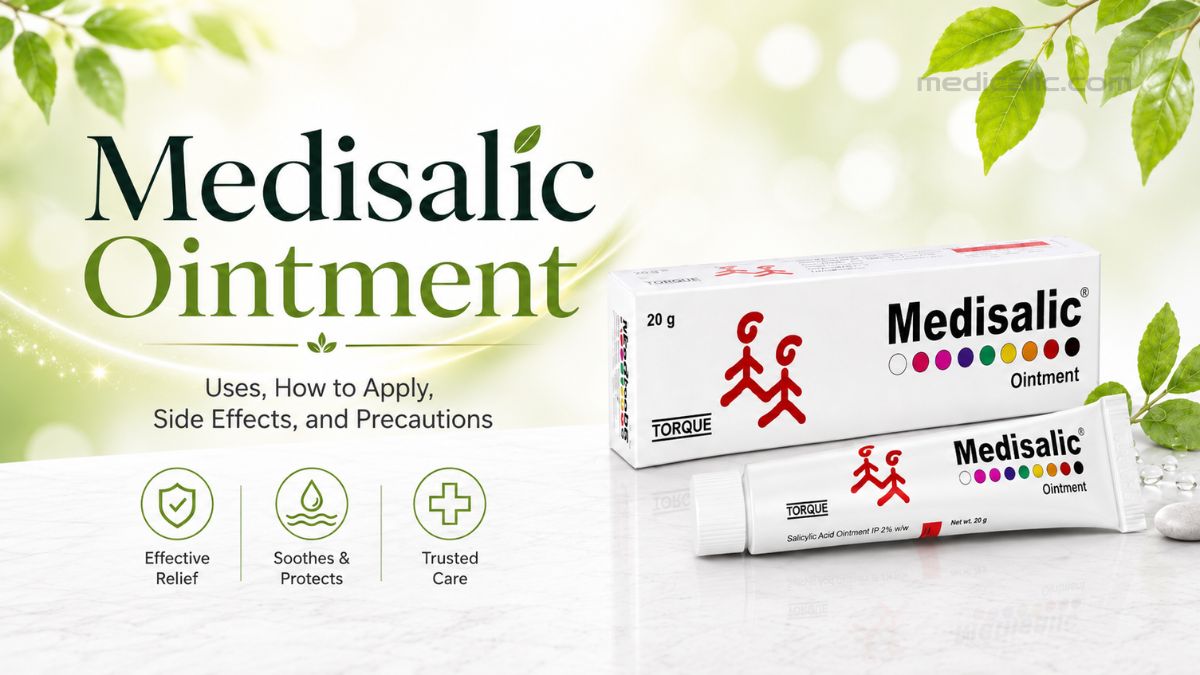
When an itchy skin patch becomes thick, rough, and scaly, it is natural to look for fast relief. Medisalic may help in selected, correctly diagnosed conditions. It is a prescription-strength topical medicine intended for specific inflammatory and scaly skin conditions. It is not a treatment for every unexplained rash.
Medisalic Ointment combines a very potent topical steroid with a scale-softening medicine. When prescribed for the right condition, Medisalic can reduce inflammation and help remove thick scaling. However, inappropriate use may increase the risk of skin thinning or infection-related problems.
What Is Medisalic Ointment?
Torque Pharmaceuticals lists Medisalic as a topical ointment containing:
- Clobetasol propionate 0.05% w/w
- Salicylic acid 3% w/w
The formulation also contains butylated hydroxytoluene 0.01% as a preservative, together with an ointment base.
The manufacturer lists it for conditions such as eczema and psoriasis, with dosing directed by a physician.
Medisalic is manufactured in India, and its availability, prescription status, packaging, and official instructions may differ between countries.
Each active ingredient has a different role.
Clobetasol propionate reduces inflammation, redness, swelling, and itching. Clobetasol 0.05% ointment is classified in US labeling as a super-high-potency topical corticosteroid. [1]
Salicylic acid is a keratolytic. This means it softens and helps remove thick, dead surface skin. [2]
Together, these ingredients may be useful when inflamed skin is also thick and heavily scaled. By loosening the surface buildup, salicylic acid may help the corticosteroid penetrate the affected area more effectively. Both medicines are recognized topical options for appropriately selected psoriasis plaques. [3]
What Is Medisalic Used For?
Medisalic is mainly considered for diagnosed, steroid-responsive skin conditions with significant scaling.
Plaque psoriasis
Plaque psoriasis can cause raised, inflamed patches covered with dry or silvery scale. A dermatologist may prescribe a potent corticosteroid for small, stubborn plaques on thicker areas of skin, while salicylic acid helps lift the scale.
Strong corticosteroids are generally unsuitable for delicate areas such as the face or skin folds unless a dermatologist specifically recommends them.
Thickened eczema or dermatitis
Repeated inflammation and scratching can leave some eczema patches dry, rough, and thickened. A clinician may prescribe a strong topical steroid when a milder treatment has not adequately controlled the flare.
Medisalic may not be appropriate for wet, weeping, infected, extensively broken, or undiagnosed skin, which may require a different treatment approach.
Other scaly inflammatory conditions
In selected cases, specialists may use this combination for other diagnosed inflammatory skin disorders.
Because many skin conditions share similar symptoms, confirming the diagnosis before using a potent steroid is important. A powerful steroid may temporarily reduce visible redness while allowing the underlying condition to continue or worsen.
Medisalic may control inflammation and scaling, but it does not permanently cure chronic conditions such as psoriasis or eczema.
How to Use Medisalic Safely
Use Medisalic exactly as directed by the prescribing clinician and according to the instructions supplied with your product. Do not apply more often or in a thicker layer because the rash feels severe.
A safe application routine generally involves the following:
- Gently clean and dry the affected skin.
- Apply only enough ointment to leave a thin film.
- Smooth it over the diagnosed area without vigorous rubbing.
- Wash your hands afterward unless your hands are being treated.
- Avoid contact with the eyes, mouth, inside of the nose, and other mucous membranes.
- Do not cover the area with plastic wrap or an airtight dressing unless instructed.
The manufacturer recommends physician-directed dosing. Although some US clobetasol ointment labels advise twice-daily application, the correct frequency can vary by product, diagnosis, treatment area, and age. Follow the instructions provided for your own medicine rather than another person’s routine.
How much should you apply?
A clinician or pharmacist may describe the correct amount using fingertip units. One adult fingertip unit generally covers an area about twice the size of an adult palm.
How long can you use Medisalic?
Because Medisalic contains clobetasol, it is not suitable for open-ended self-treatment.
US labeling for clobetasol 0.05% ointment limits continuous treatment to two weeks and no more than 50 grams per week.[4] It also recommends reassessing the diagnosis when the condition has not improved. These limits come from a US clobetasol-only label. Not a Medisalic-specific US label, so the instructions supplied with your product and your prescriber’s advice take priority.
Do not automatically restart Medisalic every time a rash returns. Frequent relapses may indicate that the diagnosis, trigger, treatment strength, or long-term maintenance plan needs review.
Can you use moisturizer with Medisalic?
Often, yes. Moisturizer can support the skin barrier in eczema and psoriasis, but do not mix it directly with Medisalic unless instructed.
Clobetasol guidance recommends leaving at least 30 minutes between Medisalic and a moisturizer or another topical product. [5]
Where Should You Not Apply Medisalic?
Medisalic should only be applied to the affected area recommended by your healthcare professional. Avoid using it on areas or conditions where a potent steroid may worsen the problem or mask important symptoms.
Avoid applying Medisalic:
- Face and delicate skin folds
including the groin, armpits, and genital area unless specifically prescribed. - Broken or damaged skin
such as cuts, ulcers, or severely irritated areas. - Acne, dark spots, or unexplained facial rashes
because clobetasol can worsen acne-like eruptions and may mask other skin conditions. - Suspected ringworm or untreated skin infections
because steroids may change the appearance of the rash and allow some infections to spread. - Airtight coverings or over large body areas
unless supervised by a healthcare professional.
Skin in delicate areas is thinner and may absorb topical steroids more easily. US clobetasol labeling advises avoiding use on the face, groin, and armpits and not using it for conditions such as rosacea or perioral dermatitis. [6]
Seek medical advice if the treated skin becomes increasingly painful, warm, swollen, crusted, or produces pus. An infection may require separate treatment.
Can Medisalic Help Varicose Veins?
Medisalic cannot repair faulty vein valves or remove enlarged veins.
In some cases, a clinician may prescribe a topical corticosteroid for inflammation caused by varicose eczema. This may help control the skin inflammation, but it does not treat the underlying circulation problem, which may require compression therapy or vascular treatment.
Possible Side Effects
Brief burning, stinging, dryness, or irritation may occur after application. Contact a healthcare professional if these symptoms are severe, persistent, or worsening.
Possible local side effects include:
- Skin thinning or fragility
- Stretch marks
- Visible small blood vessels
- Changes in skin color
- Acne-like bumps
- Folliculitis, or inflammation around hair follicles
- Delayed healing
- Allergic contact dermatitis
- Secondary skin infection
Prolonged use of a highly potent steroid, application over large or damaged skin areas, or use under an airtight covering can increase systemic absorption.
Rarely, enough clobetasol can enter the body to suppress the hypothalamic-pituitary-adrenal axis—the system that helps regulate the body’s natural steroid hormones.[7] US labeling also notes the possibility of Cushing-like effects, elevated blood sugar, and other systemic complications with excessive exposure.
Because Medisalic also contains salicylic acid, healthcare professionals recommend avoiding prolonged use over large or damaged areas without medical supervision. Children and people with kidney or liver disease should use extra caution.
Seek prompt medical advice for spreading redness, pus, open sores, marked swelling, severe irritation, unusual weakness, or symptoms appearing beyond the treated area.
Who Should Consult a Clinician First?
Professional advice is especially important when:
- You are pregnant or breastfeeding
- The treatment is intended for a child
- You are already using another topical steroid
- The rash is near the eyes
- A large body area needs treatment
- You have diabetes, kidney or liver disease, or an adrenal or pituitary disorder
- You have previously reacted to clobetasol, salicylic acid, or another ingredient in the ointment
- The skin may be infected
- The rash has not been formally diagnosed
Children can absorb proportionally more topical steroid through their skin and may be more vulnerable to systemic side effects.[8] Age recommendations vary by formulation and country. Some US clobetasol ointment labels do not recommend use in children younger than 12; in other settings, a clinician may occasionally prescribe clobetasol to a younger child under close supervision. Do not use Medisalic on a child unless a qualified clinician has specifically recommended it.
Medisalic Ointment, Cream, Soap, and Face Wash
Torque’s official medicated product is listed as Medisalic Ointment. Some pharmacy pages may loosely refer to it as “Medisalic cream,” but creams and ointments have different bases and may behave differently on the skin.
Always check the dosage form, active ingredients, and strength printed on your package.
Medisalic Soap and Medisalic Face Wash are separate cleansing products. Their listed ingredients do not contain the clobetasol–salicylic acid medicinal combination found in the ointment. Despite sharing the Medisalic name. These products serve different purposes and should not be considered alternatives to the ointment.
Frequently Asked Questions
Yes. Medisalic contains clobetasol propionate, a super-high-potency topical corticosteroid, together with salicylic acid.
Itching and inflammation may begin to improve within several days, but the response depends on the diagnosis, severity, body area, and correct application.
Arrange a review if the condition worsens or does not improve within the period specified by your prescriber. US clobetasol labeling recommends reassessing the diagnosis when there is no improvement within two weeks.
Only during the prescribed treatment period. It should only be used during the treatment period recommended by a healthcare professional.
Follow your prescriber’s plan. Very potent steroids are usually stopped or stepped down once the flare is controlled rather than continued unnecessarily. If you have used Medisalic regularly for longer than prescribed, ask your clinician how to stop safely instead of changing the regimen on your own.
The Bottom Line
Medisalic may help when a correctly diagnosed skin condition is both inflamed and heavily scaled. Clobetasol reduces inflammation, while salicylic acid loosens the thick surface scale.
Because the combination is potent, apply only a thin layer to the prescribed area and use it for the recommended duration. Avoid the face and delicate skin folds unless specifically directed, and do not use it for acne, ringworm, varicose veins, or an unexplained rash.
Arrange a clinical review if the condition worsens, develops signs of infection, spreads, fails to improve, or repeatedly returns.
Medical References
Update History
Medically reviewed by Mahfuza Begum, R.Ph..
Originally written by Dr. Jubair Islam.
Your answer helps us improve the clarity and usefulness of our health content.