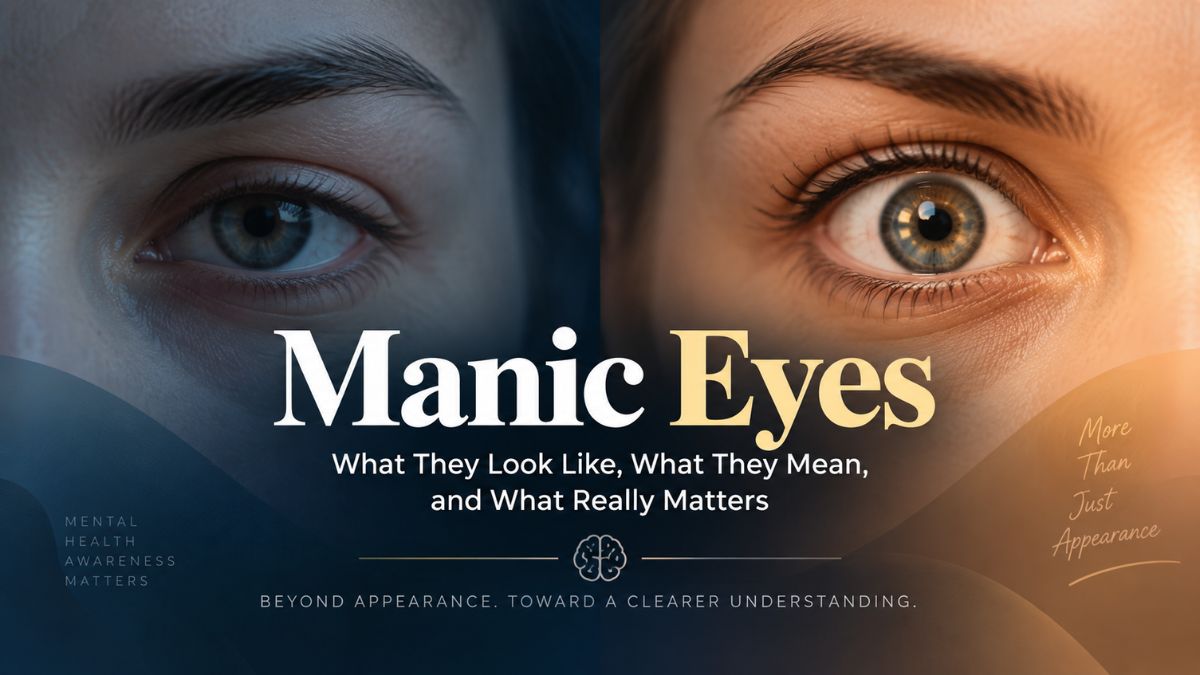
Someone’s eyes suddenly seem wider, brighter, more alert, or unusually intense. Their pupils may look larger, their eye contact may feel different, or their expression may simply seem unlike their usual self.
That can make you wonder whether you are seeing “manic eyes.”
The term is widely used online, particularly in conversations about bipolar disorder. However, manic eyes are not a medical diagnosis, and there is no specific eye appearance that can confirm mania or bipolar disorder. Clinical descriptions of mania focus on changes in mood, energy, activity, sleep, speech, thinking, judgment, and behavior—not on how a person’s eyes look.
Still, a change you repeatedly notice in yourself or someone close to you may be worth paying attention to. Some people with bipolar disorder, their relatives, and clinicians report noticing changes in gaze or facial expression during mood episodes. The useful approach is to treat those changes as a possible personal clue, not proof of a manic episode.
What Are Manic Eyes?
“Manic eyes” is an informal phrase used to describe noticeable changes in someone’s eyes or gaze during mania or hypomania.
In practice, the phrase usually refers to a noticeable change from someone’s usual gaze or expression during a mood episode.
A change may feel obvious to someone who knows the person well, but lighting, emotional arousal, sleep, facial expression, medications, substances, and normal pupil variation can all influence how the eyes appear.
A 2023 psychiatric editorial described clinical observations of sparkling eyes and pupil dilation during manic or hypomanic states. The authors emphasized that the proposed explanations remain speculative, so these observations should not be treated as a diagnostic marker.[2]
What Do Manic Eyes Look Like?
There is no universal appearance, but several descriptions occur repeatedly.
Wider or More Alert-Looking Eyes
Someone experiencing intense excitement or arousal may hold their eyelids more open, make stronger eye contact, or appear unusually animated. When this occurs alongside rapid speech and increased activity, other people may interpret the expression as a “manic stare.”
But wide or intense eyes can also occur when someone is excited, anxious, frightened, angry, sleep-deprived, or naturally expressive.
Dilated or Larger-Looking Pupils
A common question is, “Do eyes dilate when manic?”
They may appear larger in some people, but pupil dilation is not a reliable sign of mania.
Your pupils constantly change size in response to light and can also be affected by emotional arousal, medications, and recreational drugs.
In a small study of 39 people with bipolar disorder, static pupil measurements did not significantly distinguish mania, depression, remission, or healthy controls. Researchers found only a small difference in average pupil dilation speed between the overall bipolar and control groups.[3]
So, larger pupils alone cannot tell you whether someone is manic.
Bright or “Sparkling” Eyes
Some people describe their eyes as brighter or more reflective when they are hypomanic or manic.
Some people may genuinely notice brighter-looking eyes during mood episodes, but “sparkling eyes” has not been validated as an objective symptom of bipolar disorder.
An Intense or Changing Gaze
Mania can involve heightened activity, distractibility, increased social engagement, and rapid shifts in attention, which may change how someone looks at people or scans the environment.
But an intense gaze is nonspecific and can occur in many emotional states.
Manic Eyes vs Normal Eyes: What Actually Matters
There is no clinical boundary separating manic eyes vs normal eyes.
What matters more is whether the person has changed significantly from their usual baseline.
| What you might notice | What is more clinically meaningful |
|---|---|
| Wide or intense-looking eyes | Unusually elevated or irritable mood |
| Larger-looking pupils | Major increase in energy or activity |
| Rapidly shifting gaze | Racing thoughts or marked distractibility |
| Bright, highly alert expression | Much less need for sleep |
| Strong or animated eye contact | Rapid speech, impulsivity, or poor judgment |
If you are monitoring your own mood, your usual baseline matters far more than a single look in the mirror.
If your expression tends to change as your mood rises, that pattern can become part of your personal early-warning system. But it is much safer to combine it with changes in sleep, energy, thoughts, speech, spending, decision-making, and behavior rather than relying on your appearance alone.
What Research Says About the Eyes and Bipolar Disorder
If visible eye changes are so unreliable, why are researchers studying the eyes at all? Because eye movements and pupil responses can provide measurable clues about brain and nervous-system function.
A 2025 meta-analysis found group-level differences in fixation and rapid eye-movement measures in people with bipolar disorder, but these findings required specialized eye-tracking equipment.[4]
Other studies have explored pupil responses and retinal measurements, with mixed or still-limited findings. These are research signals, not a visual test for bipolar disorder.[5]
Signs of Mania That Matter More Than Eye Appearance
If you are worried about mania, look for a cluster of sustained changes rather than one physical feature.
The National Institute of Mental Health lists possible symptoms of a manic episode including:
- feeling unusually high, elated, extremely irritable, or “wired”
- becoming much more active than usual
- racing thoughts
- needing much less sleep
- talking unusually fast or jumping rapidly between ideas
- feeling able to do many things without becoming tired
- feeling unusually important, talented, or powerful
- increased involvement in pleasurable or potentially harmful activities
For bipolar I disorder, a manic episode generally lasts at least seven days, most of the day on nearly every day, unless symptoms are severe enough that hospital care is needed sooner.
There is no medical answer to “How long do manic eyes last?” because manic eyes are not a defined clinical symptom. Eye appearance can fluctuate with lighting, sleep, medication, arousal, and other factors even while a mood episode continues.
What Else Can Cause “Manic-Looking” Eyes?
Eye appearance is especially unreliable for self-diagnosis because many other factors can produce similar changes.
Possibilities include anxiety, panic, excitement, significant sleep loss, medications, stimulant or recreational drug use, eye conditions, and ordinary variations in facial expression and pupil size.
Medical conditions can sometimes mimic psychiatric symptoms as well. NICE recommends considering alternative explanations such as substance use and physical disorders, including thyroid disease, when bipolar disorder is being assessed.[6]
If you notice a major change in your pupils—particularly if one pupil suddenly becomes larger than the other—do not automatically attribute it to mania. New unequal pupils accompanied by headache, eye pain, drooping eyelid, double vision, vision loss, or other neurological symptoms require prompt medical assessment.[7]
What to Do If You Notice Possible Manic Eyes
If your eyes seem different and mania is on your mind, step away from the mirror and look at your overall pattern of functioning.
Consider whether your sleep has dropped sharply, especially if you do not feel tired. Notice whether your thoughts or speech are unusually fast, your energy has increased dramatically, or you are making impulsive decisions that are out of character.
If you already have bipolar disorder, changes that reliably occur before your episodes may be useful as part of an individualized relapse plan. NICE recommends identifying personal triggers and early warning signs and developing a plan for what to do if symptoms return.
Tracking sleep, mood, energy, medication use, and unusual behavior will usually tell you and your clinician far more than photographs of your eyes.
Do not stop or change prescribed psychiatric medication on your own because you think mania is starting. Contact the clinician who manages your treatment for individualized advice.
When to Get Urgent Help
Possible mania deserves timely professional assessment when symptoms are significant, escalating, or interfering with judgment and everyday functioning.
NICE recommends urgent specialist mental health assessment when mania is suspected or when someone may pose a danger to themselves or others.
Seek emergency help for immediate danger, severe loss of contact with reality, or a situation in which the person cannot remain safe.
In the United States, you can call or text 988 for the Suicide & Crisis Lifeline. For a life-threatening medical emergency, call 911. People outside the United States should use their country’s emergency number or local mental health crisis service.[8]
The Bottom Line
Manic eyes may describe something you genuinely notice, but they cannot diagnose mania.
If something looks different, look beyond the eyes: changes in sleep, mood, energy, speech, thoughts, judgment, and behavior matter far more.
A change in appearance can be a clue. The whole pattern tells the more useful story.
Medical References
Update History
Clinical guidance updated to reflect current recommendations.
Originally written by Dr. Rahul Kushwaha.
Your answer helps us improve the clarity and usefulness of our health content.