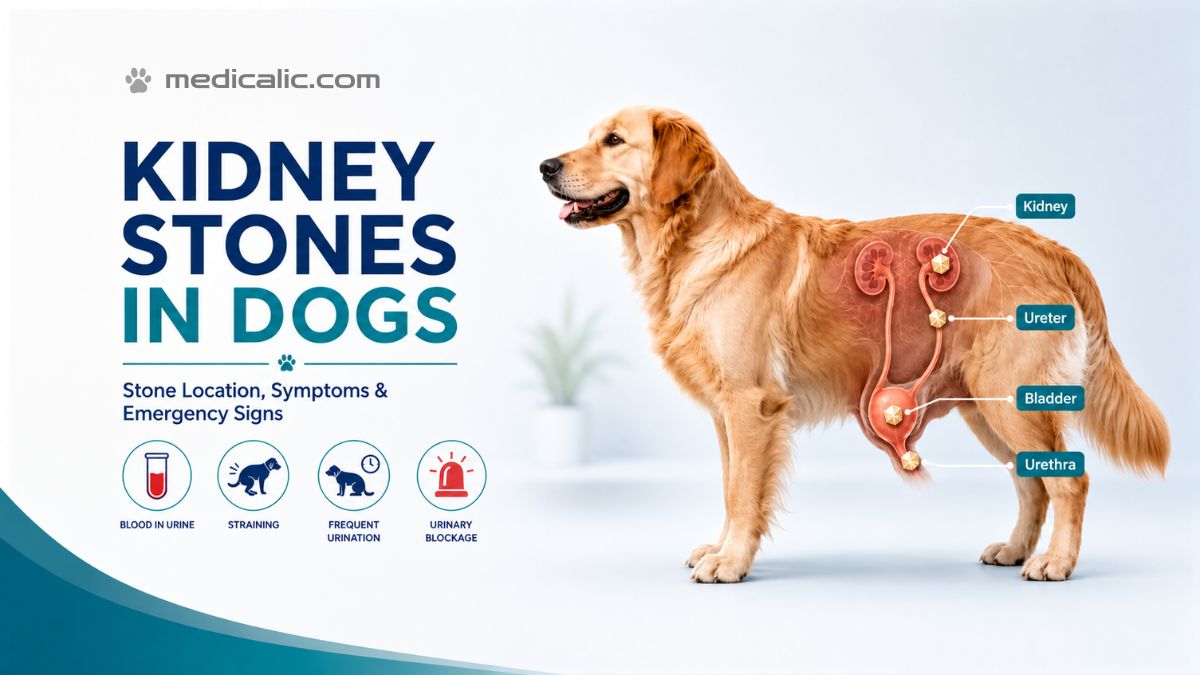
Kidney stones in dogs are mineral deposits that can form in the urinary tract. Although many pet owners use “kidney stones” to describe any urinary stone, the exact location matters. A stone may sit inside the kidney, move into a ureter, irritate the bladder, or become trapped in the urethra. Each location affects urine flow differently, and some situations are much more urgent than others.
The urinary tract works like a drainage system. The kidneys make urine, the ureters carry urine to the bladder, the bladder stores urine, and the urethra carries urine out of the body. When a stone interferes with that pathway, signs may range from no obvious symptoms to a life-threatening urinary blockage.
Veterinary references classify urinary stones, or uroliths, by both location and mineral type. Stones can develop in the kidney, ureter, bladder, or urethra, and obstruction can become serious depending on where urine flow is blocked. [1]
This guide explains kidney stones in dogs through the lens of anatomy: where stones can be located, how they affect urine flow, what symptoms may appear by location, and when a dog needs urgent veterinary care.
The Dog Urinary Tract: A Simple Anatomy Map
Kidneys → Ureters → Bladder → Urethra
That pathway explains why stone location changes the risk.
The kidneys filter blood, remove waste products, balance fluids and electrolytes, and produce urine. From each kidney, urine drains through a thin tube called ureter. The ureters carry urine to the bladder, where urine is stored until the dog urinates. The urethra then carries urine from the bladder out of the body.
A stone in any part of this pathway may cause irritation, infection-like signs, pain, or blockage. But the urgency depends heavily on where the stone is located and whether urine can still flow.
A non-obstructive kidney stone may be monitored. A ureter stone may threaten kidney drainage. A bladder stone may cause irritation and lower urinary signs. A urethral stone can stop urination altogether, which is an emergency.
Kidney Stones vs. Ureter, Bladder, and Urethral Stones
Not every urinary stone affects a dog the same way. The location of the stone helps explain the risk, the symptoms, and how urgent the situation may be.
| Stone location | Where it is | What it can affect | Common signs | Urgency |
|---|---|---|---|---|
| Kidney stone | Inside the kidney | Kidney tissue, urine formation, infection risk, possible movement into the ureter | Often no obvious signs; sometimes pain, blood in urine, infection, or kidney value changes | May be monitored if not blocking urine flow |
| Ureter stone | In the tube between the kidney and bladder | Urine drainage from one kidney to the bladder | Pain, vomiting, lethargy, nausea, weakness, or vague illness | Can become serious, especially if urine flow is blocked |
| Bladder stone | Inside the bladder | Bladder lining and lower urinary tract comfort | Frequent urination, blood in urine, accidents, straining, licking, discomfort | Needs veterinary evaluation; urgency depends on signs and blockage risk |
| Urethral stone | In the tube where urine leaves the body | Urine leaving the bladder | Repeated straining, little or no urine, crying, painful belly, weakness | Emergency if the dog cannot urinate normally |
This is why “kidney stones” is sometimes too broad as a home description. A quiet stone inside the kidney is different from a stone blocking the ureter or a stone stuck in the urethra. The symptoms may overlap, but the risk is not the same. [1]
Where Stones Can Form in Dogs
Kidney stones
A kidney stone is located inside the kidney. Veterinarians may call these stones nephroliths. Some kidney stones cause no obvious signs, especially if they are not blocking urine flow or causing infection. A dog can have a kidney stone and still urinate normally if urine can move through the urinary tract.
This is one reason kidney stones may be found during imaging for another problem. A dog may act normal, eat normally, and urinate normally even though a stone is present.
A kidney stone can still matter even when a dog seems fine. It may irritate kidney tissue, contribute to infection, grow larger, affect kidney function, or move into a narrower part of the urinary tract.
Ureter stones
A ureter stone is located in the tube between the kidney and bladder. This location is concerning because the ureter is narrow. Even a small stone can become serious if it lodges there and blocks urine drainage from the kidney.
If a stone blocks the ureter, pressure can build behind the blockage and affect the kidney. Ureteral obstruction may cause vomiting, lethargy, and flank or kidney pain, especially when obstruction is sudden and complete. [1]
This problem can also be hard for owners to recognize. A dog may still pass urine from the other kidney, so the dog may appear to be urinating even while one kidney is obstructed.
Bladder stones
Bladder stones sit inside the bladder. They are often more noticeable than kidney stones because they can rub against the bladder lining. This may cause blood in the urine, frequent urination, accidents in the house, straining, licking around the urinary opening, or discomfort. [3]
Bladder stones, urinary tract infections, and bladder inflammation can look very similar from the outside. Testing is needed to tell them apart.
Many bladder stones can be seen on X-rays or ultrasound, although some stone types are harder to see on routine X-rays and may require ultrasound or contrast imaging. [3]
Urethral stones and blockage risk
The urethra carries urine from the bladder out of the body. If a stone becomes trapped in the urethra, urine may not pass normally. This can quickly become dangerous, especially in male dogs because the male urethra is longer and narrower.
A dog with urethral obstruction may strain repeatedly, produce only drops of urine, vocalize, have a painful abdomen, or become weak. Urethral obstruction is considered an emergency because urine cannot leave the body normally.
What changes when a stone moves?
A stone may stay in the kidney without causing immediate signs. In some dogs, veterinarians monitor these stones with repeat imaging and urine testing. Monitoring is not the same as ignoring the stone. It means the vet is checking whether the stone grows, moves, causes infection, or affects kidney function.
If a kidney stone moves into the ureter, the risk increases because the ureter is narrow. A stone may partially or completely block urine flow from that kidney. This may cause pain and illness even if the dog can still pass urine from the bladder.
If a stone reaches the bladder, it may roll around and irritate the bladder lining. This can cause blood in the urine, frequent urination, accidents, licking around the urinary opening, and repeated attempts to urinate.
Blockage can happen in the ureter or urethra. Ureter blockage affects drainage from the kidney. Urethral blockage affects urine leaving the body. Both can be dangerous, but a dog that cannot urinate needs emergency care.
Urine is meant to move in one direction: from the kidneys to the outside of the body. When flow is blocked, pressure can build and kidney function can be affected. [1]
Symptoms Depend on Where the Stone Is
Kidney stones may cause no obvious signs
A kidney stone may be silent, especially if it is not blocking urine flow or causing infection. Some dogs act normal, eat normally, and urinate normally. This does not mean the stone is harmless forever, but it explains why imaging is often needed to find it.
Other kidney stones may be linked with pain, infection, blood in the urine, or kidney function changes.
Ureter stones may cause pain, vomiting, or lethargy
A ureter stone may cause vague but serious signs. Dogs may seem painful, restless, hunched, weak, nauseous, or lethargic. Vomiting can occur. [1]
Because one kidney may still drain normally, a dog may continue urinating, which can make the problem harder to recognize at home.
Bladder involvement may cause blood in urine or frequent urination
When stones irritate the bladder, signs often look like a urinary tract infection. A dog may urinate small amounts often, have accidents, strain, lick the urinary opening, or pass blood-tinged urine. [3]
These signs should be checked because bladder stones, infection, inflammation, and other urinary problems can look similar.
Urethral blockage may cause straining with little or no urine
A stone in the urethra can cause repeated straining with only drops of urine or no urine at all. Owners may mistake this for constipation because the dog keeps posturing. [1]
Why symptoms can look like a UTI
Urinary stones and urinary tract infections can both cause blood in urine, frequent urination, discomfort, and accidents. Some stones are also associated with infection.
Because the signs overlap, a veterinarian may need urinalysis, urine culture, and imaging to separate infection from stones or confirm that both are present.
When Kidney or Urinary Stones Are an Emergency
Unable to urinate
A dog that cannot urinate needs emergency veterinary care. This is especially true if the dog is straining, crying, restless, weak, or producing only drops.
Repeated straining with little urine
Repeated unproductive straining can signal urethral obstruction. This should not be watched at home or treated with home remedies.
Severe pain or belly discomfort
A painful abdomen, hunched posture, trembling, whining, or reluctance to move can suggest severe urinary discomfort. A blocked or irritated urinary tract can be very painful.
Vomiting, weakness, fever, or lethargy
Vomiting, weakness, fever, or marked lethargy may indicate a more serious complication, such as obstruction, infection, kidney stress, or systemic illness. Ureteral obstruction may produce vomiting and lethargy, while obstructive urinary disease can cause signs that vary with the site and severity of blockage.
Male dogs with possible urinary blockage
Male dogs need extra caution because stones may lodge in the narrower urethra. A male dog that strains repeatedly and passes little or no urine should be treated as an emergency.
How Kidney and Urinary Stones Form in Dogs
Kidney and urinary stones can develop for several reasons, and many dogs have more than one risk factor. The full explanation depends on the stone’s mineral makeup, urine chemistry, infection status, diet pattern, breed risk, and overall health. [1,2]
Minerals collect in concentrated urine
Urine contains dissolved minerals and waste products. When urine becomes concentrated, minerals are less diluted and may be more likely to form crystals.
Hydration does not guarantee that stones will not form, but concentrated urine can be part of the risk picture for some dogs.
Crystals may grow into stones
Crystals can sometimes join together and grow into stones. Not every crystal becomes a stone, and not every stone causes symptoms, but crystals can be an important clue during urinalysis.
Urine pH can influence stone formation
Urine pH can make some minerals more or less likely to form crystals. For example, some stones are associated with alkaline urine, while others are more likely in acidic conditions.
Urine pH alone cannot confirm stone type, but it helps guide the diagnostic picture.
Infection, breed, diet, and metabolic factors may contribute
Certain bacterial infections can change urine chemistry and contribute to stone formation, especially struvite stones in dogs. Breed and genetic factors may increase risk for some stone types. Diet and treat patterns can influence urine minerals, pH, and concentration, although diet advice should always depend on stone type. Liver or metabolic conditions may also contribute to some stones, especially urate stones. [2]
The cause is not always obvious from symptoms. Because several causes can happen together, veterinarians use urine testing, imaging, bloodwork, culture, and stone analysis to understand the full picture.
Common Stone Types Found in Dogs and Why Type Matters
Stone type matters because stones that look similar can behave very differently. One stone may be dissolvable under veterinary guidance, while another may not dissolve at all. Some stones are linked with infection, some with metabolism or genetics, and some require long-term recurrence prevention.
| Stone type | Why it matters |
|---|---|
| Struvite | Commonly associated with urinary tract infection in dogs; some may dissolve with appropriate veterinary treatment |
| Calcium oxalate | Common in dogs; usually does not dissolve medically and may recur |
| Urate | May be linked with inherited uric acid metabolism problems or liver conditions |
| Cystine | Associated with cystinuria and requires stone-specific prevention planning |
| Mixed or less common stones | May include silica, calcium phosphate, xanthine, compound, or mixed-mineral stones |
Appearance alone cannot reliably identify the stone type. Stone analysis is the most reliable way to identify what a stone is made of, because treatment and prevention depend on mineral composition.
How Vets Find Where the Stone Is
Physical exam and symptom history
A veterinarian starts by asking what you have noticed: straining, blood in urine, accidents, vomiting, appetite changes, pain, drinking habits, and previous urinary issues.
A physical exam may reveal pain, dehydration, a distended bladder, fever, or other clues.
Urinalysis
Urinalysis checks urine concentration, pH, blood, protein, inflammatory cells, bacteria, and crystals. It does not always prove the stone type, but it helps guide the next steps.
Urine culture
A urine culture checks for bacterial infection and helps identify which antibiotic may work. Culture is especially important when struvite stones or recurrent urinary signs are suspected.
Bloodwork and kidney values
Bloodwork helps assess kidney function, hydration, electrolytes, liver values, calcium levels, and overall health. This is especially important if a stone may be blocking urine flow or affecting the kidneys.
X-rays
X-rays can show many mineral stones, especially radiodense stones. However, some stones are radiolucent and may not show clearly on routine X-rays. [1,3]
Ultrasound
Ultrasound can help locate stones in the kidney, ureter, or bladder and can sometimes detect stones that are not obvious on X-rays. It may also show kidney swelling or other structural changes. [1,3]
Stone analysis if a stone is passed or removed
If a dog passes a stone or has one removed, laboratory analysis can identify its mineral type. This result helps the veterinarian decide how to treat the stone and reduce recurrence risk.
How Kidney Stones in Dogs Are Treated
Treatment depends on where the stone is, whether urine flow is blocked, whether infection is present, what stone type is suspected, and how sick the dog is. A quiet, non-obstructive stone is different from a stone causing pain, infection, kidney stress, or urinary blockage. [1,7]
Some stones that are not causing signs or obstruction may be monitored. Monitoring usually means follow-up urine testing, imaging, and watching for infection, growth, movement, or urinary signs.
If infection is present, treatment may include antibiotics chosen based on culture results. Infection control is especially important for struvite stones. Some struvite stones may dissolve with a prescription diet and veterinary monitoring, but this is not appropriate for every stone type. Calcium oxalate stones usually do not dissolve medically. [2,7]
Dogs with pain, nausea, dehydration, or illness may need medications or supportive care. If a stone blocks urine flow or threatens kidney function, a procedure may be needed. Options depend on location, stone type, size, clinic resources, and the dog’s condition. [1,7]
Can Home Remedies Help?
Home care may support urinary health after a veterinary diagnosis, but it cannot safely replace diagnosis or treatment. Stone type and location determine what is safe.
Hydration can help dilute urine and may support urinary health. Increasing water intake is a common prevention goal for many stone-forming dogs, but it should not be described as a guaranteed way to dissolve stones. [4,6]
Home remedies cannot reliably break up, dissolve, flush out, or remove kidney stones. Apple cider vinegar, lemon juice, urinary pH changers, herbal “stone breaker” products, and random supplements may be unsafe if the stone type is unknown. Changing urine acidity in the wrong direction can worsen the problem.
What Do Kidney Stones Look Like in Dogs?
What stones may look like on X-rays
On X-rays, some stones appear as bright white mineral densities in the kidney, bladder, ureter, or urethra. Calcium-containing stones are often easier to see. Some stones, such as certain urate or cystine stones, may be less visible on routine X-rays. [1,3,5]
What stones may look like on ultrasound
On ultrasound, stones may appear as bright structures that create shadowing behind them. Ultrasound can help evaluate the kidneys, ureters, and bladder, especially when X-rays do not show the stone clearly. [1,3]
What passed stones may look like
A passed stone may look like a tiny pebble, grain of sand, hard crystal, or irregular mineral fragment. It may be smooth, rough, pale, tan, brown, yellowish, or darker depending on mineral type and surface material.
Why appearance alone cannot identify the stone type
Appearance alone cannot reliably identify the stone type. A stone that looks small or smooth may still be clinically important. A stone that looks similar to another may have a completely different mineral composition. Laboratory analysis is the best way to confirm what it is made of.
How to Prevent Kidney and Urinary Stones From Coming Back
Prevention depends on the stone type, the dog’s urine results, infection history, diet, and overall health. A prevention plan for struvite stones is not the same as a plan for calcium oxalate, urate, cystine, or mixed stones. [2,4,5,7]
Common prevention goals may include keeping urine diluted, using the right stone-specific diet, treating urinary tract infections early, avoiding random supplements, and scheduling follow-up urine testing or imaging.
Encouraging water intake may help keep urine dilute. Your veterinarian may recommend wet food, added water, or other hydration strategies based on the stone type and your dog’s health. Some nutrition guidance discusses sodium as a tool to increase thirst in selected situations, but this should only be done with veterinary direction because high salt intake can be harmful for some pets, especially those with heart, liver, or kidney disease. [6]
For dogs prone to infection-induced struvite stones, early detection and treatment of urinary tract infections is important. High-risk dogs may need regular urine testing and imaging to catch recurrence early. [2,7]
Questions to Ask Your Vet
Where is the stone located?
Ask whether the stone is in the kidney, ureter, bladder, or urethra. Location affects urgency and risk.
Is urine flow blocked?
A blocked urinary tract is more urgent than a non-obstructive stone. Ask whether imaging shows obstruction, kidney swelling, or a distended bladder.
What type of stone is suspected?
The suspected stone type guides treatment and prevention. Ask whether stone analysis is possible if a stone is passed or removed.
Can this type of stone dissolve?
Some stones may dissolve with veterinary treatment, while others usually cannot. Do not assume dissolution is possible without your veterinarian’s guidance.
What symptoms should make me seek emergency care?
Ask your veterinarian which signs are urgent for your dog, especially if your dog has a known stone, kidney changes, infection, or a history of urinary blockage.
What is the recurrence prevention plan?
Ask about diet, water intake, urine testing, infection monitoring, imaging, and follow-up timing.
FAQs About Kidney Stones in Dogs
No. Kidney stones are located in the kidneys, while bladder stones are located in the bladder. Both are urinary stones, but they can affect different parts of the urinary tract and may cause different symptoms, risks, and treatment needs.
Yes. A kidney stone may move from the kidney into the ureter and then toward the bladder. The ureter is the most concerning part of that pathway because it is narrow, and a stone may block urine drainage from the kidney.
Yes. A kidney stone can become dangerous if it moves into the ureter and blocks urine flow from the kidney. A stone can also cause an emergency if it becomes trapped in the urethra and prevents urine from leaving the body.
Some dogs show no signs at first. Others may have blood in the urine, discomfort, frequent urination, vomiting, lethargy, pain, or signs that look like a urinary tract infection. The signs depend heavily on where the stone is located.
Conclusion
Kidney stones in dogs are best understood by location. A stone inside the kidney may be quiet and monitored, while a stone in the ureter or urethra can interfere with urine flow and become urgent. Bladder stones may cause lower urinary signs such as frequent urination, blood in the urine, accidents, or straining.
Symptoms alone cannot reliably show where the stone is or what it is made of. Veterinary testing is needed to locate the stone, check for infection or obstruction, evaluate kidney function, and identify the stone type when possible.
The safest approach is to treat kidney stones as a veterinary diagnosis, not a home guess. Once the location and stone type are understood, your veterinarian can decide whether monitoring, treatment, removal, or long-term prevention is the best path.
Medical References
Update History
Medically reviewed by Dr. Neelam Mehta.
Originally written by Medicalic.
Your answer helps us improve the clarity and usefulness of our health content.