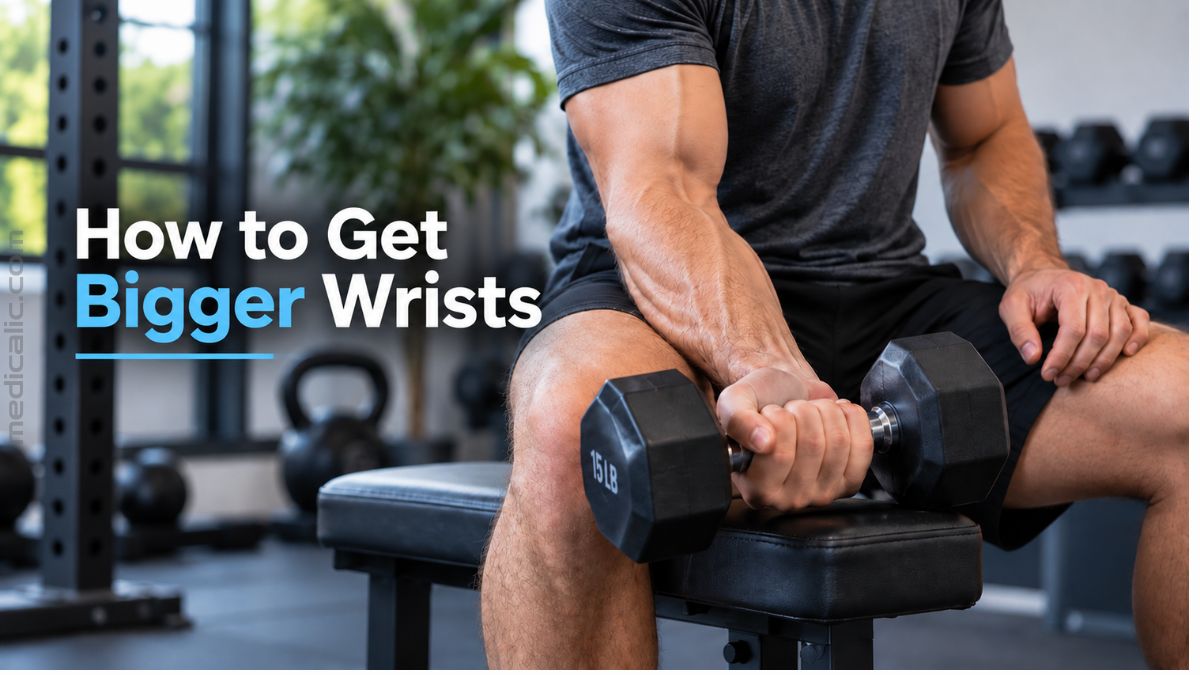
If your watch always seems loose on the smallest setting, or your wrists look unusually thin next to your hands and arms, it is natural to wonder whether the right exercises can make them bigger.
The answer depends on what you are trying to change. Once you reach skeletal maturity, exercise is unlikely to make the bones of your wrist noticeably wider.[1] Genetics, skeletal proportions, and your natural frame determine much of that size.
But your wrist bones are only part of how your lower arms look.
You can build the forearm muscles above the wrist, strengthen your grip, and create a thicker, better-proportioned transition from your hand to your arm. The key is knowing which parts of the wrist and forearm can actually respond to training—and focusing your effort there.
Can You Actually Make Your Wrists Bigger?
The short answer is no—at least not much at the joint itself.
The narrowest part of your wrist is built around eight small carpal bones, supported by ligaments and other connective tissues. Most of the muscle that controls your wrist, fingers, and hand sits farther up in the forearm, with long tendons crossing the wrist to reach the hand.[2]
Resistance training can make those forearm muscles larger through hypertrophy, while bones and tendons also adapt to repeated loading. But those adaptations do not usually produce a noticeable increase in the width of an adult wrist joint.[3]
In practical terms, you cannot “bulk up” the wrist the way you can a muscle—but you can build substantial thickness just above it.
What Makes Wrists Look Bigger?
If appearance is your goal, forearm hypertrophy offers the greatest opportunity.
Your forearms contain muscles responsible for wrist flexion and extension, finger movement, gripping, pronation, and supination. Developing these muscles adds thickness above the wrist and creates a more substantial transition from your hand into your arm.
Grip-focused exercises can contribute because many of the muscles that close your fingers and stabilize your wrist originate in the forearm. Balanced arm training matters too. Large biceps and triceps combined with underdeveloped forearms can make naturally small wrists look even narrower.
That is why the most useful exercises are the ones that train the forearms through flexion, extension, gripping, and rotation.
Best Exercises to Make Your Wrists Look Bigger
You do not need specialized equipment to train this area effectively. Dumbbells, resistance bands, a pull-up bar, or safely loaded household objects can provide enough resistance.
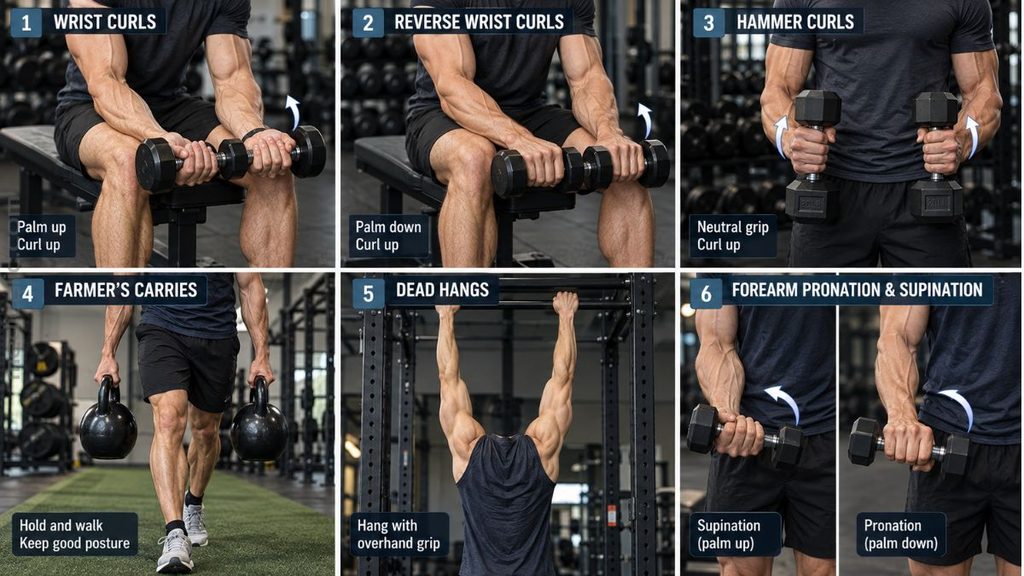
1. Wrist Curls
Support your forearms on a bench or your thighs with your palms facing upward. Let your wrists extend comfortably over the edge, then curl the weight upward under control.
Wrist curls emphasize the wrist and finger flexors, which make up much of the muscle mass on the palm side of the forearm. Building these muscles can make the lower forearm look fuller and create a thicker transition into the wrist.
Move slowly, especially on the way down, and keep your forearms planted so your elbows or shoulders do not take over.
Try: 2–3 sets of 10–15 repetitions. Once you can reach the top of that range with good control, increase the resistance slightly.
2. Reverse Wrist Curls
Place your forearms on a bench or your thighs with your palms facing downward. Raise the backs of your hands toward your forearms, then lower them slowly.
This movement trains the wrist extensors on the back of the forearm. These muscles are often less developed than the flexors, but adding size here can make the forearm look more balanced from the side and top.
Use less weight than you would for regular wrist curls. The range of motion is naturally smaller, so there is no need to force your wrists into an uncomfortable position.
Try: 2–3 sets of 10–15 repetitions.
3. Hammer Curls
Hold a dumbbell in each hand with your palms facing inward and keep that neutral grip throughout the curl.
Hammer curls train the elbow flexors while placing strong emphasis on the brachioradialis, a prominent muscle that runs along the thumb side of the forearm.[4] Developing it can add noticeable thickness to the lower arm and improve the transition between the upper arm and wrist.
Keep your elbows close to your sides and avoid swinging the weights. If you have to lean backward to finish the rep, the load is probably too heavy.
Try: 2–3 sets of 8–12 repetitions.
4. Farmer’s Carries
Hold a challenging pair of dumbbells or kettlebells at your sides and walk with an upright posture while maintaining a firm grip.
Farmer’s carries train the finger flexors and wrist stabilizers isometrically, meaning the muscles work hard without repeatedly moving through a large range of motion. They are especially useful for building grip strength while keeping the forearms under sustained tension.
Choose a load that feels demanding but still allows you to walk without excessive shrugging, leaning to one side, or losing your grip almost immediately.
Try: 2–3 carries of about 20–45 seconds.
5. Dead Hangs
Hang from a secure pull-up bar using a comfortable overhand grip. Let your arms stay long, but avoid forcing your shoulders into an uncomfortable position.
Dead hangs place prolonged tension on the finger flexors and other grip muscles of the forearm.[5] They are a simple way to build grip endurance and give the forearms more work without adding another weighted movement.
You do not need to turn every set into a maximum-effort test. Stop before your grip completely gives out, and if hanging causes wrist or shoulder pain, shorten the hold or choose another grip exercise.
Try: 2–3 comfortable holds, gradually increasing the duration as your grip improves.
6. Forearm Pronation and Supination
Hold a light dumbbell, hammer, or similar lever with your elbow bent to about 90 degrees and braced close to your side. Slowly rotate your forearm so your palm turns upward, then downward, without letting the upper arm swing.
Pronation and supination train forearm rotation, a movement regular wrist curls do not fully address. These exercises are not likely to add as much visible mass as hammer curls or wrist curls, but they help build more balanced forearm strength and control.
Keep the resistance light and the movement smooth. Holding the weight farther from the end increases leverage, so even a small dumbbell or hammer can become surprisingly challenging.
Try: 1–2 sets of 12–20 controlled repetitions per side.
A Simple Wrist and Forearm Workout Routine
For most people, two direct forearm sessions per week are a good starting point—especially if your training already includes rows, pull-ups, deadlifts, or other exercises that challenge your grip.[6]
Add this routine near the end of an upper-body or pull workout so forearm fatigue does not interfere with heavier lifts.
| Exercise | Sets | Reps / Duration | Rest | Focus |
|---|---|---|---|---|
| Hammer Curl | 2–3 | 8–12 reps | 60–90 sec | Brachioradialis and upper-forearm thickness |
| Wrist Curl | 2 | 10–15 reps | 60 sec | Wrist and finger flexors |
| Reverse Wrist Curl | 2 | 10–15 reps | 60 sec | Wrist extensors |
| Farmer’s Carry or Dead Hang | 2 | 20–45 sec | 90 sec | Grip strength and sustained tension |
| Pronation / Supination | 1–2 | 12–15 reps/side | 45–60 sec | Rotational strength and control |
How to Progress
Build up gradually rather than trying to exhaust your forearms every session.
- Reach the top of the rep range first. If the target is 10–15 reps, keep the same weight until you can complete 15 controlled reps across your sets.
- Then increase the load slightly. Small jumps—around 1–2 lb or 0.5–1 kg for wrist exercises—are usually enough.
- Count your other grip work. Rows, pull-ups, deadlifts, carries, and climbing all add to forearm fatigue, so adjust direct training accordingly.
How to Get Bigger Wrists at Home
A pair of dumbbells can cover most of your forearm training at home, but they are not essential. A loaded backpack, water containers, resistance bands, or a secure pull-up bar can also provide useful resistance.
The key is progression. Whatever equipment you use, the exercise needs to become gradually more challenging through added resistance, repetitions, or training volume.
How Long Does It Take to See Results?
You are unlikely to get bigger-looking wrists as fast as social media sometimes promises. Meaningful forearm growth takes consistent training over time, not a few days of wrist exercises.
Strength often improves before obvious changes in muscle size appear. Visible forearm development generally requires consistent resistance training over weeks and months, and your results will depend on your starting point, genetics, training volume, nutrition, sleep, and recovery.
Do not rely exclusively on the circumference of the narrowest part of your wrist to measure progress. That measurement may change very little even when your forearms are becoming noticeably larger.
Instead, take occasional forearm measurements at the same location, compare progress photos under similar conditions, and track improvements in exercises such as hammer curls, carries, and hangs.
Nutrition for Forearm Muscle Growth
Forearms grow by the same basic rules as any other muscle group: progressive resistance training provides the stimulus, while adequate energy intake, protein, sleep, and recovery support adaptation.
For most people, total daily protein matters more than any special “muscle-building” food or supplement. Evidence suggests that gains in lean mass tend to level off around 1.6 grams of protein per kilogram of body weight per day, although individual needs vary.[7]
Creatine can also support strength and muscle gain when combined with resistance training, but no supplement can selectively enlarge your wrists or forearms.[8] Consistent training and adequate nutrition still do most of the work.
What Does Not Make Your Wrists Bigger?
Endless wrist curls: More repetitions are not automatically better. Muscle growth requires sufficient resistance, progression, and recovery.
Using hand grippers constantly: Grippers can strengthen your grip and train some forearm muscles, but they are not a method for widening adult wrist bones.
Chasing a pump: Increased blood flow can temporarily make your forearms look fuller after training. That temporary swelling is not the same as permanent muscle growth.
Trying to gain body fat specifically around the wrist: You cannot reliably control where your body stores fat, and gaining excess body fat simply to change wrist appearance is not a useful strategy.
Training through pain: Joint or tendon pain is not evidence that an exercise is working better.
How to Train Your Wrists Safely
Your forearms can tolerate regular training, but the small joints and tendons involved do not benefit from sudden jumps in workload.
Begin with manageable resistance and controlled repetitions. Train both wrist flexion and extension instead of repeatedly loading only one movement pattern. Increase weight gradually, especially during wrist curls and rotational exercises.
Stop or modify an exercise if it causes sharp pain. Persistent swelling, numbness, tingling, unexplained weakness, loss of grip strength, or pain that does not improve with rest deserves assessment by a qualified healthcare professional.[9]
The Takeaway
If you want your lower arms to look thicker and stronger, consistency matters more than any single “wrist” exercise. Train your forearms through curls, carries, hangs, and controlled rotation, progress the resistance over time, eat enough protein, and give the process a few months. The visible change will come from building a stronger, better-developed forearm—not from chasing shortcuts.
Medical References
Update History
Originally written by Haikal Rayyan.
Your answer helps us improve the clarity and usefulness of our health content.