If you have been training your legs consistently but your thighs still look almost unchanged, it is easy to blame your genetics—or assume you are missing some “secret” exercise. Usually, the answer is less dramatic. Meaningful thigh growth comes from progressively challenging the right muscles, doing enough weekly work, eating enough to support recovery, and giving the process time.
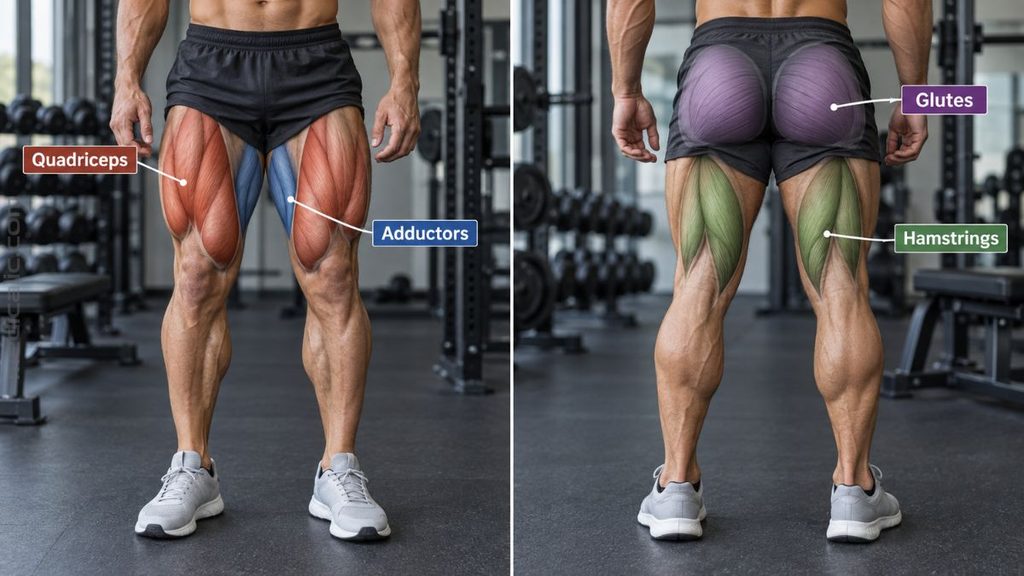
Building well-developed thighs takes more than quad-dominant squats. Your quadriceps create much of the size at the front of the thigh, your hamstrings add depth at the back, and the adductors contribute to inner-thigh thickness. The glutes also shape the overall look of the hips and upper legs.
Genetics influence your frame, natural proportions, and how quickly you respond to training, but they do not fix your muscle size permanently. When you pair progressive training with enough fuel and recovery, you create the conditions your muscles need to adapt and grow.
How to Get Bigger Thighs: What Actually Works
To get bigger thighs, progressively challenge the quadriceps, hamstrings, and adductors with resistance training. Around 10 challenging weekly sets for the muscles you want to prioritize is a useful reference point for many lifters, while adequate recovery, sufficient calories, and enough protein help support growth.[1]
That number is only a starting point. Beginners may grow with less, while more experienced lifters can sometimes benefit from additional volume if they are recovering and progressing well.
You do not necessarily have to train your thighs on exactly two days each week. When total training volume is matched, research suggests that frequency itself has relatively little effect on hypertrophy. However, dividing your work across two sessions is often more comfortable and practical than trying to perform every hard set in one workout.
Thigh size also depends on body fat, bone structure, and genetics. You can deliberately build thigh muscle, but you cannot reliably decide where your body stores additional fat. Eating more food may increase body weight, but it does not guarantee that the extra fat will go to your thighs rather than your abdomen, hips, or elsewhere.
That is why resistance training is a more predictable strategy than trying to get bigger thighs simply by gaining weight.
Best Exercises for Bigger Thighs
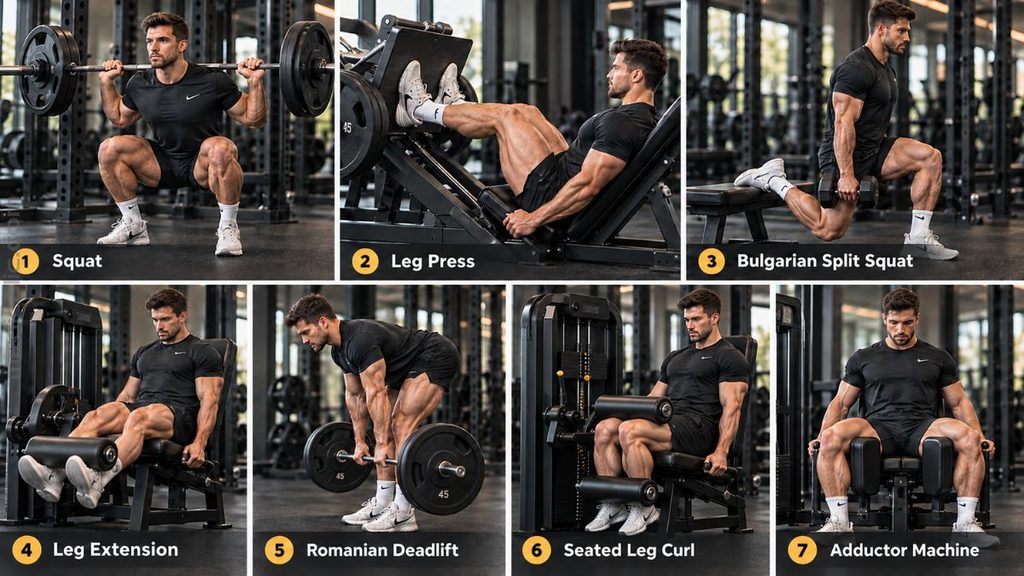
A handful of well-chosen exercises can cover everything your thighs need. Prioritize the quadriceps, hamstrings, and adductors, then add direct glute work if a fuller lower-body shape is part of your goal.
| Exercise | Main muscles trained | Practical rep range |
|---|---|---|
| Squat | Quads, adductors, glutes | 6–12 |
| Leg press or hack squat | Quads, glutes | 8–15 |
| Bulgarian split squat | Quads, glutes, adductors | 8–12/leg |
| Leg extension | Quadriceps | 10–20 |
| Romanian deadlift | Hamstrings, glutes | 6–12 |
| Seated leg curl | Hamstrings | 8–15 |
| Adductor machine | Inner thighs | 10–20 |
Squats
Squats are useful for building overall lower-body mass because several large muscles work simultaneously.
Focus on a controlled range of motion rather than adding weight at the expense of depth and technique. For most people, squatting as deeply as they can comfortably control is a solid default for developing the quads, glutes, and adductors. Lengthened partial reps can also have a place in hypertrophy training, but a consistent full range of motion remains a reliable foundation.[2]
Keep your knees tracking comfortably in line with your toes, and use the deepest range you can control without your lower back rounding excessively.
Leg Presses and Hack Squats
Leg presses and hack squats allow you to challenge your quadriceps heavily without requiring as much balance as a free-weight squat.
Machines are not inherently worse for building muscle. What matters more is whether you can train the target muscles hard, consistently, and progressively.
Choose a foot position that lets your knees bend deeply and comfortably rather than shortening the range just to move more weight.
Bulgarian Split Squats
Bulgarian split squats train one leg at a time and can provide a strong stimulus for the quadriceps and glutes.
They are particularly useful when you want more thigh and glute development but cannot—or do not want to—rely entirely on heavy bilateral squats.
Use a stance long enough to stay balanced and descend under control, keeping the front foot planted as you load the quads and glutes.
Leg Extensions
Leg extensions deserve a place in a thigh-building program because compound exercises do not necessarily maximize growth in every part of the quadriceps.
Leg extensions can complement squats because the two movements do not stimulate every part of the quadriceps equally. Leg extensions appear particularly useful for targeting the rectus femoris, while squats provide a broader lower-body stimulus.[3]
Romanian Deadlifts and Leg Curls
Building the front of your thighs is only half the job. Your hamstrings add much of the size and shape at the back, so they deserve direct attention too.
Romanian deadlifts challenge the hamstrings primarily through movement at the hip, while leg curls train them through knee flexion. These movement patterns complement each other.
Seated leg curls may have an advantage over prone curls for hamstring growth, possibly because several hamstring muscles are trained at longer lengths in the seated position.[4]
Push your hips back and stop when you feel a strong hamstring stretch; forcing the weight lower often reduces control without adding useful range.
On seated leg curls, control the stretched position and avoid bouncing through the bottom of the rep.
Adductor Exercises
Deep squats and similar lower-body exercises already train the adductors, but direct adductor-machine work can add targeted volume if larger inner thighs are a priority.
It will not selectively add or remove inner-thigh fat; the purpose is to develop the underlying muscle.
No single exercise builds the entire thigh equally. A squat pattern, a knee-flexion hamstring exercise, a hip hinge, and one or two isolation movements usually give you a more complete stimulus than relying on squats alone.
How to Train Your Thighs for Muscle Growth
Start with an amount of training you can recover from rather than immediately chasing the highest possible number of sets.
Around 10 challenging weekly sets for a muscle you want to prioritize is a useful reference point, not a rigid prescription. Beginners can grow with less, while experienced lifters may need more. Increasing volume only helps when you can recover and continue progressing.
You also do not have to stay permanently in the traditional 8–12-repetition range. Muscle hypertrophy can occur across a fairly wide range of loads when sets are sufficiently challenging, although heavier loads are generally better for maximizing strength.
For most working sets, aim to finish with roughly one to three repetitions in reserve (1–3 RIR). The last few reps should feel difficult, but you do not need to grind every set to complete muscular failure.[5] Train hard enough to challenge the target muscles while leaving enough in reserve to maintain good technique and performance across the rest of the workout.
Rest long enough to maintain performance rather than racing against the clock. For demanding compound lifts like squats, presses, and deadlifts, around two minutes or more often works well. Isolation exercises usually need less—roughly one to two minutes is a practical starting point. Rushing your rest can reduce the weight or reps you manage on later sets, while much longer rests are not automatically better for muscle growth.
Most importantly, track your performance. If the prescribed range is 8–12 repetitions and you eventually perform 12 controlled repetitions with room to spare, increase the resistance slightly.
A Simple 2-Day Bigger-Thigh Workout Plan
If you are new to resistance training, start with one or two fewer sets on several exercises and build up gradually as your strength and recovery improve.
Workout A — Quad Emphasis
| Exercise | Sets × reps |
|---|---|
| Squat | 3 × 6–10 |
| Leg press | 3 × 8–12 |
| Bulgarian split squat | 2 × 8–12/leg |
| Leg extension | 2 × 10–15 |
| Seated leg curl | 3 × 8–15 |
Workout B — Balanced Thigh Emphasis
| Exercise | Sets × reps |
|---|---|
| Romanian deadlift | 3 × 6–10 |
| Hack squat or leg press | 3 × 8–12 |
| Walking lunge | 2 × 10–12/leg |
| Seated leg curl | 3 × 10–15 |
| Adductor machine | 2 × 12–20 |
Give your legs enough time to recover between hard sessions. Two nonconsecutive training days—for example, Monday and Thursday—work well for many people.
If bigger glutes and thighs are both priorities, add two or three sets of hip thrusts to one session. If you also want larger calves, train them directly with standing or seated calf raises.
Keep your major exercises consistent long enough to become stronger at them while maintaining good technique. Constantly changing movements makes progress harder to measure.
How to Get Bigger Thighs at Home
You can build bigger thighs without a gym, although progressively increasing resistance can become more challenging.
Useful home exercises include Bulgarian split squats, reverse lunges, step-ups, goblet squats, sliding hamstring curls, single-leg movements, and resistance-band exercises.
Adjustable dumbbells or a securely loaded backpack can provide additional resistance. You can also progress an exercise by adding repetitions, increasing resistance, improving range of motion, or moving to a more difficult variation.
Home workouts, bodyweight movements, and resistance bands can all build muscle when they provide enough resistance and become progressively more challenging.
What to Eat to Grow Your Thighs
Training tells your muscles to adapt; nutrition gives your body the energy and raw materials to do it.
A practical protein target for someone trying to build muscle is about 1.6 grams per kilogram of body weight per day, or roughly 0.7 grams per pound. For most people who resistance train, pushing protein intake substantially higher appears to provide little additional muscle-building benefit.[6]
Calories matter as well. A large surplus is unnecessary, but staying in a substantial calorie deficit for too long can make muscle gain harder. If growing your thighs is the priority, maintenance calories or a modest surplus is usually more supportive than aggressive dieting.[7]
If your weight and measurements have remained unchanged for months despite progressive training, a modest increase in food intake may be useful.
Creatine monohydrate can modestly support gains in lean body mass when combined with resistance training, but it is optional and certainly not a thigh-specific shortcut.
How Long Does It Take to Get Bigger Thighs?
If you are hoping to get significantly bigger thighs in seven days, reset the timeline.
A hard leg workout may temporarily make your thighs appear fuller because of increased blood flow, glycogen, and associated fluid. That temporary “pump” is not the same as permanent muscle growth.
Visible thigh growth is better judged over months, not days.
An 8–12-week block is a useful first period for evaluating whether your program is working. Compare strength, thigh measurements, progress photos taken under similar conditions, and how your clothes fit.
Beginners may notice changes relatively quickly. Experienced trainees usually progress more slowly. Genetics, starting muscle mass, nutrition, sleep, training quality, age, and other factors all influence how quickly visible changes occur.
Why Your Thighs May Not Be Growing
If you have been training for months without progress, examine the basics before blaming your genetics.
Common problems include:
- using the same resistance and repetitions indefinitely;
- doing only squats while neglecting hamstrings or other quadriceps exercises;
- performing too little challenging weekly training;
- adding so much training that performance and recovery deteriorate;
- shortening your range of motion simply to lift heavier weights;
- changing exercises before you have time to progress them;
- eating too little protein or total food; and
- sleeping or recovering poorly.
A good program may feel repetitive—and that is often a strength. What matters is that it stays measurable, progressive, and sustainable.
Putting It Into Practice
If you are trying to figure out how to get bigger thighs, the answer is less exciting than most quick-fix promises: consistent, progressive training.
Building bigger thighs is slow, fairly unglamorous work. Pick a handful of dependable exercises, track your weights and reps, eat enough to support the work, and give the program at least 8–12 weeks before judging whether it is moving you in the right direction. Keep giving your muscles a reason to adapt, then give them enough time to do it.
Medical References
Update History
Originally written by Haikal Rayyan.
Your answer helps us improve the clarity and usefulness of our health content.