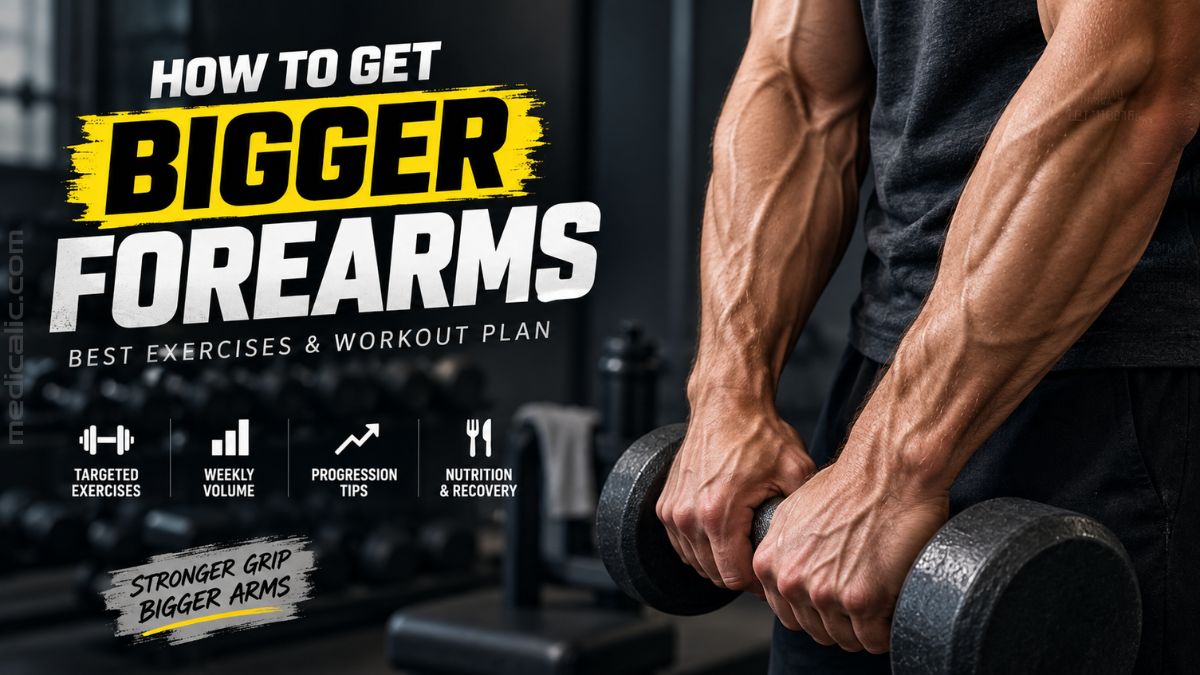
You can build a strong back, improve your curls, and still look down at your arms and wonder: Why aren’t my forearms growing?
Forearms can be stubborn because they already work during rows, pull-ups, deadlifts, carries, and curls. That regular workload makes it easy to assume they are getting enough stimulus. Sometimes they are. But if size is the goal, indirect training may not be enough. That can be frustrating—especially when the rest of your upper body is getting stronger while your forearms seem stuck.
So, what does it really take to build bigger forearms? Treat them like any other muscle group: train the movements they perform, use enough challenging weekly volume, progressively make the work harder, and give your body enough nutrition and recovery to adapt.
The encouraging part is that you do not need a dedicated “forearm day” or a complicated collection of exercises. A focused 10–20 minutes added to two or three workouts per week can be plenty for many lifters.
How to Get Bigger Forearms: What Actually Works
Muscle growth, or hypertrophy, happens when resistance training repeatedly gives a muscle a strong enough stimulus and the body has the resources to recover from it.
The basics still do most of the heavy lifting: train consistently, accumulate enough challenging work each week, and progress it over time. For muscle growth, higher weekly volume—around 10 sets per muscle group—is often a useful benchmark, although there is no scientifically established “perfect” number specifically for the forearms.[1] There is no magical rep range either; muscle can grow across a fairly broad range of loads when the sets are challenging enough, while heavier loads generally have a greater advantage for maximal strength.[2]
Forearms also receive indirect work during upper-body training, so factor that existing workload into how much direct forearm work you add.
For many people, starting with roughly 6–10 challenging direct forearm sets per week, spread across different forearm functions, is more sensible than suddenly adding high-volume daily training. Adjust from there based on progress and joint comfort.
The Forearm Muscles You Need to Train
Your forearm is not one muscle. It contains multiple muscles responsible for moving the wrist, fingers, and forearm.
The wrist flexors, located primarily on the palm side, help bend the wrist and contribute to gripping. The wrist extensors on the opposite side extend and stabilize the wrist.
Then there is the brachioradialis, the prominent muscle running along the thumb side of the forearm toward the elbow. It assists with elbow flexion and contributes substantially to the muscular look of the upper forearm.
Finally, several muscles help with pronation and supination—turning the palm downward and upward.[3]
In practice, a balanced routine simply needs to cover wrist flexion, wrist extension, elbow flexion, rotation, and some form of gripping.
Best Exercises for Bigger Forearms
A good forearm program can be built around just six or seven movements.
Wrist Curls
Wrist curls directly load the wrist flexors. Support your forearms on your thighs or a bench with your palms facing upward. Let the wrist move through a comfortable range, then curl the weight upward without lifting your forearms. Sets of roughly 10–20 controlled repetitions work well.
Reverse Wrist Curls
Reverse wrist curls use the same idea with the palms facing downward. Expect to use considerably less weight for reverse wrist curls than for regular wrist curls. Aim for controlled sets of about 12–20 reps rather than chasing heavy numbers. Lower the weight slowly and under control—about 2–3 seconds is a useful tempo if it helps you maintain good form.
Reverse Curls
Reverse curls use a palms-down grip and provide another way to train the elbow flexors and upper forearm. Keep your elbows fairly still and avoid turning the movement into a swinging full-body curl.
Hammer Curls
Hammer curls are a wrist-friendly alternative for many people. Hold the dumbbells with your palms facing each other and curl normally. Changing your grip shifts how the elbow and forearm muscles share the work, which is why hammer and reverse curls can complement traditional curls. Just remember that feeling—or measuring—more muscle activation in one variation does not automatically mean it will produce more long-term growth.[4]
Pronation and Supination
Pronation and supination target forearm rotation. Hold one end of a very light dumbbell and slowly rotate the hand from palm-up toward palm-down. The long lever makes surprisingly little weight feel difficult, so this is not an exercise to load aggressively.
Farmer’s Carries
Farmer’s carries challenge your support grip and provide a strong isometric forearm stimulus. Hold heavy dumbbells or kettlebells and walk while keeping your posture controlled.
Dead Hangs
Dead hangs can serve a similar role using a pull-up bar. They are especially convenient for calisthenics-focused training, although hangs alone do not train every forearm function.
A Simple Bigger-Forearms Workout
Use the following as an exercise menu rather than a routine you must complete in full. Choose two or three movements per session and, at first, aim to keep your total direct forearm work around the weekly range discussed above.
| Exercise | Sets | Reps/Time | Main Emphasis |
|---|---|---|---|
| Reverse or Hammer Curl | 3 | 8–15 | Elbow flexors/upper forearm |
| Wrist Curl | 2–3 | 12–20 | Wrist flexors |
| Reverse Wrist Curl | 2–3 | 12–20 | Wrist extensors |
| Pronation/Supination | 2 | 10–15 each side | Rotation |
| Farmer’s Carry or Dead Hang | 2 | 20–45 sec | Grip |
For example, one workout might include hammer curls, wrist curls, and carries, while the next emphasizes reverse curls, wrist extensions, and rotation.
Two or three shorter sessions are often easier on the wrists and elbows than cramming all your weekly work into one marathon session. The frequency itself is not the magic ingredient; its main advantage is that it lets you spread your weekly training volume across more manageable, higher-quality sessions.[5]
How to Progress for Faster Forearm Growth
Searching for how to get bigger forearms fast can lead you toward extreme routines—daily wrist curls, hundreds of gripper repetitions, or training every set until your hands barely work.
More is not automatically faster.
A better strategy is double progression. Suppose your target for wrist curls is 12–20 reps. Choose a resistance that allows about 12 controlled repetitions. Over the following workouts, gradually build toward the top of the range. Once you can reach 20 reps on your working sets with clean technique, increase the resistance slightly and repeat.
Your working sets should also be genuinely challenging. Research suggests hypertrophy tends to improve as sets finish closer to muscular failure, but you do not need to reach absolute failure every time.[6][7] Leaving roughly one to three good repetitions in reserve (1–3 RIR) is a practical approach for many working sets.
Forearm exercises reward control more than ego. If increasing the weight forces you to shorten the movement, bounce out of the bottom, or swing your entire arm, the resistance is probably too heavy. Use a comfortable range of motion and let the joint move naturally, but do not force a painful end-range position just to make the exercise look “full range.”
How to Get Bigger Forearms With Dumbbells
You do not need specialized grip gear when a pair of adjustable dumbbells can cover nearly every major forearm function—from wrist flexion and extension to hammer curls, rotation, and loaded carries. Dumbbells also make unilateral training easy, so a stronger side is less likely to compensate for a weaker one. If one forearm lags behind, start with that side and match its repetitions with the stronger arm.
No dumbbells or gym? Household objects and bodyweight can provide plenty of workable alternatives.
How to Build Forearms at Home or Without Gym Equipment
At home, the goal is to turn simple objects—or your own bodyweight—into resistance you can progressively challenge.
A loaded backpack can substitute for dumbbells during wrist curls, curls, and carries. Water containers can work in the same way. A sturdy pull-up bar allows dead hangs and towel hangs, while a towel can also be used for hard wringing movements or isometric resistance.
If you truly want to train without equipment, you can resist wrist flexion, extension, and rotation with your opposite hand. These manual-resistance movements can be challenging, but progression is harder to measure than it is with weights.
That is the main limitation of equipment-free forearm training—not that it cannot work, but that you eventually need a reliable way to increase the challenge. Exercise science supports bodyweight and home-based resistance training as legitimate ways to improve muscular fitness.[8] If bodyweight training already makes up most of your routine, calisthenics gives you several easy ways to increase grip demand without adding much equipment.
Why Your Forearms Aren’t Growing
If your grip is getting stronger but your forearms are not noticeably growing, your program may be too grip-dominant. Add direct wrist flexion, extension, rotation, and elbow-flexion work instead of simply doing more holds or gripper repetitions.
The opposite problem is doing too much. Adding high-volume direct work too quickly can irritate the wrists or elbows before it accelerates growth.
Progress can stall when the exercises never become harder. If you have used the same weight for the same repetitions for months, your body has little reason to keep adapting. Constantly changing exercises creates the opposite problem: you never keep a movement long enough to know whether you are actually progressing.
And genetics do matter. Wrist circumference, bone structure, muscle length, and tendon insertions influence how your forearms look. Training cannot change your skeleton or insertion points—but it can increase the muscular tissue you have available.
Nutrition and Recovery for Forearm Growth
Forearm growth depends on the same fundamentals as muscle growth elsewhere in the body: adequate protein, enough total energy, sufficient sleep, and time to recover between hard sessions.
For many lifters, around 1.6 grams of protein per kilogram of body weight per day is a practical evidence-based target for supporting muscle growth. More is not automatically better, and individual needs can vary with body size, total calorie intake, training, and overall diet.[9]
Tendons deserve patience too. Tendon tissue generally adapts more slowly to training than muscle, so your wrists and elbows may not tolerate sudden jumps in load or weekly volume as well as your muscles do. Give the common flexor and extensor tendons around the elbow time to adapt by increasing resistance and training volume gradually.[10][11]
Recovery matters too. Normal muscular fatigue after training is expected. Persistent or worsening elbow or wrist pain, significant swelling, numbness, tingling, or unexplained weakness is different and may signal irritation of a tendon, joint, or nerve. Back off the aggravating exercise and seek medical evaluation if symptoms are significant, worsening, or fail to settle.[12]
How Fast Can You Build Bigger Forearms?
Do not be surprised if your strength improves before your forearms look noticeably bigger. Visible hypertrophy usually takes longer and depends on your training history, genetics, nutrition, starting size, and program quality.
So there is no credible “seven-day” or guaranteed “30-day” forearm transformation.
Think in months, not days. Track one or two key exercises, periodically measure your forearm at the same location under similar conditions, and use photos taken with similar lighting and arm position.
If your repetitions, resistance, and eventually measurements are trending upward, the boring answer is also the effective one: keep going.
Bottom Line
If you want bigger forearms, stop treating them as an afterthought.
Train more than your grip. Give the wrist flexors, wrist extensors, elbow flexors, and rotational muscles a reason to adapt. Start with a manageable amount of direct weekly work, perform your sets hard enough to be productive, and progress them gradually.
A few effective movements, performed consistently and made progressively harder over time, will take you further than fancy equipment, daily workouts, or a punishing 30-day challenge. Give your forearms that same structured attention, and they finally have a reason to catch up. Pick two movements from the menu, add them to your next pulling session, and track your reps and resistance for the next 8–12 weeks. Then judge the program by what actually changed—not by how your forearms looked after a few workouts.
Medical References
Update History
New medical references added.
Safety information updated.
Reference accuracy and source links verified.
Originally written by Haikal Rayyan.
Your answer helps us improve the clarity and usefulness of our health content.