Whether you are researching clinical breast enlargement or simply searching for “how to get bigger boobs,” the internet is full of overnight promises—from herbal supplements and massage oils to chest workouts and hormone-based products. If you have ever felt overwhelmed by these claims or frustrated trying to separate clever marketing from medical reality, that confusion is understandable.
The promises can sound convincing, especially when it is difficult to tell which methods actually affect breast tissue and which simply change how the chest looks. That distinction matters: increasing actual breast volume is very different from making the chest look fuller, firmer, or more projected.
The evidence is fairly clear. There is no proven food, exercise, massage, cream, or over-the-counter supplement that reliably and permanently increases adult breast tissue. However, building the muscles underneath your breasts, improving your posture, and wearing a well-fitted bra can change how your chest looks. Changes in body weight may also affect breast size, although not predictably.
For people who want a substantial increase in actual breast volume, medical procedures such as fat transfer and breast implants are more predictable—but they also involve risks, limitations, and long-term trade-offs.
How to Get Bigger Breasts Naturally
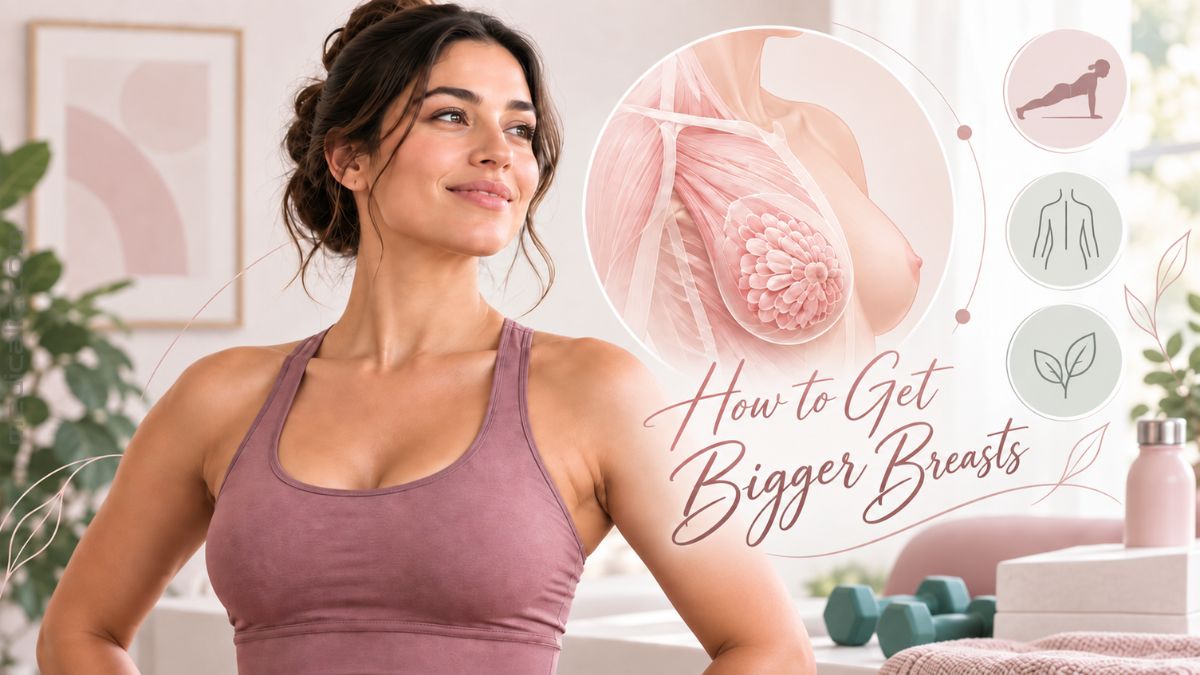
The reason natural methods have limited effects is largely anatomical: breasts are made mainly of fatty tissue, glandular tissue, ducts, and connective tissue, while the pectoralis major muscle sits underneath the breast rather than forming part of it.[1]
That anatomy explains why chest exercises can change the shape of your upper body without actually increasing breast tissue.
Here is a practical comparison:
| Method | Does it increase breast tissue? | What it may do |
|---|---|---|
| Chest exercises | No | Build muscle beneath the breasts |
| Better posture | No | Make the chest appear more lifted |
| Breast massage | No proven lasting effect | May feel relaxing |
| Specific foods | No | Support general nutrition |
| Weight gain | Sometimes increases breast fat | Also changes fat elsewhere |
| Enlargement supplements | No good evidence | May cause side effects or interactions |
| Fat transfer | Adds volume | Transfers your own fat into the breasts |
| Breast implants | Adds volume | Produces a more predictable size increase |
If your goal is a fuller-looking chest rather than a specific cup-size increase, several realistic options can help. First, it helps to understand why breast size varies so much.
What Determines Breast Size?
Genetics and anatomy
Genetics influence breast development, body proportions, and where your body tends to store fat.
The amount of fatty versus glandular tissue also varies considerably from one person to another. That is why two people of similar height and weight can have very different breast sizes.
Hormones and life stage
Hormones play an important role in breast development and change.
Breasts can look or feel different during puberty, menstrual cycles, pregnancy, breastfeeding, and menopause. Certain prescription medicines that affect hormones may also change breast size in some people.
Body weight
Because breasts contain fatty tissue, gaining or losing a significant amount of body fat can change their size.
The catch is that you cannot choose where your body stores additional fat. You may gain more around your abdomen, hips, thighs, face, breasts, or several areas depending largely on genetics and body composition.
Deliberately gaining weight solely to increase breast size is an imprecise strategy. If your goal is appearance rather than added breast tissue, more controllable options are available.
How to Get Bigger Breasts Without Surgery
Without surgery, the realistic goal is to improve chest shape, posture, support, and projection rather than trying to stimulate new breast tissue.
Can Exercise Make Your Breasts Look Bigger?
Not the breast tissue itself—but strength training can make your chest look fuller or more developed by building the pectoral muscles underneath the breasts.
Exercises such as push-ups, chest presses, incline presses, and chest fly variations train the pectoral muscles beneath your breasts. As those muscles become stronger and somewhat larger, they may create a firmer, more developed base underneath the breast.
Use gradual increases in resistance rather than searching for a special “breast enlargement workout.” Training your chest around twice per week is a practical starting point for many people, provided you allow enough recovery between sessions.[2]
Improve your posture
Slouched posture and rounded shoulders can make the chest look less prominent.
Strengthening your upper back, shoulders, chest, and core—and simply becoming more aware of your posture—can make your torso look taller and your chest more projected. Even a small postural improvement may help prevent slouching from making the chest appear flatter.
Choose a well-fitted bra
A supportive bra can create one of the fastest changes in appearance.
Depending on your preferences, padded, balconette, plunge, or push-up styles may create more lift or upper-breast fullness under clothing. A professional bra fitting can also be helpful if your current bras gape, dig in, ride up, or fail to provide adequate support.
These approaches can change how the chest looks, but not breast tissue itself. So what about the foods, supplements, massage, and hormone-based products marketed for enlargement?
Do Foods, Supplements, Massage, or Hormones Increase Breast Size?
Foods and phytoestrogens
Soy, flaxseed, fennel, fenugreek, nuts, dairy products, and other foods are often promoted as natural breast enhancers. Some contain phytoestrogens, but eating these foods does not reproduce the breast-development effects of human estrogen.
Phytoestrogens used in breast-enhancement supplements have not been shown to promote breast growth.
Nutritious foods can certainly belong in a healthy diet; they just should not be marketed as targeted breast-growth treatments.
Breast enlargement pills and creams
Breast-enhancement supplements commonly contain ingredients such as wild yam, saw palmetto, and phytoestrogen blends.
There is no good evidence that these products reliably increase breast size. Supplements can also cause side effects or interact with medications, including blood thinners such as warfarin.[3]
“Natural” does not automatically mean effective or harmless.
Topical creams have also not been shown to permanently enlarge adult breast tissue.
Breast massage
Breast massage may feel soothing or relaxing, but it has not been shown to produce lasting breast growth or permanently add a cup size, regardless of the technique, oil, or topical remedy used.
Birth control and hormones
Some prescription drugs—including certain hormonal treatments and birth-control pills—can cause temporary breast fullness or tenderness in some people. Hormonal shifts and fluid retention may contribute, and the effect varies from person to person.
That does not make hormones an appropriate DIY breast-enhancement method. Birth control or hormone therapy should be used for an appropriate medical reason after considering its benefits, risks, and contraindications with a healthcare professional.
Breast pumps and vacuum devices
Be cautious with consumer breast pumps or vacuum devices that promise permanent enlargement. Specialized external tissue-expansion systems have been studied in clinical settings, but that is not the same as evidence that ordinary home devices can safely and predictably increase breast size. Claims of rapid or permanent cup-size gains should therefore be viewed skeptically.
What Actually Increases Breast Volume?
Once the goal shifts from looking fuller to actually increasing breast volume, the options become much narrower. At that point, the established approaches are medical procedures.
Fat transfer breast augmentation
Fat transfer involves removing fat from another part of your body with liposuction, processing it, and injecting it into the breasts.
It can provide a relatively subtle increase while using your own tissue. However, the final amount of retained fat can vary, and additional treatment may sometimes be needed.
Recognized risks include cysts, infection, microcalcifications, fat necrosis, and loss of some transferred fat.
Research continues to examine techniques that may improve fat retention and outcomes, but the procedure is not risk-free or perfectly predictable.[4] Recent systematic reviews confirm that technique and patient selection remain important considerations.
Breast implants
Breast implants generally offer a more predictable increase when someone wants a substantial change in breast volume.
In the United States, approved breast implants include saline-filled and silicone gel-filled devices. Implants, however, should be viewed as a long-term medical commitment rather than a one-time cosmetic procedure.
Breast implants are not lifetime devices. Complications can include capsular contracture, pain, rupture or deflation, infection, changes in breast or nipple sensation, and the need for additional operations.
Breast implants are also associated with breast implant-associated anaplastic large cell lymphoma, or BIA-ALCL, a rare type of T-cell lymphoma. The risk is higher with textured implants than with smooth implants. Rare cases of other cancers, including squamous cell carcinoma in the capsule surrounding implants, have also been reported.[5]
If you are considering augmentation, discuss your goals, implant type, alternatives, expected results, long-term monitoring, follow-up needs, and potential complications with a qualified plastic surgeon.
Can You Get Bigger Breasts During Puberty?
Breast size can continue to change during puberty because development may not be finished yet.
Breast development typically begins between ages 8 and 13 and continues through the teenage years. The timing, final size, shape, and degree of asymmetry vary widely between individuals.
No commercial product or home remedy has been shown to safely accelerate normal breast development.
If breast development begins unusually early, has not started by around age 13, or you are worried that puberty is not progressing normally, speak with a parent or guardian and a pediatric or adolescent healthcare professional rather than experimenting with hormones or enlargement products.
When Should a Breast Change Be Checked?
Wanting larger breasts is a cosmetic goal; a new or unexplained breast change is a different medical question.
Most breast changes are not cancer, but it is important to contact a healthcare professional if you notice a new lump, persistent swelling, a new change in breast size or shape, unusual nipple discharge, nipple inversion, persistent skin dimpling or puckering, or other changes that are unusual for you.[6]
A sudden change affecting one breast deserves medical evaluation rather than an attempt to correct it with home remedies.
The Bottom Line
The right option depends on what you actually want to change—volume, projection, symmetry, or simply how your clothes fit. Nonsurgical approaches can improve appearance, while a substantial increase in breast volume generally requires a medical procedure. Keeping that distinction clear makes it easier to choose based on realistic results rather than marketing promises.
Medical References
Update History
Originally written by Dr. Rahul Kushwaha.
Your answer helps us improve the clarity and usefulness of our health content.