Between ring lights, focal-length distortion, and viral jaw-sculpting trends on social media, the internet has turned the jawline into a DIY remodeling project. High-resistance silicone exercisers, mastic gum, and aggressive mewing routines all sell a similar promise: repeat the movement long enough, and your lower face will look more sculpted.
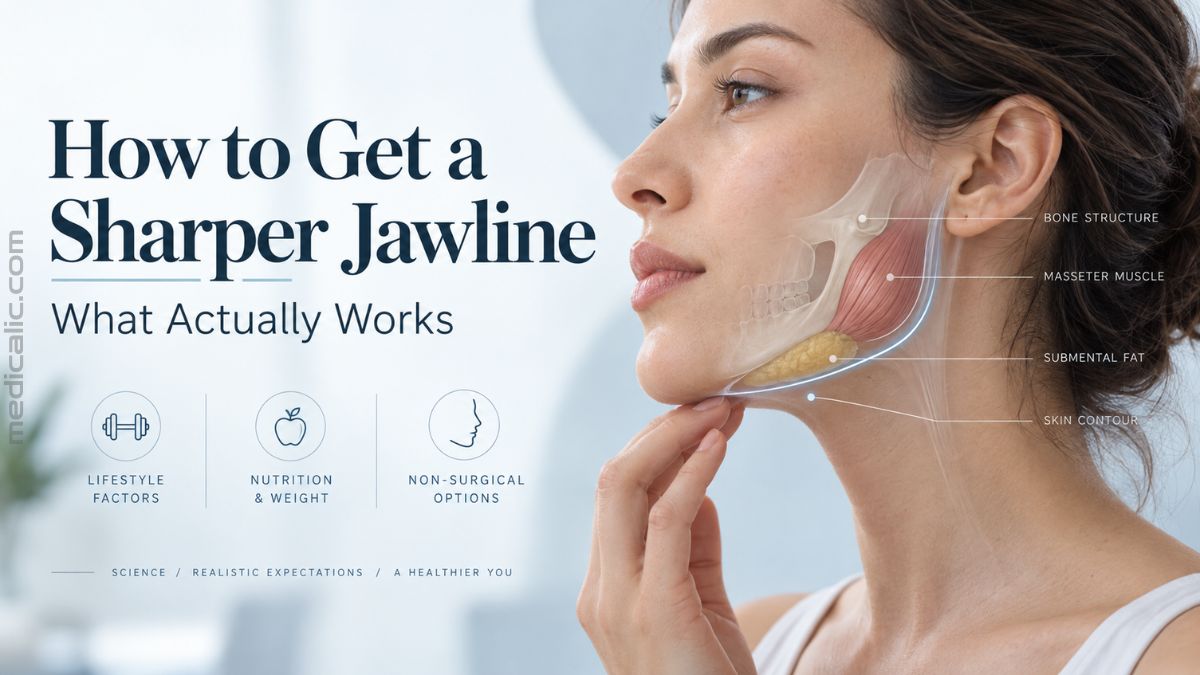
Human anatomy is less cooperative. Jawline definition depends on several interacting factors, including mandibular bone structure, chin projection, submental fat, masseter size, and skin and soft-tissue quality. Chewing has not been shown to meaningfully remodel a mature jawbone, and facial exercises cannot selectively remove fat beneath the chin.
If your jawline looks softer or less defined than you would like, the useful question is not simply, “Which exercise works?” A better question is: What is actually reducing your jawline definition, and what does the evidence show can realistically change it?
What Makes a Jawline Look Sharp?
A defined jawline is essentially a visible boundary between the lower face and neck. Several anatomical features influence how clear that boundary appears.
Bone Structure and Chin Projection
The mandible, or lower jawbone, forms the basic framework of your lower face. Its width, angle, and shape—as well as how far your chin projects—can all influence jawline definition.
Genetics and facial development play major roles. You can therefore be lean and healthy yet naturally have a softer jawline because your chin projects less or your mandibular shape is rounder.
Adult bone remains biologically active, but ordinary tongue pressure or chewing exercises have not been shown to dramatically reshape the adult jaw. Current evidence does not support claims that mewing can substantially remodel an adult jaw.[1]
Facial and Under-Chin Fat
Fat beneath the chin and around the lower cheeks can soften the border between your jaw and neck.
If excess body fat is contributing, gradual overall fat loss may make the jawline more visible. But you cannot reliably decide where your body loses fat first.
A systematic review and meta-analysis involving 13 studies and 1,158 participants found no evidence that exercising one specific area caused greater fat loss from that area. In practical terms, repeatedly exercising your jaw should not be expected to selectively burn fat beneath the chin.[2]
Jaw Muscle Size
The masseter is a strong chewing muscle near the back of each side of your jaw.
Larger masseters can make the lower face appear wider or more square. Some people consider that look more defined, while others prefer a narrower lower face.
More masseter size does not necessarily mean more jawline definition.
Skin and Soft Tissue
Skin laxity, jowling, and age-related soft-tissue changes can gradually blur the jawline even when your weight stays stable.
In those cases, additional weight loss or jaw exercises may not address the main cause.
How to Get a Sharper Jawline Naturally
Natural approaches can improve jawline visibility when the factor affecting it is modifiable. They cannot completely override your inherited facial anatomy.
Aim for Healthy Overall Fat Loss if Appropriate
If excess body fat is contributing and weight loss is appropriate for your health, gradual overall fat loss may also reduce some facial or under-chin fat.
Rather than following a special “jawline diet,” focus on sustainable habits such as balanced nutrition, regular physical activity, adequate protein and fiber, and resistance exercise when appropriate.
Where you lose fat first is largely individual. Some people notice facial changes early; others do not.
If you are already at a healthy weight, losing additional weight purely to make your face look leaner may provide little improvement and may not be appropriate for your health.
Improve Head and Neck Posture
Posture changes the way the jaw–neck angle is displayed, especially in profile. A forward-head position can compress the area beneath the chin, while a neutral head-and-neck position may make the contour look cleaner. It will not change the underlying bone or remove fat.
If you regularly develop neck pain or stiffness, a physical therapist or other qualified healthcare professional can help assess your posture and movement rather than relying on cosmetic posture exercises alone.
Protect Your Skin
Skin quality influences how clearly the jawline retains its contour with age. Daily broad-spectrum sun protection helps limit ultraviolet damage to collagen and elastin, while avoiding smoking and maintaining adequate nutrition support skin structure over time. These measures help preserve baseline skin quality; they do not actively sculpt the jawline.
Treat Puffiness as Temporary
High-sodium meals, alcohol, poor sleep, allergies, and other fluid shifts can temporarily make the lower face look fuller. Addressing the trigger may reduce that puffiness, but this is different from losing submental fat. Diuretics or deliberate dehydration should not be used as cosmetic jawline strategies.
Do Jaw Exercises, Chewing Gum, or Mewing Work?
Lifestyle changes can help when fat, posture, skin, or temporary puffiness is part of the problem. But what about the methods marketed specifically as “jawline exercises”? This is where social-media claims often outpace the evidence.
Jaw and Facial Exercises
A 2025 systematic review evaluated facial exercises, myofunctional techniques, and facial massage across 12 studies involving 321 women aged 30 to 70.
Some studies reported localized improvements around areas including the cheeks and jawline. However, the studies were small, used different techniques and outcome measures, and included no male participants. The authors concluded that the evidence remains insufficient to confidently establish these methods as effective facial-rejuvenation techniques.[3]
Current evidence is too weak to recommend facial exercises as a reliable method for producing a noticeably sharper jawline.
Chewing Gum
Chewing gum increases chewing activity, but current evidence does not show meaningful reshaping of the adult jaw. If you want the full breakdown, read does chewing gum help your jawline?
In a randomized clinical trial involving 58 healthy adults, participants completed gum-chewing training three times daily for six months. Their maximum bite force increased, but researchers found no significant change in masseter muscle thickness or mandibular shape.[4]
That distinction matters: stronger chewing function does not automatically produce a visibly sharper jawline. Excessive or very hard chewing can also aggravate jaw fatigue or temporomandibular symptoms in some people.
Mewing
Mewing involves maintaining a particular tongue position against the roof of the mouth, often with claims that constant pressure can reshape the jaw or improve facial structure.
Tongue position matters in oral function and development, but DIY mewing has not been shown to substantially remodel a fully developed adult jaw.
Online claims that mewing can reshape a fully developed jaw go well beyond the available evidence. If the feature you want to change is structural—or simply does not respond to lifestyle changes—the conversation shifts from DIY methods to professional options.
Professional Options for a More Defined Jawline
Professional treatment should be selected according to the anatomy involved: submental fat, skeletal projection, masseter size, skin laxity, or a combination. Each requires a different approach.
Under-Chin Fat Treatments
For adults with moderate-to-severe fullness caused by submental fat, In the United States, Kybella (deoxycholic acid) is approved for moderate-to-severe fullness caused by submental fat in adults. Adverse effects can include swelling, bruising, pain, numbness, and firmness; more serious risks include nerve injury affecting the smile and difficulty swallowing.[5] Treatment should be performed by an appropriately trained healthcare professional.
Another approach is cryolipolysis, commonly called fat freezing, using devices cleared for the intended treatment area. Treatment beneath the jaw can temporarily affect nerves involved in lip or tongue movement. A rare but more serious complication called paradoxical adipose hyperplasia causes treated fat to grow rather than shrink and may require surgery.[6]
Liposuction is more invasive but can directly remove submental fat in suitable candidates.
Chin and Jawline Filler
When poor chin or jaw projection is the main issue, further fat loss will not correct the structural deficit.
Dermal filler can add contour or projection in carefully selected patients. In the U.S., Juvéderm Volux XC is approved for adults over 21 with moderate-to-severe loss of jawline definition, and clinical-study results may last up to approximately 12 months.[7]
Fillers are medical procedures. Although severe complications are uncommon, accidental injection into a blood vessel can cause tissue death, vision loss—including blindness—or stroke. Fillers should be administered by an appropriately licensed, trained professional; DIY and needle-free filler injection should be avoided.
Botulinum Toxin for Prominent Masseters
When prominent masseter muscles are widening the lower face, botulinum toxin type A can reduce muscle volume and narrow the lower-face contour in selected patients.
A 2026 meta-analysis of five randomized placebo-controlled trials involving 536 participants found short-term improvements in masseter prominence, muscle thickness, and patient satisfaction. However, study results varied, and longer-term evidence is still needed.[8]
In the United States, treatment specifically for cosmetic masseter prominence remains off-label as of September 2026. The FDA accepted an application for BOTOX Cosmetic for this indication for review on August 4, 2026, but acceptance for review is not approval.
Long-term skeletal effects remain uncertain. A 2024 systematic review found an approximately 6% decrease in mandibular cortical thickness across available human studies after botulinum toxin exposure, while clear decreases in overall bone volume or density were not demonstrated. The clinical importance remains uncertain. Whether you are considering a professional treatment or a DIY approach, one principle still applies: more aggressive does not mean more effective.
What to Avoid When Trying to Define Your Jawline
Aggressive jaw training adds risk without evidence of better cosmetic results.
Be cautious with prolonged hard-gum chewing, high-resistance jaw-training devices, forceful mewing, programs promising targeted chin-fat loss, deliberate facial trauma or “bonesmashing,” and any form of DIY injectable treatment.
If a product claims it can dramatically reshape mature facial bone without surgery, orthodontic treatment, or another medically established intervention, strong clinical evidence should support that claim. Rather than chasing the most dramatic promise, it is more useful to match the solution to the feature you actually want to change.
How to Choose the Right Approach for Your Face
| What May Be Softening the Jawline | What Usually Won’t Fix the Main Cause | What May Help |
|---|---|---|
| Excess facial or under-chin fat | Jaw exercises, facial yoga, targeted chewing | Sustainable overall fat loss when appropriate; selected procedures such as Kybella, cryolipolysis, or liposuction |
| Limited chin or jaw projection | More weight loss, hard chewing, mewing | Structural assessment; dermal filler may improve contour in selected patients |
| Prominent masseter muscles / wider lower face | Jaw trainers or heavy chewing to “build” the jaw | Avoid unnecessary chewing overload; botulinum toxin may reduce masseter prominence in selected patients |
| Skin laxity or age-related soft-tissue changes | More jaw exercise or additional weight loss | Skin protection and professional assessment for appropriate cosmetic options |
| Posture-related appearance | Fat-loss strategies when body fat is not the issue | A comfortable, neutral head-and-neck position may improve how the jaw–neck angle appears |
Instead of copying someone else’s jawline routine, start with the feature that is actually reducing your jawline definition.
The table above is a starting point, not a diagnosis. More than one factor can contribute at the same time, which is why professional assessment can be useful before choosing a cosmetic procedure.
A qualified dermatologist, plastic surgeon, facial plastic surgeon, or other appropriately trained clinician can assess these factors if you are considering a procedure.
The practical goal is to identify what is limiting jawline definition and decide whether changing it is realistic, appropriate, and proportionate to your facial anatomy.
The Takeaway
Social media can make the lower face seem like pliable clay—that with the right exerciser or tongue posture, anyone can chisel a new profile. Biology is less dramatic: you cannot exercise away bone structure or selectively burn under-chin fat.
For meaningful change, start with what is actually reducing jawline definition. Overall fat loss may reveal natural contours when excess body fat is a factor, and neutral head-and-neck posture may improve the jaw–neck angle. Popular DIY jaw-sculpting methods, however, have not been shown to reliably reshape an adult jawline.
When the issue is structural—such as limited chin projection, prominent masseters, submental fat, or skin laxity—targeted clinical options may help. The key is matching the intervention to the underlying anatomy and keeping expectations realistic.
A sharp jawline is an aesthetic preference, not a vital sign. It is neither a measure of health nor evidence that your natural facial structure needs to be “fixed.”
Medical References
Update History
Originally written by Dr. Rahul Kushwaha.
Your answer helps us improve the clarity and usefulness of our health content.