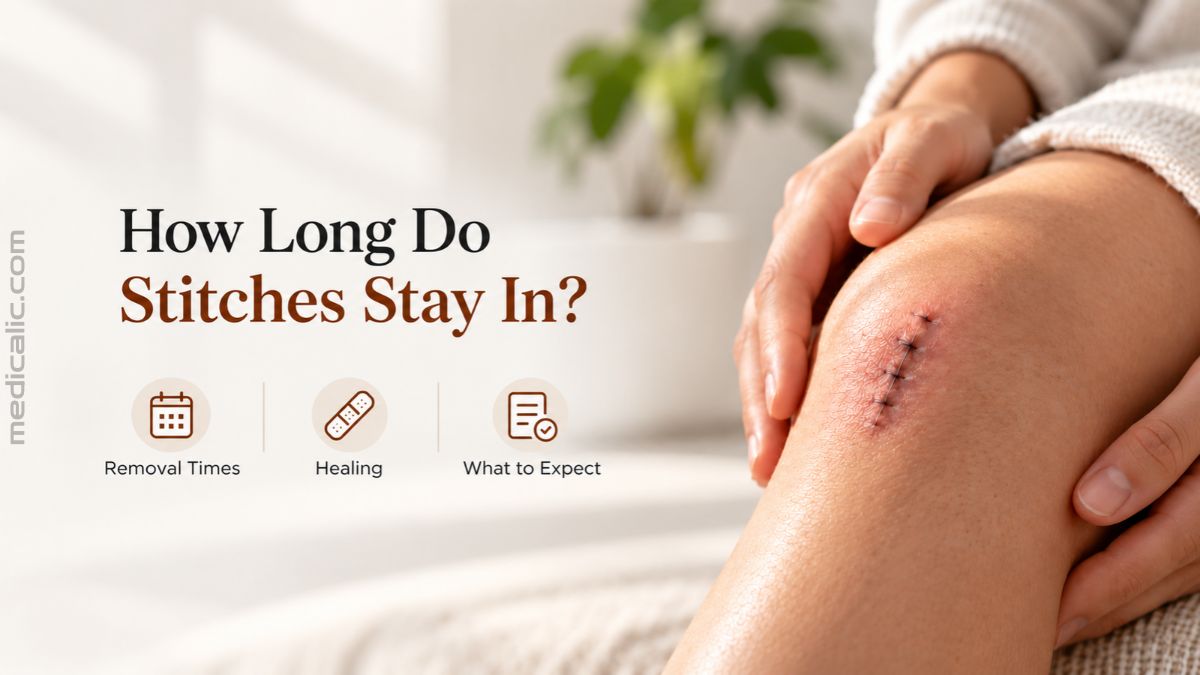
Whether your stitches came from a kitchen accident, a sports injury, or surgery, once the wound starts looking better, one question usually takes over: how long do stitches stay in?
There is no single countdown that works for every wound. Stitches on some parts of the body can come out within a few days, while others need more time to keep the healing skin from pulling apart. The type of stitch matters too—dissolvable sutures follow a very different timeline from stitches that need to be removed.
Instead of judging by how the wound looks, it helps to understand how long stitches typically stay in, why the timing changes from one body area to another, and what can happen if they come out too early—or stay in too long.
How Long Do Stitches Stay In?
When it comes to stitches, location matters. Healthcare providers follow established clinical timelines based largely on where the wound is located and the type of closure used. Here is the standard baseline:[1]
| Body area or procedure | Typical timeline |
|---|---|
| Face | 3–5 days |
| Scalp | 7–10 days |
| Arms | 7–10 days |
| Trunk | 10–14 days |
| Legs | 10–14 days |
| Hands or feet | 10–14 days |
| Palms or soles | 14–21 days |
| C-section incision | Removable stitches or staples: about 5–7 days; dissolvable stitches do not usually require removal[2] |
| Episiotomy or perineal tear | Often begin dissolving after about 10–14 days and may take up to 6 weeks to disappear completely[3] |
Note: Always follow the specific timeline given by your treating physician, as underlying health conditions such as diabetes or circulation problems can affect healing.[4]
Why Removal Timing Varies by Body Area
A simple facial cut may need sutures for only a few days, while a knee laceration can require up to two full weeks. This clinical difference comes down largely to mechanical tension and localized vascularity.
The biggest driver is physical movement. Areas like the knees, elbows, hands, palms, and feet endure constant stretching, bending, and weight-bearing stress. Because these high-tension zones are under continuous pull, sutures must remain anchored longer to mechanically reinforce the wound edges until newly formed collagen gains enough tensile strength to withstand everyday motion without tearing open.[5]
Conversely, facial wounds generally experience less structural tension and benefit from a rich blood supply that delivers oxygen and nutrients to the healing tissue, supporting faster repair.[6] Removing facial stitches swiftly is also critical for cosmetic reasons, as taking them out early allows the tissue to settle smoothly while helping prevent noticeable “railroad track” cross-hatch marks along the scar line.
Beyond anatomy, individual systemic factors dictate recovery speed; wound size, depth, and conditions like diabetes, smoking, poor nutrition, or immune suppression can slow tissue regeneration, which is why two people with similar injuries often receive entirely different removal schedules.
Suture Types: Dissolvable vs. Non-Absorbable Timelines
Before thinking about removal, it helps to know which type of suture is holding the wound together.
Non-absorbable stitches, typically made from materials like nylon, polypropylene, or braided silk, provide reliable surface tension. When used for skin closure, they usually need to be clipped and removed manually by a healthcare professional once the wound edges have safely fused. Because your body does not break down these materials, they maintain their structural strength until extracted.[7]
Absorbable (dissolvable) stitches follow an entirely different timeline. Your body gradually degrades and absorbs the suture material over time, meaning a dedicated extraction visit is generally not required.
However, there is no universal countdown for this process. While certain light surface or mucosal stitches may loosen and disappear within days or a couple of weeks, deeper structural materials engineered for prolonged internal support can take several months to break down completely.[8]
It is not unusual to feel a small knot or notice a lingering piece of a dissolvable stitch several weeks after a procedure. The material frequently loses its mechanical grip long before the strands are entirely absorbed. In some cases, as the tissue heals, the body may even push a tiny fragment of the stitch toward the surface, creating a minor, pimple-like bump.[9] Even if this happens, never pull, scratch, or attempt to cut a stubborn stitch at home, as premature tampering can introduce bacteria or disrupt the deep structural healing underneath.
What Happens If Stitches Come Out Too Early—or Stay in Too Long?
Removing stitches too early can allow the wound to reopen, while leaving them in too long can increase irritation and visible stitch marks.
A wound can look sealed on the surface before the tissue underneath has regained enough strength. If sutures are removed prematurely—or if a stitch accidentally snaps during active movement—the wound margins can pull apart. This complication is known as wound dehiscence. If the wound edges separate, healing may be delayed, and the risk of infection and a more noticeable, wider scar can increase.
On the other hand, keeping removable stitches in longer is not automatically safer. As the skin heals around a stitch, prolonged retention can trigger localized irritation. This increases the likelihood of noticeable cross-hatched or “railroad track” marks along the scar line. In delayed cases, the skin can actually start to heal over the knots, making the eventual removal noticeably more difficult and uncomfortable.[10]
How to Care for Your Stitches Until Removal Day
Proper wound care keeps mechanical tension low and protects the healing tissue while the stitches do their job:
- Follow the 24-to-48-Hour Dry Rule: Keep the dressing clean and completely dry for the first 24 to 48 hours.[11] After this initial seal forms, you may gently rinse the wound with mild soap and water unless your surgeon explicitly specifies otherwise.
- Pat, Never Rub: After cleansing, gently pat the area dry with a sterile gauze pad or clean towel. Never scrub or pick at dried crusts around the knots.
- Avoid Submerging the Wound: Avoid baths, hot tubs, and swimming pools entirely until your provider gives direct clearance.[12] Prolonged water saturation softens the healing epidermis and introduces waterborne bacteria straight down the suture tracts.
- Limit Mechanical Strain: Avoid heavy lifting or repetitive exercises that pull across the suture line, particularly for incisions located over joints, the back, or the extremities.
What to Expect at the Doctor’s Office: Does It Hurt?
If you are dreading your removal appointment, you can usually set your anxiety aside. For most simple skin wounds, the extraction process is straightforward and typically does not require any additional local anesthesia or numbing injections.
The clinician will clean the area, gently stabilize the knot with sterile forceps, and snip the suture directly at the skin surface. As the thread is pulled through, removal is quick and usually causes little more than a brief pulling or pinching sensation.[13] For most people, it is a very simple step that safely marks the end of your initial healing phase.
Are You Fully Healed Once the Stitches Are Out?
Removing sutures simply means the wound has developed enough initial stability that it no longer requires external scaffolding. It does not mean your tissue has returned to normal strength.
In fact, a healing wound is remarkably fragile in those early days. At one week, the repairing tissue typically possesses only about 3% of its original strength. Over the following weeks, as collagen continues to reorganize, this increases to roughly 20% to 30%. Even after three months of deep remodeling, a healed scar generally plateaus at around 80% of uninjured skin’s original strength—it rarely returns to a full 100%.
Because this fresh tissue remains vulnerable to stretching, healthcare providers may place Steri-Strips (small adhesive tapes) across the incision after suture removal to provide a little extra transitional support. If applied, let these fall off on their own over the next few days. Finally, once the wound is fully closed, protect the new scar from excessive sun exposure, which can make discoloration more noticeable.[14]
Takeaways
Knowing the expected healing timeline makes it easier to understand when stitches are ready to come out. Stitch removal marks an important milestone, but it is not the end of the recovery process. Give the healing tissue time to rebuild, protect it from unnecessary strain, and let the recovery process continue.
Medical References
Update History
Originally written by Dr. Rahul Kushwaha.
Your answer helps us improve the clarity and usefulness of our health content.