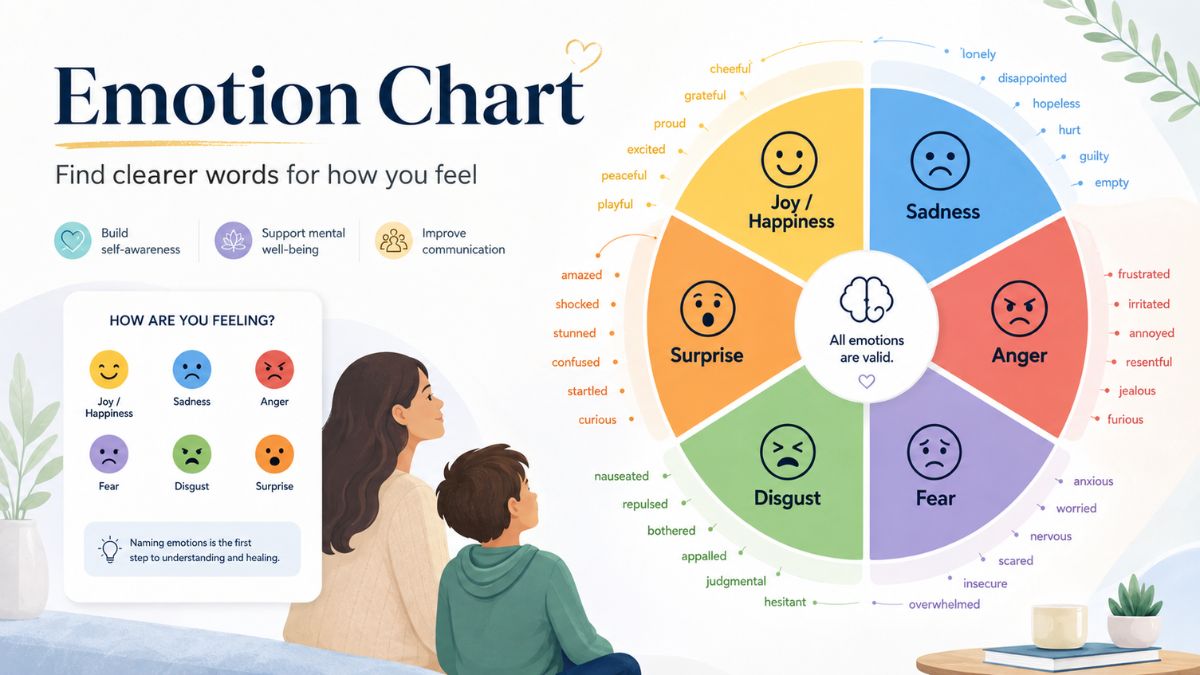
Sometimes the hardest part of a difficult emotion is not the emotion itself—it is not knowing what to call it. You may say, “I feel bad,” when the experience is actually a mix of disappointment, loneliness, anxiety, irritation, shame, or overwhelm. An emotion chart can help you move from that vague emotional fog toward language that feels more accurate.
Naming a feeling does not automatically make it disappear. But finding a more precise word can make the experience easier to understand, communicate, and respond to. Once you can say, “I feel rejected and worried,” you have much more useful information to work with than simply saying, “I feel awful.”
Think of an emotion chart as a map: useful for finding your direction, but not the territory itself. It can help you describe what you feel more clearly, but it is not a diagnostic tool and cannot tell you what treatment you need.
What Is an Emotion Chart?
An emotion chart, sometimes called a feelings chart, is a visual tool that organizes emotion words so they are easier to recognize, compare, and describe.
Some charts use broad categories such as joy, sadness, anger, fear, disgust, and surprise. Others include more precise terms, facial illustrations, intensity scales, or dimensions such as energy and pleasantness. A feelings wheel usually places broad emotions near the center and more specific words toward the outside.
There is no single scientifically accepted master list of human emotions, and different psychological models organize them in different ways. In a 2017 study, researchers analyzing self-reported reactions to 2,185 videos identified 27 distinguishable varieties of emotional experience, with many categories connected by smooth gradients rather than sharp boundaries.[1]
A Simple Emotion Chart
| Broad emotion | More specific feelings to explore |
|---|---|
| Joy / Happiness | content, pleased, excited, grateful, proud, hopeful |
| Sadness | disappointed, lonely, hurt, discouraged, grief-stricken |
| Anger | annoyed, irritated, frustrated, resentful, offended, furious |
| Fear | uneasy, nervous, worried, anxious, insecure, frightened |
| Disgust | put off, disapproving, repulsed, revolted |
| Surprise | startled, confused, amazed, astonished, shocked |
Use this emotion chart as a starting point, not a rigid classification system. You may feel relief and sadness together, or anger mixed with hurt and embarrassment.
The goal is not to find the one “correct” emotion. You may feel several things at once. The goal is to find language that makes your experience a little clearer.
How to Use an Emotion Chart
You do not need to analyze yourself for 20 minutes. A useful emotional check-in can take less than a minute.
1. Notice Before You Name
Start with what is happening right now—both mentally and physically.
Are you tense, heavy, restless, or unusually energized? Is your mind racing? Do you want to withdraw, argue, cry, escape, or reach out to someone?
These clues do not prove which emotion you are experiencing, but they can narrow the search.
2. Pick the Closest Broad Emotion
Choose the category that feels nearest: sadness, anger, fear, joy, disgust, surprise—or something else.
Do not worry about being exact yet. “Close enough” is enough to begin.
3. Get More Specific
Suppose you first choose anger. After looking more closely, “frustrated” may fit better. Or you may notice disappointment, embarrassment, fear, or hurt underneath it. “Sad” might become lonely, disappointed, or grieving.
That shift matters.
“Why am I so angry?” is broad.
“Why do I feel dismissed and frustrated?” gives you a clearer starting point.
4. Add Intensity and Context
Try this simple sentence:
“I feel ___ at about ___ out of 10 because ___.”
For example:
“I feel disappointed at about 6 out of 10 because I expected more support.”
Now you have more than a label: you have a feeling, its intensity, and some context. That gives you something concrete to work with.
Why Naming Emotions May Help
Psychologists sometimes use the term affect labeling for the process of putting emotional experiences into words.
Research on affect labeling suggests that putting feelings into words can influence how the brain and body respond to emotional information. But the effect is not identical for everyone or every situation.[2]
That is why the popular phrase “name it to tame it” needs some caution.
Naming a feeling is not an emotional off-switch. Its effects may vary depending on timing, emotional intensity, context, and the person using the strategy.[3]
A more useful goal is:
Name the emotion so you can understand it more clearly—not so you can force it to disappear.
Emotion Chart vs. Feelings Wheel vs. Mood Meter
These tools have a similar purpose, but they organize emotions differently.
An emotion chart may use words, faces, scales, categories, or grids.
A feelings wheel usually moves from broad categories toward increasingly specific emotion words.[4]
A Mood Meter-style tool organizes feelings using dimensions of pleasantness and energy. Someone who feels unpleasant and highly energized, for example, might explore words such as tense, frustrated, worried, or angry.[5]
No single format is universally best. If you already know the broad emotion but need a more precise word, a feelings wheel may help. If you mainly notice that you feel highly energized and uncomfortable, an energy-and-pleasantness chart may be easier to use.
Using an Emotion Chart as an Adult
Emotion charts are not just for children. Adults may find them especially useful when several feelings become tangled together.
After critical feedback at work, “I’m angry” may turn out to be a mix of embarrassment, disappointment, and worry after a closer check.
That distinction can change your next step—from reacting defensively to pausing, asking for clarification, or deciding which part of the feedback is useful.
Adults can use emotion charts for journaling, therapy, relationship conversations, conflict reflection, and daily check-ins.
They work best as prompts for curiosity rather than instructions about how you should feel.
Emotion Charts for Kids
For children, simpler is usually better. A preschooler does not need dozens of emotion words at once. A few familiar categories, clear language, and age-appropriate illustrations may be more useful.
A 2026 cross-sectional study of 197 typically developing German children ages 4 to 6 found that emotion-specific vocabulary was associated with aspects of emotion knowledge and regulation. Importantly, depth of understanding mattered alongside vocabulary size.[6]
Because the study was cross-sectional, it cannot prove that teaching more emotion words directly improves emotion regulation.
For parents, caregivers, and educators, the practical takeaway is to teach meaning, not just labels. Help a child understand what frustrated means, when it may fit, and how it differs from anger or disappointment.
Ask “Which feeling seems closest?” instead of telling a child “You are angry.”
Facial expressions can offer useful clues, but they cannot reveal someone’s internal emotional state with certainty.[7]
Try the Emotion Chart and Feelings Wheel
Find a Word That Fits What You Feel
Browse by chart or wheel, then switch between adult and child-friendly emotion words.
What an Emotion Chart Cannot Tell You
An emotion chart is a self-awareness tool, not a psychological test. It cannot tell you which emotion you are “supposed” to feel.
It cannot diagnose depression, an anxiety disorder, PTSD, ADHD, or another mental health condition. Nor can it determine exactly why you feel a certain way, reveal what another person definitely feels, or decide what treatment you need.
How an emotion is experienced and described can be influenced by culture, language, personality, past experiences, physical health, sleep, stress, and the situation itself.
And if no word fits perfectly, that does not mean you are using the tool incorrectly.
What to Do After You Identify the Feeling
Finding the word is only the beginning. Once you have a likely label, ask yourself four questions:
- What happened just before this feeling became noticeable?
- How intense is it right now?
- Is another emotion mixed in or underneath it?
- What would genuinely help next?
You may need rest, information, reassurance, a boundary, connection, time, problem-solving, or simply permission to experience the feeling without immediately trying to fix it.
The point is not to judge the emotion or automatically act on it. It is to understand what the feeling may be telling you, then choose a response that fits the situation.
When an Emotion Chart Is Not Enough
Consider speaking with a qualified mental health professional if emotional distress is persistent, overwhelming, difficult to manage, or significantly affecting sleep, work, school, relationships, or daily functioning.[8]
Frequently Asked Questions
An emotion chart is a visual guide that organizes emotion words, faces, intensities, or other cues to help you identify and describe what you may be feeling.
There is no universally accepted final list. Some models use a small set of broad categories, while other research describes emotional experience as more varied, blended, and overlapping.
Not exactly. A feelings wheel is one type of emotion-organizing tool, typically moving from broad categories toward more specific emotion words.
No. An emotion chart can support emotional awareness, but it cannot diagnose a mental health condition. Diagnosis requires an appropriate clinical assessment.
Bottom Line
An emotion chart will not tell you everything about what you feel—and that is not its job. Its real value is simpler: it gives you words when an emotional experience feels difficult to describe.
Start broad, get more specific if you can, and add intensity and context. Then ask what the feeling may be signaling and what would actually help next.
Sometimes moving from “I feel awful” to “I feel disappointed, lonely, and a little worried” is a small change in language—but a meaningful step toward understanding what you need next.
Medical References
Update History
New medical references added.
Reference accuracy and source links verified.
Medically reviewed by Dr. Jubair Islam.
Originally written by Dr. Rahul Kushwaha.
Your answer helps us improve the clarity and usefulness of our health content.