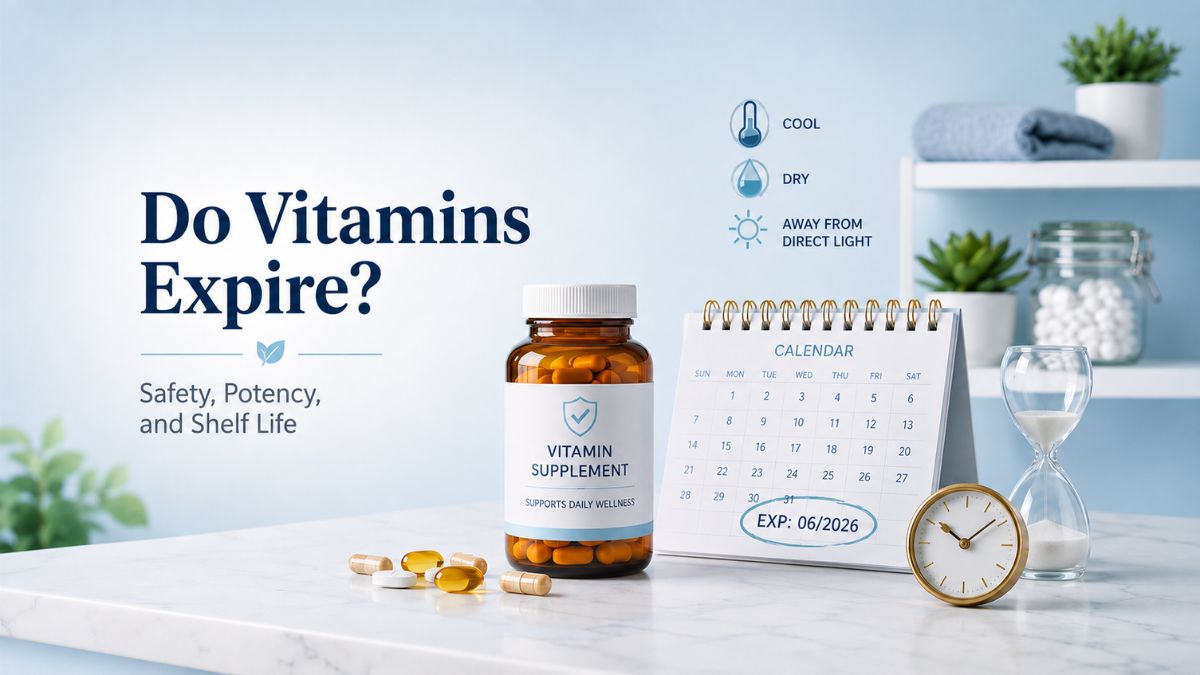
That half-used bottle of vitamins has been sitting in the back of your cabinet for months. The tablets look normal. The bottle is still tightly closed. Then you spot the date on the label—and realize it expired a while ago.
So, do vitamins expire, and does that mean you need to throw them away immediately?
The short answer is yes—but expiration is not as dramatic as it sounds. Vitamins do not suddenly transform from “good” to “dangerous” the moment the printed date passes. For most vitamin supplements, the bigger concern is declining potency and uncertain quality. Over time, certain vitamins can break down, meaning an older supplement may no longer deliver the amount listed on the label.
How quickly that happens depends on the vitamin itself, its formulation, packaging, and storage conditions. Heat, moisture, oxygen, and light can all accelerate vitamin degradation. Research also suggests that different formulations may age very differently.
Do Vitamins Really Expire?
Yes—but “expire” needs a little context.
Unlike fresh food, most vitamin tablets do not suddenly spoil at midnight on their expiration date. Vitamins are chemical compounds, and some gradually become less stable as time passes.
Exposure to environmental factors such as heat, light, oxygen, and moisture can trigger chemical reactions that reduce the amount of active vitamin remaining in a product. A 2025 scientific review, for example, identified heat, light, oxygen, pH, and interactions with other components as important factors affecting vitamin stability.[1]
That creates an important distinction:
An expired vitamin may still contain active nutrients, but you can no longer confidently assume it provides the full dose printed on the label.
In the United States, dietary supplements are not required to carry an expiration, shelf-life, or “best if used by” date. When a manufacturer does include one, however, the date should be supported by valid data and should not be false or misleading.[2]
So the date matters. It simply should not be interpreted as an instant chemical switch.
What Does the Expiration Date on Vitamins Mean?
Think of the expiration or best-by date as the manufacturer’s supported window for product quality when the supplement is stored according to its instructions.
Before that date, the manufacturer is generally indicating that the product should meet its established specifications throughout its stated shelf life.
Afterward, there is more uncertainty.
A vitamin tablet does not necessarily contain 100% of its labeled dose on Tuesday and suddenly drop to zero on Wednesday. Degradation is typically gradual. But once a supported shelf-life period has passed, you have less assurance that the product still meets its original potency and quality specifications.
That distinction becomes especially important when the dose actually matters medically.
What Happens to Vitamins After They Expire?
So what actually changes once that shelf-life window has passed? The most important issue is often loss of potency.
Not all vitamins are equally stable. Vitamin C, for instance, is particularly vulnerable to oxidation and environmental conditions. Thiamin, or vitamin B1, can also degrade under certain processing and storage conditions.
A 2026 study of ready-to-drink nutritional supplements found that degradation rates of vitamins C and B1 increased as storage temperature rose. Packaging and processing also influenced nutrient stability. These findings came from liquid nutritional beverages, so their exact shelf-life estimates should not be applied directly to ordinary tablets or capsules. Still, the study demonstrates why “age” is only part of the equation.[3]
Minerals such as calcium, iron, magnesium, and zinc are elements and do not chemically break down in exactly the same way as organic vitamin molecules. But a multivitamin also contains coatings, binders, other nutrients, and sometimes oils or moisture-sensitive ingredients. The quality of the finished supplement can therefore still change over time.
How Long Do Vitamins Last After the Expiration Date?
That naturally raises the next question: how long is an expired vitamin still usable? Unfortunately, there is no evidence-based universal grace period that applies to every product.
You may see claims online that vitamins stay good for one, two, or even several years after expiration. In reality, no single timeline applies reliably to every product.
Shelf life depends on the nutrient, formulation, packaging, manufacturing process, storage temperature, humidity, and exposure to light and oxygen. A sealed tablet bottle kept in a cool, dry cabinet cannot automatically be treated the same as gummies stored in a humid bathroom or supplements forgotten in a hot car.
For that reason, there is no reliable answer such as “all vitamins are safe for six months after expiration.”
If the date has passed, replacing the product is the simplest way to know you are receiving the dose stated on the label.
Is It Safe to Take Expired Vitamins?
This is where expiration dates can become confusing. For many standard vitamin products, an expired date is more likely to raise a potency and quality concern than signal that the supplement has suddenly become toxic.[4]
But “expired” should not automatically be translated into “safe.”
Storage damage changes the equation. Do not use a supplement if you notice mold, moisture inside the container, a damaged seal, a rancid or unusual smell, leaking softgels, badly clumped powder, or major changes in color or texture. Gummies that have melted, become unusually wet, or changed significantly should also be discarded.
Appearance is not a perfect test, either. A tablet can look completely normal while containing less of a sensitive vitamin than its label claims.
For an inexpensive everyday supplement, replacing an expired bottle is usually more practical than trying to estimate how much potency remains.
Do Unopened Vitamins Expire?
What if the bottle has never been opened? Unopened vitamins still have a shelf life.
Keeping a bottle sealed reduces repeated exposure to outside air and humidity, which may help protect the contents. However, it does not stop chemical changes indefinitely.
Temperature, residual oxygen, packaging materials, formulation, and time can continue to affect stability even when the seal has never been broken.
So an unopened bottle that has passed its expiration date should not automatically be considered equivalent to a new one.
Opening the bottle introduces additional variables. Every opening creates another opportunity for humid air to enter, particularly if the supplement is stored near a shower, sink, stove, or other warm and humid area. Handling vitamins with wet hands or repeatedly leaving the lid loose can add even more moisture exposure.
Do Gummy and Liquid Vitamins Expire?
The answer is still yes—but this is where formulation starts to matter even more.
Gummy vitamins contain a moisture-containing, food-like matrix, making their stability different from that of a dry tablet. Heat and humidity may affect not only the vitamin itself but also the gummy’s texture and physical quality.
Vitamin C provides a good example. A 2026 study evaluating a specially designed liposomal vitamin C gummy found that formulation technology improved vitamin C stability during processing and storage. These findings highlight an important point: two gummy products containing the same vitamin may not degrade at the same rate.[5]
Liquid vitamins also have their own stability characteristics. Follow the manufacturer’s refrigeration and storage directions rather than assuming every liquid supplement belongs in the refrigerator.
Fish oil is technically an omega-3 fatty-acid supplement rather than a vitamin, but it is often stored alongside vitamins. Oils rich in omega-3 fatty acids are vulnerable to oxidation, which can lead to rancidity and other chemical changes. A distinctly rancid product should not be used.[6]
When You Should Replace Expired Vitamins
For casual everyday use, some uncertainty may seem minor. But there are situations where uncertain potency simply is not worth the gamble.
Pregnancy is one of them. If you are pregnant or trying to become pregnant, replace an expired prenatal vitamin rather than depending on a product with uncertain nutrient levels. Folic acid intake around conception and early pregnancy is particularly important for reducing the risk of neural tube defects, and 400 micrograms daily is generally recommended for women capable of becoming pregnant, although individual prenatal needs can vary.[7]
The same principle applies when a supplement is being used to correct a diagnosed deficiency. If a clinician has recommended vitamin D, vitamin B12, iron, folate, or another nutrient at a specific dose, use an in-date product.
When treatment depends on a predictable dose, an expired bottle introduces uncertainty you do not need.
Why Storage Conditions Matter
Vitamin degradation is chemistry happening slowly—and poor storage can speed it up.
Higher temperatures accelerate many chemical reactions, which is one reason leaving supplements in a hot vehicle is a bad idea. The 2026 nutritional beverage research found progressively faster degradation of vitamins C and B1 at higher storage temperatures.
Humidity is another concern. Moisture can affect powders, tablets, chewables, and gummies. Oxygen can contribute to oxidation, while light can accelerate deterioration of certain sensitive compounds. Modern supplement packaging is often designed partly to limit these exposures.
This is why the steamy bathroom cabinet may be convenient—but not necessarily ideal.
How to Store Vitamins Properly
For most supplements, the best approach is refreshingly simple: keep the product in its original container, close the lid securely, and store it in a cool, dry location away from direct sunlight and excessive heat. Avoid transferring vitamins to decorative containers or organizers for long-term storage unless you can preserve the original labeling and appropriate storage conditions.[8]
Follow the individual label when refrigeration is required. More refrigeration is not automatically better; moisture and condensation can create problems for products that were designed for room-temperature storage.
Leave manufacturer-provided desiccant packets in the bottle unless the packaging specifically instructs otherwise, and keep all supplements safely out of reach of children.
Most importantly, storage cannot reverse aging. Good conditions may help preserve quality, but they do not make a supplement last forever.
Should You Take Vitamins Past Their Expiration Date?
If an expired vitamin looks normal and has been stored properly, the main uncertainty is whether it still provides the full labeled dose. Discard products that show storage damage or physical changes, and use an in-date supplement whenever accurate dosing matters.
When accurate dosing matters, certainty beats guesswork.
How to Dispose of Expired Vitamins
If you decide it is time to replace the bottle, the next question is what to do with the old one. In the United States, medicine take-back programs or prepaid mail-back options are generally preferred for unused or expired supplements when available. If those options are not accessible, follow current federal, product-specific, or local disposal guidance.[9]
Outside the U.S., disposal recommendations can differ. A pharmacist or local government waste authority can tell you what applies where you live.
Frequently Asked Questions
Some dietary supplements may not carry an expiration or best-by date. In that case, follow the manufacturer’s storage guidance and contact the manufacturer if you need product-specific shelf-life information. If the supplement is old, has been stored poorly, or you depend on it for a medically important dose, replacing it is the more reliable choice.
An expiration date alone does not mean a vitamin suddenly becomes poisonous. With many vitamin supplements, the more predictable concern is declining or uncertain potency. However, supplements affected by moisture, contamination, damaged packaging, rancidity, or major physical changes should not be taken.
Yes. Vitamin D supplements have a limited shelf life. Once the manufacturer’s supported date has passed, you should not assume that every serving still provides the full labeled amount—especially if vitamin D is being used to treat a documented deficiency.
There is no scientifically established grace period that applies to every vitamin. If the expiration date has passed and reliable dosing matters, replace the product.
Bottom Line
Ultimately, an expired vitamin isn’t a ticking time bomb—it’s a product whose potency has become less predictable.
Over time, vitamins can gradually break down, and heat, humidity, oxygen, light, formulation, and packaging can all influence how quickly that happens. Once the supported shelf-life period has passed, you have less certainty that the bottle still delivers what the label promises.
If a vitamin is expired, poorly stored, physically changed, or being used during pregnancy or to treat a diagnosed deficiency, replacing it is the more reliable choice.
A fresh bottle may seem like a small detail. But when you are taking a supplement for a real health goal, knowing what dose you are actually getting is worth it.
Medical References
Update History
New medical references added.
Clinical guidance updated to reflect current recommendations.
Originally written by Mahfuza Begum, R.Ph..
Your answer helps us improve the clarity and usefulness of our health content.