Pancreatic cancer rarely gives doctors a reason to pause in surprise. When it spreads beyond the pancreas and returns after treatment, the conversation often becomes painfully practical: how much time can be gained, how much suffering can be avoided, and whether any option is still worth trying.
That is why daraxonrasib has drawn so much attention.
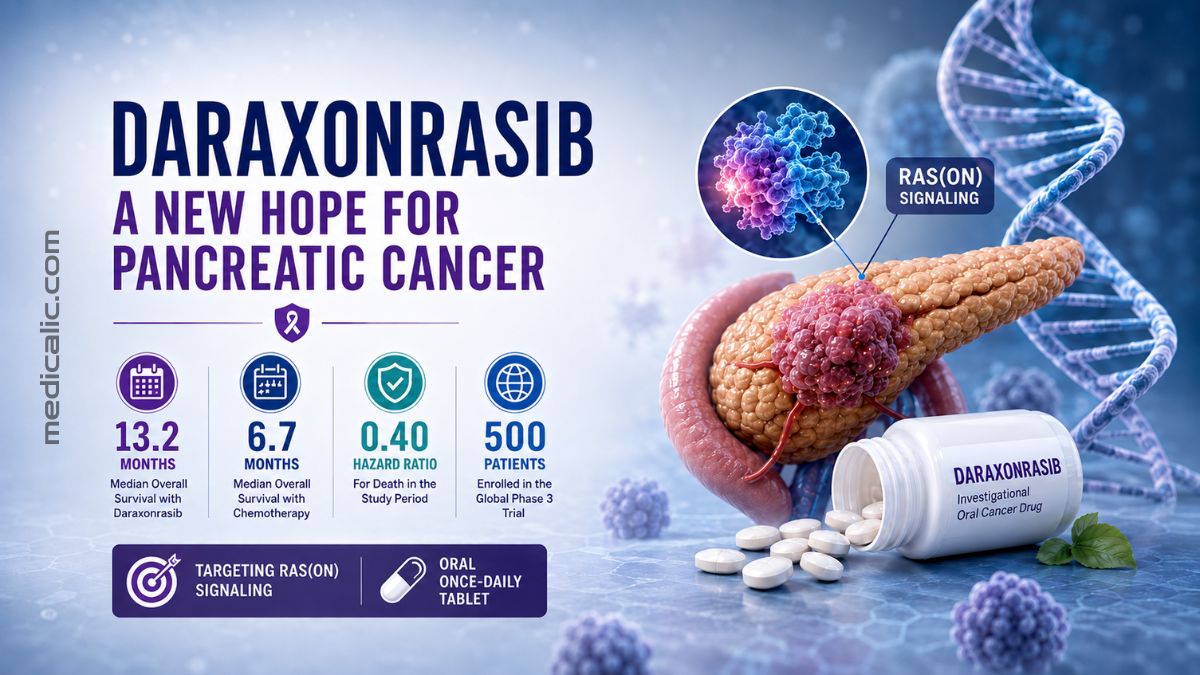
In a major Phase 3 trial, this investigational oral cancer drug nearly doubled median overall survival in people with previously treated metastatic pancreatic ductal adenocarcinoma, or metastatic PDAC. Patients who received daraxonrasib lived a median of 13.2 months, compared with 6.7 months for patients who received standard chemotherapy in the overall intent-to-treat population. The trial also reported a hazard ratio for death of 0.40, meaning the relative risk of death during the study period was reduced by 60% compared with chemotherapy. [1]
These results do not mean daraxonrasib is a cure. They also do not mean the drug is already approved for general use. Daraxonrasib remains an investigational medicine, and patients should not delay or change treatment unless their oncology team recommends it. Still, in a disease where new advances often come slowly, the RASolute 302 trial gives researchers, doctors, patients, and families a result that is difficult to ignore.
What Is Daraxonrasib?
Daraxonrasib, also known as RMC-6236, is an oral RAS(ON) multi-selective inhibitor. It is being developed by Revolution Medicines as a targeted therapy for cancers driven by abnormal RAS signaling.
RAS proteins work like growth-control switches inside cells. When they function normally, they help regulate when cells grow, divide, and stop. In many cancers, RAS signaling becomes overactive, allowing tumor cells to keep receiving growth signals even when they should not.
This matters especially in pancreatic ductal adenocarcinoma because RAS pathway changes are deeply connected to the biology of the disease. For decades, RAS and KRAS were considered extremely difficult drug targets. Researchers knew the pathway was important, but designing a medicine that could reliably block it was a major challenge.
Daraxonrasib belongs to a newer generation of RAS-targeted drugs. Instead of broadly attacking rapidly dividing cells the way traditional cytotoxic chemotherapy does, it is designed to interfere with active RAS-driven cancer signaling. That targeted approach is one reason the trial result has generated so much interest.
What the RASolute 302 Trial Studied
RASolute 302 was a global, randomized Phase 3 registrational trial. It tested daraxonrasib as a single-agent therapy in patients with previously treated metastatic PDAC.
The trial enrolled 500 patients. Of these, 248 received once-daily oral daraxonrasib, while 252 received investigator’s choice of four cytotoxic chemotherapy regimens used as standard-of-care options across different regions. [2]
The study included patients whose tumors had RAS G12 mutations, including G12D, G12V, and G12R. It also included a smaller number of patients without an identified tumor RAS mutation. This is important because pancreatic cancer is commonly driven by RAS biology, but not every patient has the same mutation profile.
The trial’s main goals were to measure overall survival and progression-free survival in patients with RAS G12-mutant tumors. Overall survival measures how long patients live after starting treatment. Progression-free survival measures how long patients live without the cancer getting worse.
Secondary endpoints included survival outcomes in the full intent-to-treat population, objective response rate, duration of response, and patient-reported outcomes such as pain, global health status, and quality of life.
Key Survival and Tumor Response Results
The survival results were the central finding of RASolute 302.
In patients with RAS G12-mutant tumors, median overall survival was 13.2 months with daraxonrasib and 6.6 months with chemotherapy. In the overall intent-to-treat population, median overall survival was 13.2 months with daraxonrasib and 6.7 months with chemotherapy. The hazard ratio for death was 0.40 in both populations. [1]
Progression-free survival also improved. In the RAS G12 population, median progression-free survival was 7.3 months with daraxonrasib and 3.5 months with chemotherapy. In the overall intent-to-treat population, median progression-free survival was 7.2 months with daraxonrasib and 3.6 months with chemotherapy.
Tumor response was also stronger with daraxonrasib. In the RAS G12 population, the objective response rate was 33.2% with daraxonrasib and 11.8% with chemotherapy. In the overall intent-to-treat population, the objective response rate was 31.6% with daraxonrasib and 11.2% with chemotherapy.
These figures matter because they show benefit across several important measures, not only one. Patients lived longer, the cancer took longer to progress, and a higher percentage of tumors shrank by a defined amount.
Researchers presented the results at the 2026 American Society of Clinical Oncology Annual Meeting, and The New England Journal of Medicine published them.
Why This Result Matters for Pancreatic Cancer
Doctors often diagnose pancreatic ductal adenocarcinoma after it has already spread. Early symptoms can be vague, and once doctors find metastatic disease, surgery is usually no longer possible.
At that stage, treatment often focuses on slowing the cancer, reducing symptoms, extending survival when possible, and maintaining quality of life. Chemotherapy remains a central part of care, but after previous treatment has stopped working, the benefit can be limited for many patients.
That context makes the daraxonrasib result clinically meaningful. A difference between 13.2 months and 6.7 months is not just a statistic on a conference slide. For patients and families, months can mean birthdays, treatment decisions, time at home, or the chance to consider another option.
However, median survival does not predict exactly what will happen to one person. Some patients may live longer than the median, while others may have more aggressive disease, more symptoms, or difficulty tolerating treatment. The trial result should be seen as a major signal of benefit in a studied population, not a guarantee for every individual patient.
Another reason the drug stands out is that it is taken by mouth. An oral targeted therapy may be more convenient than an intravenous chemotherapy regimen for some patients. But convenience does not mean risk-free. Oral cancer drugs still require careful monitoring, dose adjustments, supportive care, and regular communication with an oncology team.
Safety, Side Effects, and Quality of Life
Daraxonrasib was described as having a generally manageable safety profile in the RASolute 302 trial, but manageable does not mean harmless.
Grade 3 or higher treatment-related adverse events occurred in 43.6% of patients receiving daraxonrasib, compared with 57.5% of patients receiving chemotherapy. The most common Grade 3 or higher treatment-related side effects with daraxonrasib were rash, reported in 14% of patients, and stomatitis, or mouth inflammation and sores, reported in 12%. [2]
Treatment-related serious adverse events occurred in 10.8% of patients in the daraxonrasib group and 18.7% of patients in the chemotherapy group. Treatment discontinuation due to treatment-related adverse events occurred in 1.2% of patients receiving daraxonrasib and 11.2% receiving chemotherapy.
One Grade 5 treatment-related adverse event of pneumonitis was reported in the daraxonrasib arm. No Grade 5 treatment-related adverse events were reported in the chemotherapy arm.
Quality of life was also an important part of the trial. Daraxonrasib delayed worsening of cancer-related pain, global health status, and quality of life compared with chemotherapy. In metastatic pancreatic cancer, this point matters because symptoms such as pain, fatigue, poor appetite, weight loss, nausea, and treatment-related side effects can strongly affect daily life.
Patients taking any cancer therapy should promptly report new or worsening symptoms to their oncology team. They should discuss rash, mouth sores, diarrhea, nausea, shortness of breath, fever, worsening fatigue, or signs of infection with their care team instead of trying to manage these symptoms alone at home.
FDA Status and Expanded Access
Daraxonrasib is still investigational. It is not yet an FDA-approved standard treatment for pancreatic cancer.
The U.S. Food and Drug Administration has allowed Revolution Medicines to initiate an Expanded Access Program for eligible patients with previously treated metastatic PDAC. The FDA issued a “safe to proceed” letter for the expanded access treatment protocol in May 2026. [3]
Expanded access, sometimes called compassionate use, is not the same as full drug approval. It is a pathway that may allow certain patients with serious or life-threatening diseases to receive an investigational medicine outside a clinical trial when they cannot join a trial and have no satisfactory alternative treatment options.
Requests for expanded access must be handled through a licensed treating physician. Patients and caregivers cannot simply apply directly to the company on their own. This is why anyone interested in daraxonrasib should speak with their oncologist first.
PanCAN also advises patients not to delay current treatment while waiting for daraxonrasib access. Patients should discuss standard therapy, clinical trials, biomarker testing, and expanded access options with their healthcare team. [4]
Why Biomarker Testing Matters
Biomarker testing is important in pancreatic cancer because it can reveal tumor features that may affect treatment options or clinical trial eligibility.
For daraxonrasib, RAS biology is central to the story. But biomarker testing can also identify other important alterations, such as BRCA-related DNA repair changes, MSI-high status, mismatch repair deficiency, NRG1 fusions, and other potentially actionable findings.
For patients, the practical question is not only “Is daraxonrasib promising?” A better question is: “Has my tumor been tested well enough to know which options may apply to me?”
Patients with pancreatic cancer can ask their oncology team whether comprehensive biomarker testing has already been done, whether more testing is needed, and whether the results could open the door to a clinical trial, targeted therapy, immunotherapy in rare cases, or an expanded access pathway.
New Update: Early Combination Data With Vopimetostat
A newer development involves early data from Tango Therapeutics studying vopimetostat in combination with daraxonrasib. Independent reporting described encouraging tumor responses in a small group of patients with advanced MTAP-deleted and RAS-mutant metastatic pancreatic cancer. Reported results included a 92% objective response rate in evaluable pancreatic cancer patients and a six-month progression-free survival rate of 90%. [5]
This update is exciting, but it needs careful wording. The combination data are early. The patient group was small. The study was not a randomized Phase 3 trial, and it did not provide the same level of evidence as RASolute 302.
Early cancer trial results can look dramatic, but researchers still need to confirm them. Larger controlled studies must show whether the combination truly improves survival, delays disease progression, maintains quality of life, and remains safe compared with existing treatment options.
For now, the strongest evidence for daraxonrasib in pancreatic cancer remains the Phase 3 RASolute 302 trial of daraxonrasib monotherapy in previously treated metastatic PDAC. The vopimetostat combination is an important area to watch, not a proven standard treatment.
Could Daraxonrasib Help Other Cancers?
Researchers are studying daraxonrasib beyond pancreatic cancer because RAS alterations appear in multiple tumor types, including some lung and colorectal cancers.
That does not mean the drug is already proven across all RAS-mutant cancers. Cancer biology differs by tumor type. A drug that works in metastatic pancreatic cancer may not work the same way in lung cancer, colorectal cancer, ovarian cancer, endometrial cancer, or bile duct cancer.
Each cancer type needs its own clinical trial evidence. Doctors must consider mutation profile, prior treatments, tumor behavior, side-effect risks, performance status, symptoms, and patient goals before recommending any therapy.
The broader significance is still important: daraxonrasib may represent a turning point in the long effort to drug RAS-driven cancers. But the responsible message is not “this drug works for many cancers.” The responsible message is that daraxonrasib has produced strong Phase 3 evidence in previously treated metastatic PDAC, while research in other settings continues.
What Patients and Caregivers Should Ask
Patients interested in daraxonrasib should bring focused questions to their oncology team.
- First, has the tumor had comprehensive biomarker testing?
- Second, does the patient’s cancer profile match any current daraxonrasib trial or expanded access criteria?
- Third, are there standard treatment options that should be used before considering expanded access?
- Fourth, what are the possible benefits and risks in this specific patient’s situation?
- Fifth, how would side effects such as rash, mouth sores, diarrhea, fatigue, breathing symptoms, or infection risk be monitored?
Note: These questions matter because pancreatic cancer care is highly individual. A treatment that is promising in a trial may not be appropriate for every patient at every stage of disease.
Common Questions About Daraxonrasib
No. Daraxonrasib is not currently FDA-approved as a standard treatment for pancreatic cancer. It remains an investigational drug. The FDA has allowed an Expanded Access Program for eligible patients with previously treated metastatic pancreatic ductal adenocarcinoma, but expanded access is not the same as full approval.
No. Daraxonrasib is not a cure for pancreatic cancer. In the Phase 3 RASolute 302 trial, it significantly improved median overall survival compared with chemotherapy in previously treated metastatic pancreatic cancer. However, the disease could still progress, and individual outcomes can vary.
Daraxonrasib is designed to block active RAS signaling. RAS proteins help control cell growth, but in many pancreatic cancers, abnormal RAS activity can send continuous growth signals to cancer cells. By targeting RAS(ON), daraxonrasib aims to interfere with this cancer-driving pathway.
In the RASolute 302 trial, the most common severe treatment-related side effects with daraxonrasib included rash and stomatitis, which means inflammation or sores in the mouth. Serious side effects can occur, and one treatment-related death from pneumonitis was reported in the daraxonrasib group. Patients should report new or worsening symptoms to their oncology team promptly.
Biomarker testing can help identify tumor features that may affect treatment options or clinical trial eligibility. For pancreatic cancer, testing may reveal RAS or KRAS changes, BRCA-related alterations, MSI-high status, mismatch repair deficiency, NRG1 fusions, or other findings that could guide treatment discussions.
No. Patients should not delay, stop, or change treatment while waiting for daraxonrasib access unless their oncology team recommends it. Pancreatic cancer can progress quickly, so a qualified oncologist should guide treatment decisions based on the patient’s full medical situation.
Daraxonrasib is being studied in other RAS-driven cancers, including some lung and colorectal cancers. However, evidence from pancreatic cancer does not automatically prove that the drug works in other tumor types. Each cancer requires separate clinical trial evidence before doctors can determine whether the treatment is safe and effective in that setting.
Bottom Line
Daraxonrasib has produced one of the most important recent Phase 3 results in previously treated metastatic pancreatic ductal adenocarcinoma.
In RASolute 302, the drug nearly doubled median overall survival compared with chemotherapy. It also improved progression-free survival, objective response rate, and patient-reported quality-of-life measures.
The result is genuinely promising, but it should be presented accurately. Daraxonrasib is not a cure. It is not yet an FDA-approved standard treatment. Expanded access may be available for some eligible patients, but only through a treating physician and only under specific criteria.
The most balanced conclusion is this: daraxonrasib may mark a major step forward for RAS-targeted therapy in pancreatic cancer, but patients should make decisions with their oncology team, not from headlines alone.
Medical References
Update History
Originally written by Medicalic.
Your answer helps us improve the clarity and usefulness of our health content.