
Sciatica can make bedtime feel like a guessing game. One position may calm the pain for a few minutes, then another small movement can bring back burning, tingling, numbness, or a sharp electric-like sensation down one leg. For some people, symptoms feel worse after lying flat. For others, the hardest part is avoiding pressure on the painful hip, buttock, or leg.
The good news is that small changes in sleep position and pillow placement may help reduce irritation enough to make rest easier.
For many people, the best sleep position for sciatica is side sleeping on the less painful side with a firm pillow between the knees. Another strong option is back sleeping with the knees slightly elevated. These positions can help support the lower back, reduce pelvic twisting, and keep the irritated nerve area from feeling overly stressed during the night. [1,2]
There is no single perfect position for everyone. The best position to sleep with sciatica is the one that reduces leg symptoms, supports your lower back, and helps you wake up with less irritation.
Understanding Sciatica and Why Sleep Position Matters
Sciatica is not usually a disease by itself. It is a pattern of symptoms caused by irritation or compression of the nerve roots that form the sciatic nerve. The pain often starts in the lower back or buttock and travels down the back or side of one leg. It may also cause numbness, tingling, burning, or weakness. [2,3]
Common causes include a herniated lumbar disc, age-related narrowing around the spinal nerves, bone spurs, or other conditions that place pressure on nerve roots in the lower spine. Muscle tightness around the buttock and hip may also contribute to sciatic-type symptoms in some people, although true sciatica usually involves nerve irritation that begins in the lower spine. [2,3]
Sleep position matters because lying down changes how your spine, pelvis, hips, and legs are supported. A poor position may twist the pelvis, increase lower-back arching, or place direct pressure on the painful side. A better setup can help your body rest in a more neutral, supported position.
Sleep positioning is supportive care. It may help you sleep more comfortably, but it does not treat the underlying cause of sciatica. If symptoms are severe, persistent, or worsening, medical evaluation is important.
What Is the Best Sleep Position for Sciatica?
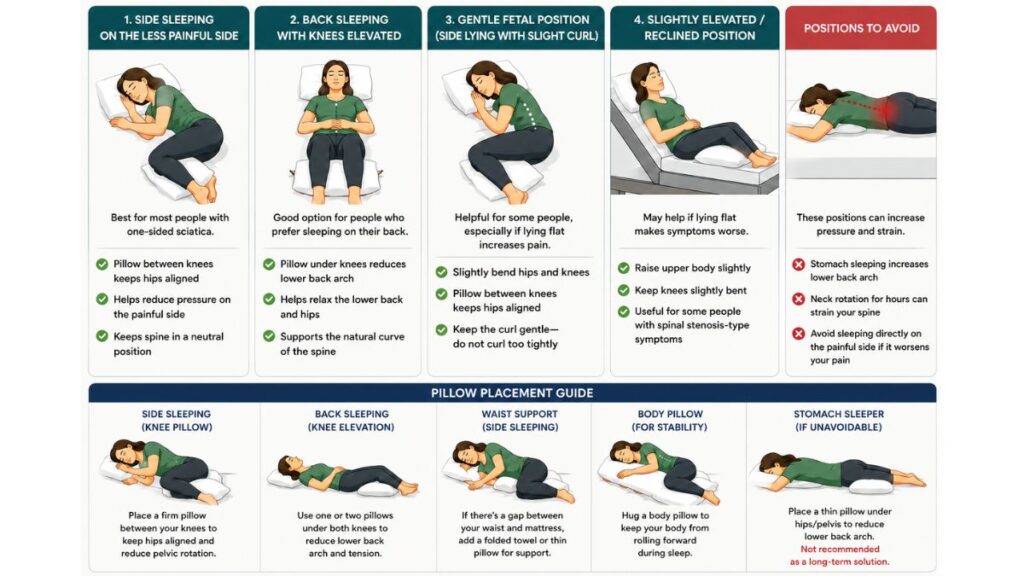
The best sleep position for sciatica pain is usually one that keeps the lower back and pelvis supported while reducing pressure on the painful side. For many people, that means starting with one of four positions.
Side sleeping on the less painful side with a pillow between the knees is often the best first option for one-sided sciatica. It may reduce direct pressure on the painful leg and help keep the pelvis aligned.
Back sleeping with one or two pillows under the knees can also work well. This position spreads body weight more evenly and may reduce excessive arching in the lower back.
A gently curled side position may help some people, especially if a slightly bent-forward posture feels better than lying flat or arching backward.
A slightly elevated or reclined position may be helpful if symptoms feel worse when lying completely flat. This may be especially useful for some people with spinal stenosis-type symptoms. [1,4]
The position to avoid most often is stomach sleeping because it can increase lower-back arching and keep the neck rotated for hours.
Side Sleeping on the Less Painful Side
For many people, side sleeping is the best position to sleep when you have sciatica pain. The key is choosing the side that hurts less.
If your right leg hurts, try sleeping on your left side. If your left leg hurts, try sleeping on your right side. This may reduce direct pressure on the irritated side and make it easier for the muscles around the hip and lower back to relax.
The pillow between your knees is the most important part of this setup. Without it, the top leg may fall forward and rotate the pelvis. That rotation can pull the lower back out of a neutral position and increase discomfort. A firm pillow helps keep the knees, hips, pelvis, and lower spine better aligned. [1]
To set up this position, lie on the side that hurts less and place a firm pillow between your knees. Keep your knees slightly bent, but do not curl tightly unless that feels better. Your hips should stay stacked, with the top hip directly above the bottom hip. If you tend to roll forward during sleep, place a body pillow in front of you and lightly hug it.
Check the space between your waist and the mattress. If your waist sinks downward, place a small folded towel or thin pillow in that gap. This can help prevent the lower back from sagging sideways, especially on a softer mattress.
Your head pillow matters too. It should keep your neck level with your spine. If your head tilts up or drops down, your spine may feel more strained by morning.
Back Sleeping With Knees Elevated
Back sleeping can also be one of the best sleep positions for sciatica. It spreads body weight more evenly across the mattress and helps keep the spine centered.
The challenge is that lying flat may increase the natural arch in the lower back for some people. This can feel uncomfortable during a sciatica flare-up. Placing one or two pillows under the knees helps bend the knees slightly and may reduce tension around the lower back and hips. [1,5]
To try this setup, lie on your back and place one or two pillows under both knees. Your knees should be gently bent, not sharply lifted. Keep your heels relaxed on the mattress. Your lower back should feel supported, not forced flat.
Use a moderate head pillow. A very thick pillow can push the head and neck forward, which may create upper-back or neck discomfort.
Some people also like placing a small towel under the natural curve of the lower back. This is optional. Keep it only if it feels supportive. If it increases back or leg pain, remove it.
Gentle Fetal Position
A gently curled side position may help some people with sciatica, especially when symptoms feel worse while standing upright, lying flat, or leaning backward. The goal is not to curl into a tight ball. The goal is to slightly bend the hips and knees so the lower back feels more relaxed.
This position may be more comfortable for people with extension-sensitive symptoms, including some cases related to spinal stenosis. In spinal stenosis, a slightly flexed posture can sometimes feel better because standing straight or extending the spine may worsen symptoms. [4]
To set up this position, lie on the less painful side. Bring your knees forward slightly and place a pillow between them to keep the hips aligned. Keep the curl gentle and relaxed.
Avoid pulling your knees tightly toward your chest. Too much curling may irritate symptoms in some people, especially if sitting or bending forward already makes the pain worse. If this position increases leg pain, numbness, or tingling, try a different setup.
Slightly Elevated or Reclined Sleeping Position
A slightly elevated position may help if lying flat makes your sciatica worse. You can create this setup with an adjustable bed, a wedge pillow, or a recliner-style position.
The idea is to raise the upper body slightly while also keeping the knees somewhat bent. This may reduce strain for some people, especially when symptoms are related to spinal stenosis or when a slightly forward-bent posture feels relieving.
This setup is not necessary for everyone. However, if flat back sleeping or flat side sleeping keeps triggering pain, a reclined position may be worth trying. Keep the angle gentle. A position that is too upright may place extra pressure on the tailbone or lower back.
Sleep Positions to Avoid With Sciatica
The main position to avoid is stomach sleeping. When you sleep on your stomach, your lower back may arch more than usual. Your neck also has to rotate to one side so you can breathe. Over several hours, this can create extra strain through the spine.
If you are a stomach sleeper and cannot change immediately, place a thin pillow under your hips and pelvis. This may reduce some lower-back arching. Still, this should be treated as a temporary harm-reduction step, not the ideal long-term position.
You should also avoid sleeping directly on the painful side if it clearly worsens your symptoms. Some people can tolerate it, but many feel more pressure in the painful hip, buttock, or leg.
Pillow Placement Guide for Sciatica Pain
Pillows can make a major difference because they help control the position of your hips, pelvis, and spine during sleep.
For side sleeping, place a firm pillow between your knees. This helps keep the hips stacked and reduces pelvic rotation.
For back sleeping, place one or two pillows under both knees. This helps soften the lower-back arch and may reduce tension around the lumbar spine.
For side sleepers with a gap between the waist and mattress, a small folded towel or thin pillow may help. This supports the waist and prevents the lower back from sagging sideways.
For people who roll toward their stomach during sleep, a body pillow in front can help stabilize the position.
For stomach sleepers who cannot avoid that position yet, a thin pillow under the hips may reduce some lumbar arching. Even with this adjustment, stomach sleeping is usually not the best position for sciatica.
Mattress Firmness and Sciatica
Your mattress can either support your sleep position or work against it. A mattress that is too soft may let your hips sink too deeply. A mattress that is too firm may create pressure around the hips, shoulders, or lower back.
Research in chronic non-specific low back pain found that medium-firm mattresses improved pain and disability more than firm mattresses. This study was not specifically limited to sciatica, so the claim should not be overstated. Still, it supports a practical point: many people with lower-back-related pain do better with a mattress that balances support and comfort. [6]
For sciatica, a medium-firm mattress is often a reasonable starting point. It should support the spine without letting the pelvis sink too far. Comfort also matters. If your mattress creates pressure points or leaves you waking up stiffer, it may not be giving your body the support it needs.
Pre-Bed Habits That May Help Sciatica Pain
Sleep position tends to work better when your body is not already irritated before bed. A few simple habits may help reduce nighttime discomfort.
Gentle movement can help some people. Light walking, easy knee-to-chest movement, or a mild piriformis stretch may reduce stiffness. Avoid aggressive stretching if it increases leg pain, numbness, or tingling.
Heat may help when muscle tightness contributes to discomfort. A warm pack on the lower back or buttock for 15 to 20 minutes may relax surrounding muscles. Some people prefer a cold pack during a fresh flare-up. Use whichever option gives relief, and avoid placing extreme heat or cold directly on the skin.
Avoid long sitting right before bed if sitting makes your sciatica worse. Stand up, walk gently, or change position before lying down.
A consistent sleep routine can also help. Pain often feels worse when sleep is poor, so a dark room, cool temperature, and regular bedtime may support better rest.
When to See a Doctor
Sleep positioning can help you rest, but it is not enough if your symptoms are severe or getting worse.
Seek medical advice if your pain lasts more than several weeks without meaningful improvement, prevents sleep despite position changes, or comes with worsening numbness, tingling, or weakness. You should also get checked if you have not had a clear diagnosis, because hip problems, sacroiliac joint pain, spinal conditions, and other issues can sometimes mimic sciatica.
Professional evaluation is especially important if you are pregnant, have a history of cancer, have unexplained weight loss, recently had a serious injury, or have symptoms that are becoming more intense.
Red Flags: When to Get Emergency Care
Some symptoms with sciatica can signal a serious medical problem. Do not wait until morning if these occur.
Seek emergency care immediately if you have sciatica with new loss of bladder or bowel control, difficulty urinating, inability to urinate, numbness in the groin or saddle area, rapidly worsening leg weakness, weakness or numbness affecting both legs, or sciatica after a serious fall, accident, or trauma.
These symptoms may suggest cauda equina syndrome or another serious spinal condition. Cauda equina syndrome is considered a medical emergency because delayed treatment can lead to permanent nerve damage.
FAQs About the Best Sleep Position for Sciatica
For many people, the best sleep position for sciatica is side sleeping on the less painful side with a firm pillow between the knees. Back sleeping with the knees slightly elevated is another good option. The right choice depends on which position reduces leg pain and supports your lower back.
The best position to sleep with sciatica pain is the one that keeps the spine supported and avoids direct pressure on the painful side. Side sleeping with a knee pillow is often the best starting point. If that does not help, try lying on your back with pillows under both knees.
Many people feel better sleeping on the opposite side because it reduces pressure on the painful hip, buttock, or leg. If sleeping on either side increases symptoms, back sleeping with the knees elevated may be more comfortable.
Stomach sleeping is usually the least helpful position for sciatica. It may increase lower-back arching and keep the neck turned to one side for several hours. If you cannot stop stomach sleeping right away, placing a thin pillow under the hips may reduce some lower-back strain.
Key Takeaways
The best sleep position sciatica sufferers can try first is usually side sleeping on the less painful side with a firm pillow between the knees. Another strong option is back sleeping with the knees elevated.
If you are wondering what is the best position to sleep with sciatica, the answer depends on your symptoms. Choose the position that reduces leg pain, supports your lower back, and avoids direct pressure on the painful side.
Avoid stomach sleeping when possible. Use pillows strategically. Choose a mattress that supports your spine without excessive sinking. If you develop bladder or bowel problems, saddle numbness, or rapidly worsening weakness, seek emergency care immediately.
Medical References
Update History
Originally written by Medicalic.
Your answer helps us improve the clarity and usefulness of our health content.